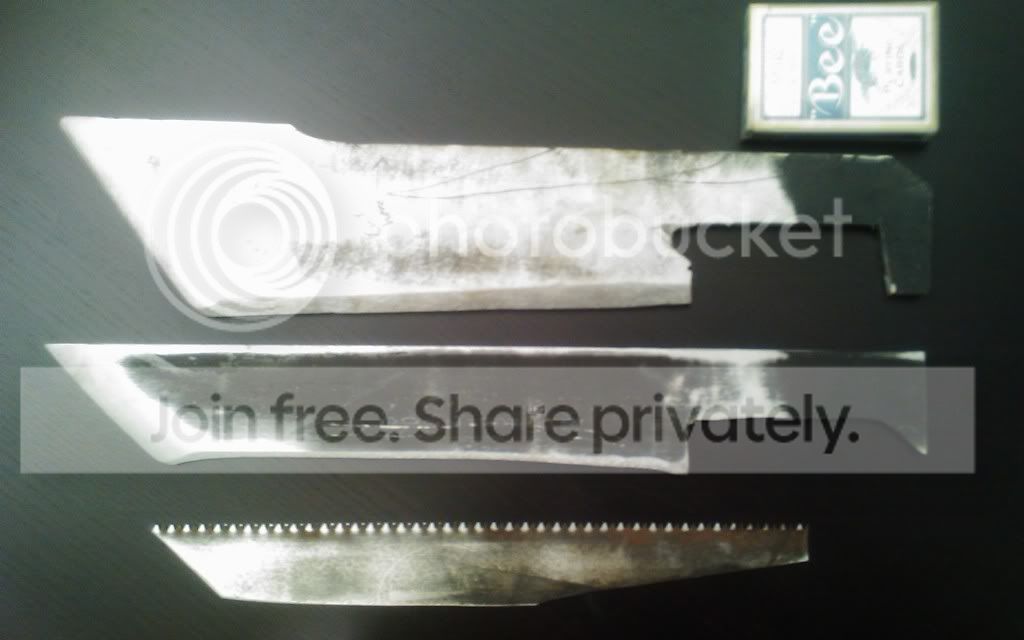
Blade making for newbie.Profiling, Grinding, HT

Joined
Mar 12, 2009
Messages
34
HI All,

This is my first post, and i have been doing alot of research of this forum and the Britishblade forum. I haven't see anyone working on some massively huge knives or swords. Am I the only one here who is interest in making these giants?

I bought some o1 steel bars from the my local metal shop (BTW I am in HK) and started on my 2 Machetes projects (Stock removal) last Sunday.

I have completed profiling the rough shape of my 2 heavy duty Tanto machetes.

18" X 4" X 8mm of "HEAVY" Duty O1 Machete, weighing at nearly 5lbs

18"X 2.5" X 6mm of "Lighter" version of Heavy Duty O1 Blade. Much lighter weighing at around 2.5lbs

Tools i have Available
-Angle Grinder
-Black and Decker rotary tool
-Bench Belt + Disk Sander

I have some Questions regarding profiling, grinding and Heat Treating. Please help to answer a newb in distress.

1. After cutting out the rough shape of my blades, i saw many jiggy point on the handle. Since they are in tight corners, my power tools can't get in the space to smooth them out. What kind of tools should i use to clean up these sharp jiggy edges??

2. I have use a #80 sandpaper to remove the blacken tar like finishing on my knifes. However, i saw many many tiny pits on the steel after removing the tar. Is there any way to remove it?? can they be smooth out by sandpaper?

3. Heat-treating , i plan to use my Charcoal BBQ grill + hairdryer attachment for the hardening process. I bought a Laser digital thermometer for reading the Temp of the blade while it is burning.
-is it necessary for me to cover the grill with a steel plate while heat treating the two blades??
If yes, i would have to get some lighter steel plate to be place on my grill
-What sort of Quench medium should i be using?? Many suggest Veg Oil, While other suggest a brine. I would prefer a brine, coz Oil is quite troublesome to dispose after the using. Furthermore i am very afraid that the oil will flare up and caught fire.

My neighbor are very sensitive abt smoke and noise.

I will post a pic of my two blades once i finish grinding the Bevels and cleaning up the blade, the tar stuff.
 
Don't brine quench O1. Oil is needed. O1 needs a medium speed oil. Canola or peanut oil would probably work.

Make sure your laser thermometer can read temps up to 1500F. Most stop a good bit short of that, but there are more expensive lasers that can measure that high. Otherwise, keep a long-reach magnet hand and check the blade frequently to see when it looses magnetism. This will be somewhere around 1414F. You need to heat a bit past that. If you can do it when it's dark, watch for very faint shadows that will seem to dance in the glowing steel. As they fade away, you're in the neighborhood of the correct temperature. That's a very rough way to heat treat, especially for O1, but it will get you some hardness out of the blade, but not the best that the steel can provide. O1 needs more accurate temperature controls than you'll be able to achieve to get the best results.

The pitting is a normal extension of that discoloration you sanded off. I consider it to be part of the mill scale, and it should be removed, but it can be very tough. You can use a hand file to smooth the edges and also to remove the mill scale. Search for draw filing and try it out to removing the pitting.

--nathan

--nathan
 
Hi. First of all welcome to blade forums! You didn't say if these are your first blades or not but, no, don't quench in brine. Your blade would break if you did because it would cool it way too fast. Oil is what you want.
O1 is a great blade steel. As silver_pilate said, check it often in the fire until it looses it's magnetism (is that a word?) and then let it soak for another minute or so.

1. Hand files or your rotary tool or plain old sandpaper are what you'll need.
2. Not sure what black tar like stuff you're referring to but, I'm imagining something like fire scale? Anyway, yes sandpaper and a sanding block is how I would get the pits out.
3. Veg or canola oil for sure. Pre-heat it to about 130 degrees F. It shouldn't flare up too bad, if at all. If it does, don't panic, just simply put some kind of lid over the container and it will go out.
 
Thankyou Nathan and Dustin for the Quick reply.

Knife making is a truly addictive Hobby. The 8mm thick blade is seriously much more difficult to modify than the 6mm blade.

Nathan, My Laser thermometer can read temp up to 1832F. I guess it can do the job.

I am very very nervous on the HT stuff. I have read many many articles and many videos on HT. Yet i am still very uncomfortable with putting Burning HOT Steel in to a pot of Oil. Maybe i should get one of those fire Extinguisher in hand.

These are my first blades. I do not expect them to be 100% perfect like other member for the forum. I was just hoping to make it presentable.

To me these handcraft knife are like legacy gifts that can be pass on to my sons and grandsons. Would it be nice if our next generations can admire our work and appreciate the BLOOD and sweat we put into each blade.
 
Andico, you really shouldn't be so nervous about the HTing. Oil has a high flash point so nothing will blow up or anything. When I quench in veg/canola oil it doesn't flame at ALL. Just be sure to quench the blade fast and get the whole blade under the oil and you likely won't have any problems. A fire extinguisher is always a good thing to have but, I haven't seen a need for one yet. Here's some good info about HTing O1 steel if you haven't seen it.. http://www.cashenblades.com/Info/Steel/O1.html

If you ordered your thermometer, where did you order it from? I think one of those would be nice to have.

I know my first blade wasn't anywhere near perfect but, they definately get better with each one I make. The main thing is to have fun and be safe.
Good luck, can't wait to see the pics.
 
Thankyou Nathan and Dustin for the Quick reply.

Knife making is a truly addictive Hobby. The 8mm thick blade is seriously much more difficult to modify than the 6mm blade.

Nathan, My Laser thermometer can read temp up to 1832F. I guess it can do the job.

I am very very nervous on the HT stuff. I have read many many articles and many videos on HT. Yet i am still very uncomfortable with putting Burning HOT Steel in to a pot of Oil. Maybe i should get one of those fire Extinguisher in hand.

These are my first blades. I do not expect them to be 100% perfect like other member for the forum. I was just hoping to make it presentable.

To me these handcraft knife are like legacy gifts that can be pass on to my sons and grandsons. Would it be nice if our next generations can admire our work and appreciate the BLOOD and sweat we put into each blade.

Putting out an oil fire with a fire extinguisher is very, very dangerous. You'll just blow burning oil everywhere with the fire extinguisher and make matters very serious and probably make the fire worse and unmanageable. Fire needs three things to burn:
  1. Fuel, which is the oil.
  2. A source of ingnition, which is the red hot blade.
  3. and lastly, oxygen.
If you're missing any of those three, you don't have fire. So, use a long pair of tongs and quickly lower the blade into the oil, point down. It might flare up at first, but when the blade goes completely under the oil, the fire usually goes out quickly. If it doesn't go out quickly, just have a lid to put over your quench tank. This will take the oxygen supply away and the fire will go out quickly. DO NOT HIT IT WITH A FIRE EXTINGUISHER.

Having a fire extinguisher handy is always necessary, but don't use it on the oil. Use it only if something other than the oil catches fire.
 
Thank for these Crucial info Scott....

I must be out of my mind to use Fire Extinguisher on Burning oil. I will be very careful with the process.

Dustin, I got that back when i was in Vancouver, i got it from a local Home Depot. It was around 180Cdn at that time. be sure to check the maximum temp it can read as Nathan Suggested.
 
O1 shouldn't make you nervous, it's not as likely as some to crack, though it may warp, especially on a long blade with uneven grinds. I wanted to make swords when I first started, everything I read said start small and work up. I'm on some large knives now, but nothing gigantic, I'm glad I started small.

With that equipment you'll spend many many days working on a sword and will probably not have a great time getting the grinds or finish you want. It's possible, of course, but not likely. Some folks on here like Chris Moss can be an inspiration, but then there's regular guys like me who spent 4 years working away with a belt sander and a dremel tool with nothing to show for it. I would suggest making at least one small knife and completely finishing it first, that way you know some of what large blades will entail. The BBQ is going to be a difficult way to heat treat your large blades, especially if you want the heat to stay even.

You can sand out all of your pits, it's going to take quite a while. You may want to draw file them first for heavy stock removal, or look into getting a cheap orbital sander and replacing the rubber backing with a hard plate. This will make removing any scale and pitting much easier.

I agree that you should oil quench that steel, but I doubt it will break on you if you brine quenched it unless you leave it rather thin and unevenly ground. Micro crack maybe, but I doubt it would pull apart in the quench.
 
You will want to get as much sanding a possible done before the HT. After the metal will be hard and much more difficult to sand or shape. I take it to at least 220 using water to wet sand with metal cutting paper.
 
DSC_0022.jpg


hi guys

I just finished a very rough profiling. i will sand it down and some major touch up this weekend.
All comments are welcome.
 
Back
Top