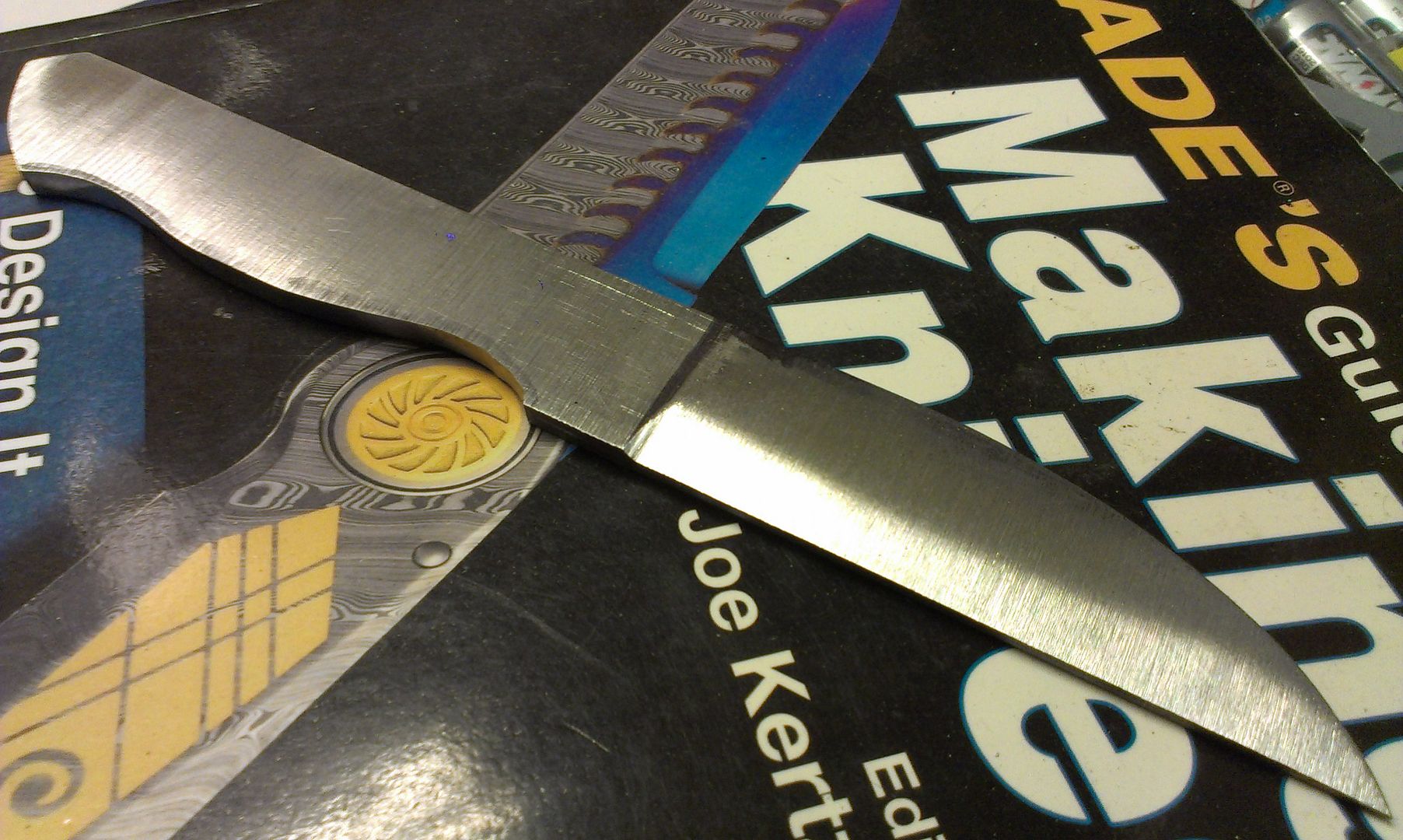
Bleh... Plunge woes.

Joined
Jun 13, 2007
Messages
7,743
Hey guys. I need help with the proper way to make my plunges. I've read that using a chainsaw file is a good tactic but I don't know which type to buy, round or flat.

I'd have preferred to have the plunge start where the line is drawn but obviously I'm going to have to push it back into the bolster area. :(
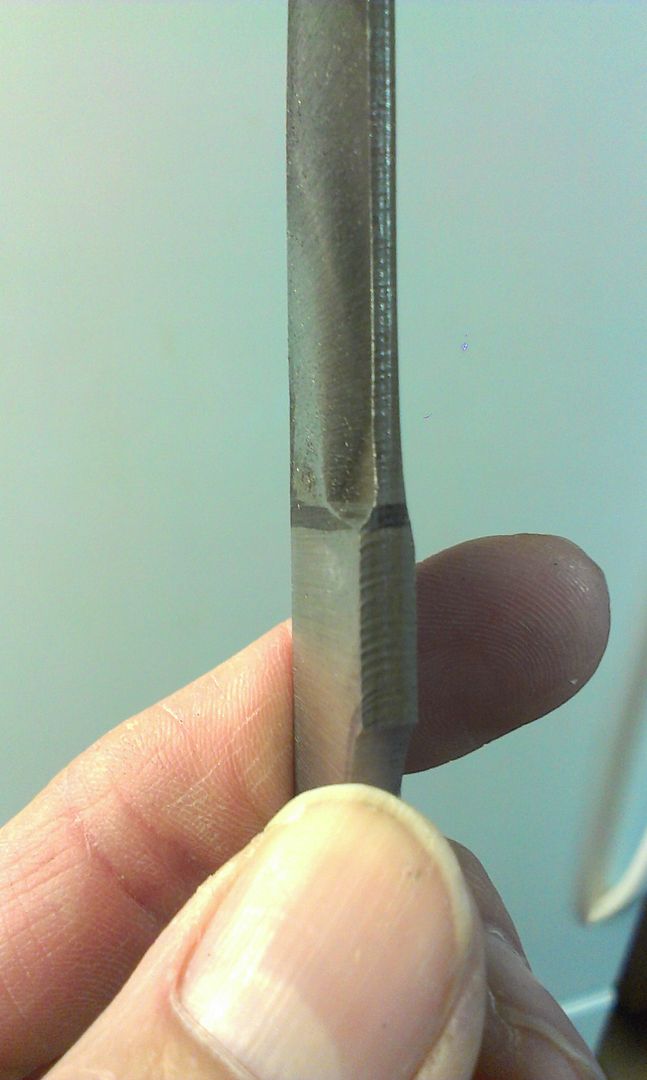
IMAG1981_zpspblvevmg.jpg


Here's the side of the knife

IMAG1980_zpsc0nfmtpx.jpg


Thanks for any advice.
 
Last edited:
DO you have a file guide? It makes a big difference. Even some mild steel clamped to the blade along the plunge line will help keep things in line. Use a round file for the plunge.
 
Thanks Willie, that's a great idea. I have next to nothing in terms of tools here, most is in storage.

I think more than anything I need to go pick up my vise. Sucks not having stuff to work with.

So a round file, then I assume I just follow the line up to the spine (if I decide on a full flat grind)?
 
Use a c clamp to hold your guide to the knife and the knife to the bench. Vice grips will work too until you start accumulating tools.
 
I use a round chainsaw file and run it along a piece of scrap steel that i hardened clamped to the blade. It helped me alot. I know USAKnifeMaker sells some file guides for the plunge that will line them up nicely. I was trying a bastard cut round file but found out real fast that doesnt work very well at all for me
 
Start the plunge 1/4th of an inch further up the blade then take it back to where you want it to be, this has helped me but is easier said then done.
 
If you don't have a file guide, just scribe your plunge line and superglue a small scrap of knife steel (say 1/4" wide by 1") at the plunge line. It will stay on for your work but can be easily popped off, especially if you leave a small bit overhanging at the spine.

I normally freehand most of my plunges and just carefully creep up on them, but on stuff where it is more critical, such as a plunge with no notch, I like to use the scrap/superglue method. I actually made myself a file guide, but find it bulky compared to the above method.
 
That's a good idea Ian. I have been using 2 of the plates that come on U-bolts bolted together to make a cheap-o-file guide to make my plunge cuts. That along with the smaller of the two chain saw files that came together work fine but because I am using a less then optimal grinder/sander, I have to take it off to start the actual beveling because it is too bulky and too much machine in the way. The catch 22 is that I need the guide on because the less than perfect grinder/sander's tracking is all over the place. It will get better when I replace the idler bearing and quit using the idler wheel as a contact wheel, but I might be able to do more than profiling in the mean time with this idea.

Starting a little ahead of where I want the plunge line to end up has helped me too. But I only go about 1/8th and use designs with lots of ricasso area to cushion my beginner plunge cutting abilities if I need more space to get both sides lined up. From my very limited experience so far.
 
Perrin your grinder has got to be better than my little Delta 1x30 :o It's not so much that the thing is unusable, it is, the problem comes from a combination of the platen being crap, the tracking being iffy, and having to totally freehand since it has no table. I suspect that a 2" belt would be easier since it (might?) be more stable as I moved the blade across the belt. Honestly the little grinder was fine when I didn't care that much about f&f but I'm trying to make something at least half way decent. May not happen but I'm trying.

Some great ideas. I'm definitely going to try glueing a piece of 1095 to the ricosso. That seems to be the easiest thing to try first.

As always I appreciate your help guys. I'll update on how it goes.
 
I often pin a sacrificial bolster on where the real bolster goes but extending up the ricasso to where the plunge will be .Then I grind right up to it.
 
use a round file and only file app half as high as you want the plunge to be.
The rest will follow when doing the bevels
 
Noob question : What's wrong with the plunge?? :confused:

I think it's worse in person than it looks in the pic.

The sides don't match up and it's just a dirty cut. The marker makes it look like it's ground straight up to the spine in the 2nd pic, but it's just the line drawn on the steel.

I wanted to ask for pointers before it got to a point where it would be hard to fix. From past experience I can see where this is going if I don't do something now to fix it. ;)

Thanks guys, and thanks for the video links. I think it would be easier if I had a Spanish notch/sharpening choil, but I don't really want one on this knife. Still, it gave me some direction. :)
 
Looking good! I'd mostly try to make more.

Try a half round file for the plunge and a Nicholson Magi-Cut for the rest. The half round will make for a nice plunge and the magi-cut will cut fast and clean.

I don't think you need a file guide, it is looking good so far. just mark it and file... practice will take care of the rest.
 
Thanks Daniel! I've been thinking about a magi-cut.

I've got a drawer full of old Nicholson files (us made), but I may grab a new one anyway. A lot of my old ones were flea market pick-ups from 10 years ago when I wanted to make knives out of them. Didn't realize then that new bar stock would be better. I'm sure it was, but I don't remember 1084 being popular back then. :)
 
Its harder to get the plunges perfectly even on a knife without a guard. Put a sacrificial guard onto your pattern, use the guard to help you set the plunge, then grind it off. Its not rocket science either. Get them close and file them clean, then use sandpaper on small dowells to finish. A good set of expensive sweedish needle files will last you years and have the perfect round files for this. If its just a small bit, sometimes cratex on a dremmel will fix it right up. Eventually you'll get better and better with the belts and be able to do most or all of it with the edges of the belts on the last few passes. That takes time and practice so at the beginning you suffer the files and dowels.

Use a lot less pressure on your convex grinds. Light pressure is the key on convex. Appleseed convexes are great on axes. A knife has to be groudn thin to work right. Thats something you have to focus on to make a working convex ground knife. Get with a knifemaker and watch him do a knife or two. Most new makers I've tought position themselves incorrectly at the grinder with their arms extended while they stand a foot or so from the grinder. You should be standing right up next to the grinder looking straight downish at the work in your hands and the belt. Again, if that convex is what you want to do, light pressure is critical.
 
Thanks for the tips Andy. I hadn't actually thought all that much about what kind of primary grind to use. I'm fairly limited by the 1x30 grinder with only a little slack area and a super shi... platen. I'm fairly certain that I'm going to do a full height convex though. It'll definitely be thin as it'll be a utility blade that won't see any hard lateral use.

A light touch is good advice. I'll keep that in mind. I just rearranged the grinder to be much higher than it was previously. I'm 6' 5" and normal benches are typically too short. I'm right over it now and I can already see an improvement in my ability to see if nothing else. I'll try closing in on it even more and see if I can feel a difference in control. I really wish that I at least had a Craftsman 2x48.

Maybe I'll ask Santa.
 
You will need a better grinder. That one will be good for sharpening.
 
Thanks for the tips Andy. I hadn't actually thought all that much about what kind of primary grind to use. I'm fairly limited by the 1x30 grinder with only a little slack area and a super shi... platen. I'm fairly certain that I'm going to do a full height convex though. It'll definitely be thin as it'll be a utility blade that won't see any hard lateral use.

A light touch is good advice. I'll keep that in mind. I just rearranged the grinder to be much higher than it was previously. I'm 6' 5" and normal benches are typically too short. I'm right over it now and I can already see an improvement in my ability to see if nothing else. I'll try closing in on it even more and see if I can feel a difference in control. I really wish that I at least had a Craftsman 2x48.

Maybe I'll ask Santa.

The 2x42 is a big step up, but it has a lot of flaws too. I have used both 1sx30 and 2x42. The 2x42 can grind eben plunges with care. I couldn't do them on the 1x30 with the jumpy tracking.
 
Back
Top