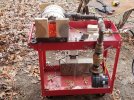
Blown forge problem

Joined
Dec 31, 2011
Messages
4,651
Hello all, Looking for a bit of advice here from ya'll folks with LOTS of forge knowledge (Stacy & others

Here is the forge with blower with stuff I had on hand for a quick 'n dirty setup for testing. This is the $78 blower from Amazon. The big pipe is 1-1/2" SS pipe with 2" PVC to connect bower to burner. The short section that goes into forge is 3/4" pipe. The end of 3/4" pipe is just flush with forge shell, not into insulation at all. The insulation has sort of a "bell" shape. This forge was originally built for a Venturi burner. I should mention there is no jet, only the 1/8" NPT nipple from gas hose to elbow at 90°.
Forge-Blower.jpg


The forge is running around 2 psig, with needle valve not full open. The blower is about half open, running on 120vac. At this point the forge has been running for perhaps 10 minutes max, and is settled in nicely around 2290F. If I close the blower inlet off fully and close needle valve a bit the forge will settle down around 1950F to 2000F range with larger black spot. My question is about the black spot in the forge. The black spot is where the flame hits forge wall across from the burner. When I back the blower and gas flow off a bit to drop temp the black spot gets larger. Is this normal for a blown forge?


The video is mirrored from actual setup, not sure why it mirrored when I uploaded to youtube, but it did. I looked for a setting to flip back but didn't find one.

Thanks to all for any comments or suggestions
 
Forge is to small for a blown burner. I had this problem with my small forge. Your wall is to close to the burner and the center of the flame is cold air that has not combusted yet. You can tell if your burner is to big if you have problems with dragons breath. If you can’t get rid of the flames coming out the front then the burner is to big. Also another issue you could have is the fuel and air are not mixed good before hitting the forge. You can solve this by making the distance from fuel injection to forge longer or adding a 90° between. You can also try stuffing some coarse steel wool in the larger section of pipe before the reducer and see if you can get the turbulence up.
 
Thanks JT - that all makes sense. I'll stick some steel wool in the pipe, and move the gas inlet down to just above where the PVC coupling is. That won't be hard to do, I'll just weld a coupling there. The existing 90 will then have more of chance to help mix gas/air. I've got a 30 lb propane tank that would make a nice forge body.

Ken H>
 
The first thing I see is that you have no manifold valve. Put a ball valve in the PVC just past the blower. This will allow you to reduce the air flow without choking the blower. I suspect you are running too lean.
 
A gate valve might help but at the 2300F setting I have about half of the blower inlet closed and if I close it more to restrict the air flow more the temp falls and it doesn't burn as "clean" from the sound, no stuttering just a clean steady sound. I've got a variable speed controller for the blower but couldn't find it today for the test. The variable speed controller was my thinking rather than the gate valve.

If it's not too rainy I hope to relocate the gas inlet and do more testing tomorrow.
 
VS on the blower will work for fine tuning the flame. A gate/ball valve is still a wise idea because it will allow the blower to run at more pressure but only deliver the amount of air you need. Without the back pressure to create some turbulence in the manifold, the air doesn't mix as well with the gas.

Another thing I noticed in your description is you are using an 1/8" pipe for the gas inlet. That is probably fine, but I think most everyone uses 1/4". That will lower the velocity of the gas to allow better mixing with the air before it reaches the chamber.
 
Ken I have like The same Forge, old Freon bottle with blown burner. Mine works perfect. Do have a needle valve on ur set up. I didn't notice 1 with ur set-up?
 
Stacy, You make some good points. I was thinking the extra 90° would help provide more turbulence to the air flow. Maybe the brillo pad I plan to stick inside the 1-1/2" pipe will help also. I've got the burner pipe clamped in vise now to move gas inlet down to bottom of SS pipe. I was planning to use 1/8" NPT, but could change to 1/4" nipple if needed. Since the 1/8" pipe nipple is almost just an extension of the gas hose I think I'll try 1/8" first, then if needed I can easy retap the hole to 1/4" NPT.

Jason, do you have a photo of your burner/forge setup handy? I'd like to see if possible. This forge is small, but large enough to handle any billet I will make, and being small is not very heavy making it easy for me to move around as I use it outside, but store inside.

Thanks again to all for comments and help.

Ken H>
 
Ken here you go.
My forge_opt.jpg
I'm not saying mine is perfect but there are no hot spots or cold spots. Also to be safe which I'm sure you know but I'm gonna say it anyway for any one new looking. Ideally you want the fan above the forge so it will never fills up with gas and blow up. I tried doing that but the hole assembly is to heavy for that. So if that fan is not on that Ball valve is closed to the fan. Also get a Gate Valve if you put something after the fan. The ball valve sucks for controlling air
 
Last edited:
Jason, Thanks for comments and photo. I like your setup. I would like to set my forge up on a cart like that, but there are "steps" to transverse from inside to outside which make a cart hard.

You asked about needle valve for control and looking back I don't see I answered that question, but yes I do have a very nice needle valve for easy control of gas flow.

Jason, is that a temp indicator only? OR - is it PID control on your forge? What temperature can you hold with it - either manual or PID.

I've been sitting here responding to emails and stuff this morning with pipe still clamped in vise - gotta get some work done! {g}
 
Put your forge on a cart and leave it outside. Toss a BBQ cover over it and the tank when not in use. I have several forges in the smithy area that way. When I need one, I just pull the cover off, roll it over by the anvil or quench tank, and light it up.

1/4" is the standard gas hose for propane and similar gasses. The only 1/8" hoses I have seen are "A" hoses for jewelers torches.

If you are re-doing things, consider a 1" burner tube.
 
Its a pid but it doesn't control my forge. Just tells me the temp. With enough fiddling around I can get it to hold any temp from 1400F and up. I also have a layer of ITC-100 in the forge. That stuff makes a big difference. On how quick and hot it gets
 
Stacy, I don't do enough forging to leave outside all the time. When I'm forging I'll work with the forge for a few days, and having it on a cart would work for that. Then it might be put inside for a few months before I get the forging desire again. I do mostly stock removal knives.

I have removed that long 1/8" pipe nipple and just a 1/8" NPT flare fitting screwed into the pipe. This makes the 1/8" size only 1/4" long so won't affect the flow all that much. The ID 1/8" portion of the flare fitting is actually a tad larger than the ID of the hose fitting. I just checked the ID of that long 1/8" pipe nipple at .254" diameter. It's a little larger than I expected. Since pipe is normally measured by ID you'd expect 1/8" pipe to be somewhere around .125" or a tad larger for sch 40. Of course pipe size is determined by OD, so the ID varies depending on sch of pipe. I expect a sch 160 pipe would be close to stated IDe of pipe. I see 1/2" sch 16 pipe is .466" ID.

Stacy, you mention considering a 1" burner tube - what portion are you talking about? The total burner tube from fan to forge? OR, the section connecting the 1-1/2" pipe to forge?

Jason, sounds like you've got your forge working really good. I don't really need the low temp control you have since I've got an EvenHeat for HT'ing.
 
Last edited:
OK an update on the forge after moving the gas inlet to bottom of SS pipe...... AND learning more about tuning the burner {g}.

JT, I did have to remove the brillo pad from the pipe. I do think it's a pretty good idea but I had it packed too tight and it restricted the air flow too much. Removing the brillo pad it works just fine.

I'm running the gas around 2 psig as before and adjusting with needle valve. With forge running around 2300F and perhaps 80% blower speed the forge sounds good and no dark spot. If I turn blower up to 100% the dark spot appears. If I turn needle valve down to reduce gas flow the dark spot appears and temp falls. I then turn blower down to slower speed and temp will stabilize around 2200F and dark spot goes away. It seems I just have to get blower speed 'n gas flow set correctly for clean burning and no dark spot.

Yesterday I played with gas flow and blower speed but could never get dark spot to go away, but today after I moved the gas inlet down to bottom of SS pipe I can adjust easy to have no dark spot. My temp indicator maxes out a bit over 2300 (2350?) so I didn't push it. 2300 is plenty for SS San Mai forging anyway.

Thank ya'll for commenting and helping me learn about a blown forge burner. The temperature is still falling outside and down to 40F now and it's just too cold for an old man like me. I've got to start getting potted plants in from outside so they don't freeze tonight. 27F forecast!!! News is talking about dangerously cold weather tonight.

Ken H>
 
I think JT's term "Brillo" pad was misleading. This is what you want as a diffuser:
s-l225.webp

Stainless steel scrubbing pad.
 
We're talking about the same thing - seems like more years ago then I like to think they were sold as copper coated and called brillo pads. Here's what I've got. I just packed it too tight. I might try again making sure it's loose and not tight at all.
IMG-3229.jpg
 
It doesn't take much of anything in the manifold to make turbulence. I twist a piece of 1" wide sheet metal a full twist and drop it in the pipe.
 
Good idea, I was thinking of something to provide a tad more turbulence, and your idea using a strip of metal with a full 360° twist would work nicely. I might make it a snug fit in the 1-1/2" pipe to help hold itself in position.

Again, please allow me to say THANK YOU to all for the suggestions and ideas.
 
I experimented and found the best twist piece was not a snug fit. About 1/4" or so smaller than the pipe seemed to work best. I think that size allowed the gasses to go around the strip as well as along it, making a more complete mix.
 
Stacy, do you think the twisted strip of metal works better for a diffuser than would the SS scrubbing pad you show photo of? I do your SS pad is coarser than the copper plated pad I show photo of.

While I've got the forge burning ok now with proper setting to keep the black spot gone and it seems to be working ok. BUT - is it possible that small section of 3/4" pipe going into forge body could be increasing the velocity of the air/gas mixture too much? What would be best size for the final pipe going into forge body? 1"? OR, the full 1-1/2" size pipe? What size should the nipple welded to the forge body be? Just large enough for final pipe to slip into? OR, should it be a larger to allow a bit of space between nipple and burner pipe?

Jason, Looking at your forge setup it looks like you're using 2" pipe from blower, then reducing down to 1-1/4" into forge body? Is that correct?

Since this forge was built for a venturi burner I'm considering building a different forge body using a 20 lb propane tank. Got an old 20 lb and a 30 lb propane tank that are scrapped that I can use.

Thanks again to all for comments and guidance.
Ken H>
 
Back
Top