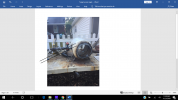
Blown forge problem

Jason, Looking at your forge setup it looks like you're using 2" pipe from blower, then reducing down to 1-1/4" into forge body? Is that correct?

Ken I'm 99% sure its 1 1/4" going into the forge. When I'm in the shop later I will update this if I'm wrong
 
Natlek, I had to google "stone wool" to know what it is. Isn't that the same as rockwool that is used for insulation? If so, I've got LOTS of that stuff laying around in the attic. I never had any idea rockwool insulation could be used for insulation in a forge. Why do I not hear more about using rockwool for forge? Maybe not for total insulation, but at least for filling gaps in spaces.

I think I've got plenty of the ceramic fiber and will perhaps have some left over so don't think I'll need any. My idea on using brick for the bottom space wasn't to "fill space" so much as to provide a more durable bottom for the forge.

Comments Stacy?

Yes , rock wool is stuff I talk about ..they are rated to 800 Celsius , fire resistant and I don t see any reason why not to use it as first layer in contact with shell ?? I don t try it so far but I will use it as top layer for my forge and for tempering oven , it is very cheap and available easy ...
Don t forget this .............this kind of products derive their thermal properties from tiny pockets of air trapped within the physical structures of the stone .So more light layer more efficient insulation .
 
Last edited:
OK folks, I've done some cutting on the propane tank and welded up the burner. You can see the back end is cut full diameter of tank, while front end is cut a bit smaller. Main question I have is the burner position. It comes in at the 9 o'clock position and points straight across. Would it be better angled slightly upward? OR, is that ok? That is a short piece of pipe welded to shell, with 1-1/4" pipe for burner tube. I felt 1-1/2" pipe was a tad large, and if the 1-1/4 is too large it will be easy to reduce to 1" pipe. Had I used 1" pipe it would have been harder to make larger. The blower tube is 2" pipe with gas injection close to blower inlet.

Where should the needle valve be located - right at the blower tube, or at outlet of regulator?

Comments and guidance before I get any further along. I will be mounting rails on front and rear to hold firebricks to close off open ends.

Forge-Shell.jpg
 
Last edited:
You should read the stickys and past forge build threads before you run out and start welding. You should not have the flame going straight across the forge.

The burner should be located about 15-20% back from the front of the forge. It should be angled at a tangent to the chamber walls ( when the lining is in place). It should be angle rearward at around 30°. There are good drawings in the stickys and in past threads showing this.

It doesn't really matter what clock position the burner enters , as it will be at a tangent to the chamber. Most folks bring it in between 9:00 and 12:00.

To diagram the blower entry, draw a circle the size of the shell. Then draw a circle the size off the proposed lining inside that circle. Draw a tangent line that touches the inner (lining) circle. Draw a second line the size of the burner tube ( saw 1.25") below that line to make a chord. This will be the path of the burner tube and flame. It will make the flame swirl around the chamber walls and eliminate hot and cold spots.
 
Stacy, I did look thru the stickys and never found the thread that detailed building the forge. This time I did find it, there is a link in the first stick: https://www.bladeforums.com/threads...atment-sticky-find-good-ht-info-here.1396447/

Reading down I find in post #7 a series of links to PID controlled forges, and in my mind I was thinking the links were for PID control aspect of forges. BUT, now I find a link to a thread by you Stacy where you talk about forges and salt pots: https://www.bladeforums.com/threads/pid-control-forge-salt-pots-and-more.782574/ - in post #4 you write some really good info on blown burner and forge and in post #6 you continue with more really good info. Everything I was looking for in those two threads, but I never found it in all my searching. Yes, I used the "Bladeforums Custom Search Engine" but still never found them. I'll spend some time this morning reading those threads.

Since giving this more thought I can see why it's important to have the burner entering horizontally at about the 10 O'clock position allowing the flame to roll around the insulation rather than hitting at a single direct spot as it does with burner at the 9 O'clock position. The flame going straight across hitting directly on other side is just like the burner entering at top and going straight down, except the flame isn't hitting the billet direct, so 9 O'clock is better than 12 O'clock.

Edit:
Wait, I know what I'll do - it will be easy to remove the legs and reweld them on so it will put the nipple at the 10-11 O'clock position and bend so it will be tangent rather than direct across. It will still be midpoint, As I'm bending I could angle so the flame is going forward a slight bit. How does that sound?

Thanks to all for help on this build.
Ken H>
 
Last edited:
Yes, leave it at 9 o'clock. Cut off the bruner port flange and weld a new one on at the proper angles ( tangential to the lining and angled back about 25-30 degrees. THe PDF on forge build is attached below, too. On your build, ignore the by-pass leg with the solenoid. A mixing chamber resolves the need for putting a diffuser in the burner. It isn't necessary, but makes a better burner. It is just a short (3-4" section of larger pipe with bell reducers on each end.

upload_2019-11-21_11-58-45.png
 

Attachments

Last edited:
Thanks a bunch Stacy - that's exactly what I'll do. MUCH easier than moving the legs and will do the same thing.

edit: I just did some cutting and changing to this:
Blower-2.jpg

I think that's what you're looking for? It's also got a very slight angle so flame is toward front just a tad
 
Last edited:
It can angle toward the front (starting at the back) or the other way. In the past most everyone made the forge with the burner in the back and angled forward. This created a large dragon's breath right in your face. Placing the burner in the front and angled back moves the dragon's breath blowing out the back. Now, that is becoming the standard placement. The only place you don't want it is right in the middle.

The credit for moving the burner up front and angling it back goes mainly to Charles at Atlas Forge. When he discussed this with me and others it was a lightbulb moment where you think, "Why didn't that ever occur to me before??"
 
I had wondered about that dragon's breath with flame toward front. I've been saying the nipple is at mid point, but it's not really. center of burner is 2" forward of center line so I think I'll leave it right there and angle toward rear a bit.

We gonna get this done yet {g}
 
I always tell people to think twice and cut once. Rushing to put something together you are not familiar with almost always ends up with a lesser quality item.

I would remove the burner from where it is and place it about 4-5" back from the front. Angle it back around 20 degrees.
Put a 1" port tube where the burner is now for a thermocouple tube and TC.

Send me an email and I'll send you a ceramic TC tube, the TC, and a simple PID to use as a read-only device. Someday later on you can make it PID controlled easily.
Adding this will take the guesswork out of knowing how hot the forge is running.


I can explain how to install the TC tube in the email exchange.
 
I don't have your email, but here is my email: sailingtoo at gmail dot com (not sure all that "at" and "dot" does much) :) With an offer like that the least I can do is follow YOUR directions to the letter!

THANK YOU SO MUCH FOR YOUR OFFER - I'll sure make good use of it. I don't expect to make it a PID controlled forge because I've got an EvenHeat oven I use for HT'ing, and sometimes normalizing. This will be used for forging.

OK, let me back out there to do some more cutting 'n welding. The metal I cut from the ends will make a good patch for the existing hole. and weld a 1" port in for the ceramic tube for TC.

Ken H>
 
Back
Top