blown vertical forge construction questions

Joined
Dec 4, 2001
Messages
3,824
Well, got another roll of ceramic wool, satinite, and bubble alumina, now need to get busy. A buddy just starting with knives that owns a welding shop will be helping and we are going to build two forges. I could do the work, but figure I'll help him out and he's got migs, tigs, ect.

The plan is to cut the 25 gallon tank in half and line with 2" of wool. The main question is, how big or small to make the openings? I would like to make the front opening or door at least 3" square so I can work hawks. As for damascus billets it could be smaller.

I've looked all over and can't find any decent plans or info other than a bunch of pictures. The pics do help, but would like to do this without screwing up. Or maybe I'm over-thinking this, a horizontal forge is no problem and easy to build, is a vertical that much harder?

Thanks
 
You're over thinking this. A vertical is very easy to build. You can make the opening about any size you want. My front opening is 3" wide and 4-1/2" tall. Back opening is smaller. My billets are usually 4" tall, thus the door size.

What's the bubble alumina for? I don't use that in a vertical. A layer of wool with a cat litter is what I use for the bottom.
 
I'll add to that with a recommendation for hearths. Basically a lip up to 3" deep by 6-8" wide welded on the outside of the shell, at the level of the bottom of the door on each side. I like that so that I can have a biggish door for tall billets but also regulate my door width by having a half brick on the hearth on each side of the door.

You probably are planning it this way anyway, but just tack welding the top and bottom on or otherwise making them easy to remove will help with relining etc. later on.
 
Thanks, figured I was over thinking it.

The bubble alumina is for the bottom, but if it's not needed I'll just coat with satinite and cat litter and save the alumina for the horizontal forge.

I hadn't thought of using firebrick, though I should have as I use it for my horizontal forge to make the opening any size I want. Thanks for the idea.

I hadn't planed on tacking the top on, though about it and was debating on a couple of tacks or just a block of scrap to hold it down. I'm going to use the domed bottom and top of the tank to make the flux run to the center and add a hole in the center to drain it out.
 
For the top on mine, I just lay a slightly over sized piece of wool there, then a piece of plate steel to hold it in place. No need to weld it, as you need to get in there later.

Salem made a good point about a hearth at the openings. I weld a piece of 1/4" plate there, this covers the wool at the opening and gives a place to rest work on.
 
I believe it was Tom Ferry who told me that all the drawbacks of the vertical forge, hot spot at the back and not being able to easily retrieve a billet that happens to fall into the forge, can be offset by making it upside down. I haven't tried it yet but plan to the next time I build a forge. I was told that it takes the forge a little longer to heat up because it has to heat from the top down but this happens to a lesser extent anyway. With the door only two inches off the floor there is room for flux to drip off the billet and should the unspeakable happen and a billet falls off it is easily retrieved with tongs.
 
Interesting. I had a smaller bearing fall into my vertical- it disappeared. I guess I'll find it when I re-line.
 
Thanks for the info.

A question though, as one of the things this forge will be required to do is forge weld wrought iron. Is there a noticeable temp difference between putting the door down low or up high? I'm thinking with an easily removable top it'd be a simple matter to shut down and pop the top and retrieve an errant billet. Of course almost all my billets have a rebar handle welded on too.
 
That is correct, Will.
Just put a shut-off valve in your blower assembly.
If something drops, shut it off, remove the lid and retrieve your part.
I have two pretty big forges. (And a smaller one, as well.) Everything that has ever accidentally fallen in, I was able to retrieve through the front door.

This is a 12" pipe split lengthways with an added 6 inch web to increase the welding.


An 8 inch for little jobs and when I go on the road and do demos:


And here's a straight 12":


Just use your imagination and get one built.
They're not complex.
 
Last edited:
Thanks for the info.

A question though, as one of the things this forge will be required to do is forge weld wrought iron. Is there a noticeable temp difference between putting the door down low or up high? I'm thinking with an easily removable top it'd be a simple matter to shut down and pop the top and retrieve an errant billet. Of course almost all my billets have a rebar handle welded on too.

after the forge is thoroughly heated I don't think there will be any difference in heat. I do think it will be more even throughout the forge. My vertical forge is an old pottery kiln that I re purposed by adding an additional layer of brick to the inside. I left the hinged door on the top thinking that if something dropped inside it would be a simple matter to shut down open the lid and retrieve my part, shut the lid refire and keep on forging. WRONG At welding heat as soon as you try to open the lid there is a searing heat that escapes the forge. you can open the lid with a long bar or a long pair of tongs, But then it is nearly impossible to get close enough to the forge to retrieve the part that fell into the forge. The only way that I can manage, is to put an old nomex coat and face shield, from my days as a fire fighter. Even then my welding gloves get smoking hot and if it takes more than about thirty seconds to get my part, the gloves are ruined and too hot to keep on. if the part is left in the forge lonng enough for the forge to cool so you can reach in the part is ruined, with huge grain and lots of scale.
 
My setup is almost just like Karl's, good combo. I made this one just for heat treating blades, great control
.
 
Agree with Bill, I would not remove to top of mine when at welding heat.

Bill, I don't think I'd like an upside down vertical at all! :)
 
No, I wouldn't remove the top at welding heat, but from experience with horizontal it should cool down enough to get something out with long tongs without waiting too long. Maybe just pop the top and let it cool.
 
I know NOTHING about a vertical forge other in just what I have read here so please take this thought with a grain of salt. Is there a reason you could not have a 2nd door down low that you would only open to retrieve something dropped?
 
Agree with Bill, I would not remove to top of mine when at welding heat.

Bill, I don't think I'd like an upside down vertical at all! :)

Don I have not forged in one, and in fact don't know for sure if it would work or not but the Idea seems good to me.

my vertical is hot enough to give a good blister after setting all night in mid forty degree weather. it would take a good hour to cool enough to reach inside and by then I think the grain in the piece would be extremely large.
 
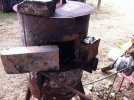
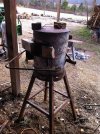
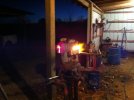
Got it built, 2" of wool, coated twice with satinite, bubble alumina on the bottom with a drain hole. I ran it last night for 6 hours, mostly playing, stacking and welding bits of wrought iron and welded and forged another hawk.

Here's what I'd do different next time. Put a 1/2" thick fire brick into the openings to protect the wool there(going to do that next time I go to the brick yard), and make a door on the bottom. I dropped the hawk 3 times while doing the finish forming. Luckily I my main opening is 5"x8" closed off with fire brick. I just shut the gas off and blower off and used a long hook to reach in and grab it.

After running for 6 hours there is some minor damage from flux, but way way less than I'd have gotten with my horizontal forge.
 

Attachments

  • IMG_0492.jpg
    IMG_0492.jpg
    100.6 KB · Views: 38
  • IMG_0491.jpg
    IMG_0491.jpg
    78.1 KB · Views: 40
  • IMG_0482.jpg
    IMG_0482.jpg
    52.1 KB · Views: 38
Nice! I like those big doors. Seems like you got good welding heats with it too.

I used bubble alumina on the wool inside the doors, a thin brick might be nicer.
 
For sure getting good welding heats, this was the first time I welded a hawk and didn't have to put a tack weld in the eye to keep it from splitting during drifting.(earlier hawks were forge welded, but the drift sucked heat fast and the weld was a weak spot) One time I shut down the gas and left the blower running to get the hawk out of the bottom and there were a few sparks coming from the wrought iron, didn't spark when gas was running so I guess it was a reducing flame.
 
Back
Top