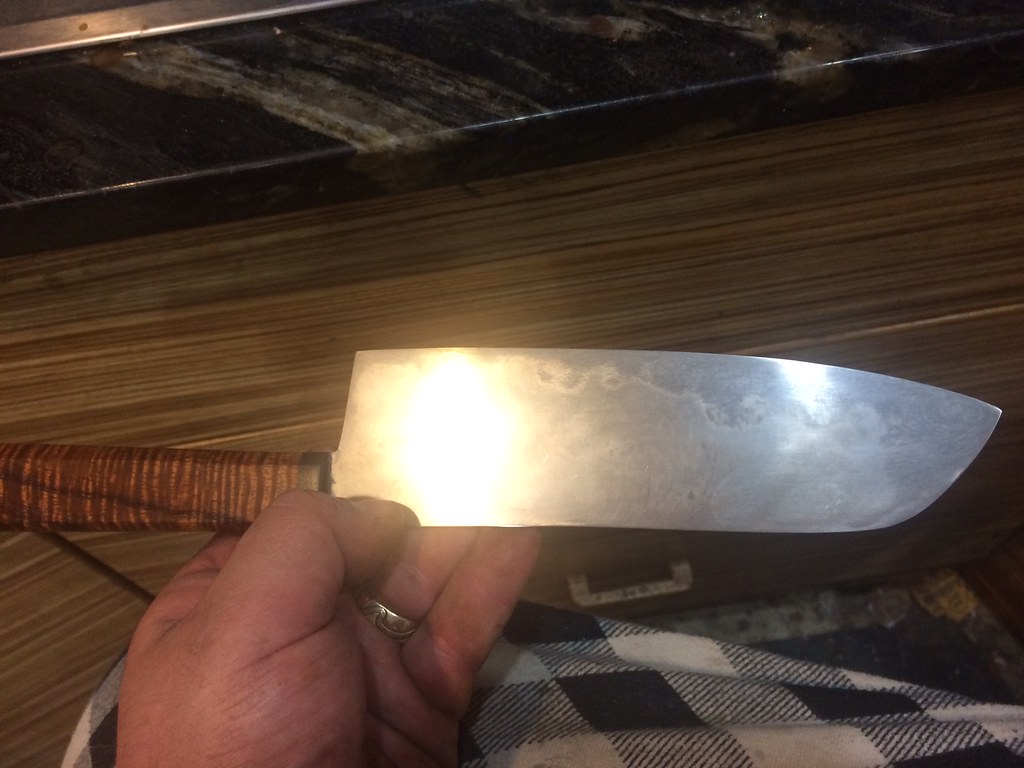
Blue 2 steel hamon

Joined
Aug 22, 2016
Messages
256
Hey guys,
Got some 6mm thick blue steel #2. I am forging to shape and attempting a hamon for blue2 honyaki gyutos. I heat treat in a kiln, have parks 50 and mcmaster 11 oil. I just quenched my first attempt using an austemp of 1490. Havent fully ground blade to check hamon yet but it looks to be smaller than my clay up.
Wondering if anyone has messed with hamons on this steel? The TTT shows it hardening above 65Hrc quenched anywhere between 1475 and 1525. My mind is telling me q
1475aus temp for hamon
1490 good balance
1525 aus temp for max hardness.

Also is RA problematic when austentizing above 1500 with this steel or does the alloy content counter some of that?
Thanks guys,
-Trey
 
I use 1475 with blue for a hamon. I tried 1460, and the whole blade was cloudy, and the Rc numbers were all over the place.

Two examples. Not as active as Hitachi white, or W2, but better than 1084. There’s a lot of nuance in the cloudy sections.

image by Wjkrywko, on Flickr

image by Wjkrywko, on Flickr
 
I usually get auto Hamon (no clay) with Aldo’s Blue 2 in a 2” tall .135” thick 8” long, full flat grind chef’s knife.

If Hamon is the ultimate goal, then lower hardening temps and soak times may be better.

Even tho I am only doing stock removal, I normalize Blue 2 and then thermal cycle. 1700f, then 3 cycles usually 1550, 1500, 1450, quenching on last cycle. Then harden at 1490f (10 minute soak), Parks 50 quench oil. Temper is at 350f. ~64HRC
 
I usually get auto Hamon (no clay) with Aldo’s Blue 2 in a 2” tall .135” thick 8” long, full flat grind chef’s knife.

If Hamon is the ultimate goal, then lower hardening temps and soak times may be better.

Even tho I am only doing stock removal, I normalize Blue 2 and then thermal cycle. 1700f, then 3 cycles usually 1550, 1500, 1450, quenching on last cycle. Then harden at 1490f (10 minute soak), Parks 50 quench oil. Temper is at 350f. ~64HRC
Mine isnt from aldo. Its Takefu blue #2(it does have a bit of chrome in it like .2/.4) and its 6mm thick. I forged the blade to shape, ground off decarb and ground a cross section. Satanite was applied. (Blade was normalized and cycled after forging). Blade was soaked at 1490 for time minutes and quenched in parks 50, tempered 350. Killed 2 60 grit belts just trying to check for hamon! Its very hard! Im starting to think i see a very small/feint hamon. Here is a pic of my clay up.
CEPS6gs

http://imgur.com/gallery/CEPS6gs
It appears my imgur link is not liked?
 
Ok, there is totally a hamon on this knife . Just harder to see than on 1095 and W2. Looks like it may have dipped, if it goes a hair lower than i wanted and i used 1490/10 min soak, would you extend soak or bump temp?
 
Lower towards the edge? How thick was the clay?
I cant tell yet if its true hamon or just activity but it looks like it went farther down the blade towards the tip than was clayed. I mixed the satanite and painted on 3 thin coats, i was under the impression this steel would be very difficult to achieve hamon formation.
Maybe less clay next time. So many variables!
 
Ah, Takefu. As far as I know, the Takefu steels similar to Blue 2 would be either Takefu V2, or V Toku 2. EXTREMELY close to Hitachi Blue 2, but the main difference being the higher Manganese % allowed in Takefu (0.5%) compared to Hitachi Ao (.2%). That higher Mn count is going to make it slightly more difficult to get the "activity" in the hamon, but still should produce something nice.
Once you get it polished and etched, we would love to see how it comes out!

I've used the V Toku 2 in a stainless clad san mai, I like it quite a bit.
 
I cant tell yet if its true hamon or just activity but it looks like it went farther down the blade towards the tip than was clayed. I mixed the satanite and painted on 3 thin coats, i was under the impression this steel would be very difficult to achieve hamon formation.
Maybe less clay next time. So many variables!

I’ve only done a few in Hitachi blue as my supply is pretty limited, but each hamon has been closer to the edge than the Clay was. In future, I’ll use very thin clay, just a suggestion for the steel to follow in the quench. I also find the heel acts like a heat sink, so I grind the back 1/3 of the plate thinner than the front pre quench to minimize this.
 
Back
Top