
-
The BladeForums.com 2024 Traditional Knife is available! Price is $250 ea (shipped within CONUS).
Order here: https://www.bladeforums.com/help/2024-traditional/
You are using an out of date browser. It may not display this or other websites correctly.
You should upgrade or use an alternative browser.
You should upgrade or use an alternative browser.
Bolsters and liners question
- Thread starter Lo/Rez
- Start date

- Joined
- Jul 4, 2010
- Messages
- 873
There was a thread a while back where the liners and bolsters were integral. Requires a mill but no solder.

- Joined
- Oct 17, 2010
- Messages
- 2,424
Spot weld, screws, pins. There's always more than one way to skin a cat. Although, soldering bolsters isn't the same as you're likely thinking of soldering. It's simply just prep, clamp, heat. You put thin pieces of wire or flat solder between the bolster and liner with flux, clamp it, and heat it, done.

SBuzek
Basic Member
- Joined
- Dec 7, 2006
- Messages
- 3,612
Back one more time. Simple way to solder.
http://www.bladeforums.com/forums/s...ing-bolsters-on-slip-joint-My-way-(pic-heavy)
http://www.bladeforums.com/forums/s...ing-bolsters-on-slip-joint-My-way-(pic-heavy)


Hi Obi Wan Javand (my slipjoint Teacher!!), what do you think is the best preparation for soldering? I mean finish grit (i use 500 g) and cleaning (i use pure alchool).
Up today i used the pre-tinning way, with good results in terms of invisibility. Pre-tinning i can recover the edges, which tend to scorch a bit, so i can reflux and scrub with a SS rod until i get perfect tinned surfaces. The thin pieces of wire, flux and clamp won't allow me to scrub any scorched area may happens, so i'm afraid i could end with some black line/dot around the joint.
I am very tempted to try the method, since pre-tinning is a 6 steps soldering operation for 1 knife, while the other method it's just 2 soldering steps!!!
Up today i used the pre-tinning way, with good results in terms of invisibility. Pre-tinning i can recover the edges, which tend to scorch a bit, so i can reflux and scrub with a SS rod until i get perfect tinned surfaces. The thin pieces of wire, flux and clamp won't allow me to scrub any scorched area may happens, so i'm afraid i could end with some black line/dot around the joint.
I am very tempted to try the method, since pre-tinning is a 6 steps soldering operation for 1 knife, while the other method it's just 2 soldering steps!!!
I tried SBuzek way the first time and failed... I guess I smoked all my flux before the thinned solder decided to melt.
It looked fool proof but not for me YET.
I now tin both sides than spring clamp and heat.
I've got a very small butane pencil torch I do the work with.
Yes it more steps but it's working for me so far.
I will re visit his way again probably with a heat gun.
How are people prepping the steel before any method ??
It looked fool proof but not for me YET.
I now tin both sides than spring clamp and heat.
I've got a very small butane pencil torch I do the work with.
Yes it more steps but it's working for me so far.
I will re visit his way again probably with a heat gun.
How are people prepping the steel before any method ??
I ensure the parts are flat by sanding on a granite plate up to 500 grit. varying the direction often (8 shape) and being firm but light. I don't deburr after this.
Cleaning is done with pure alchool (not denaturated), or acetone bath, followed by pure alchool.
Then i color a pencil line to act a barrier for the solder/flux mess. When i do this i inclinate the parts (back of bolsters and liners) in order of avoiding any graphite powder to fall in unwanted place as i'm drawing. I use clean nitrile gloves during the whole operation and i lay my pieces on clean towels on the bench.
I agree, pre-tinning is slow but probably more fail-proof.
Cleaning is done with pure alchool (not denaturated), or acetone bath, followed by pure alchool.
Then i color a pencil line to act a barrier for the solder/flux mess. When i do this i inclinate the parts (back of bolsters and liners) in order of avoiding any graphite powder to fall in unwanted place as i'm drawing. I use clean nitrile gloves during the whole operation and i lay my pieces on clean towels on the bench.
I agree, pre-tinning is slow but probably more fail-proof.
I use rivets, works well if done carefully here is an example
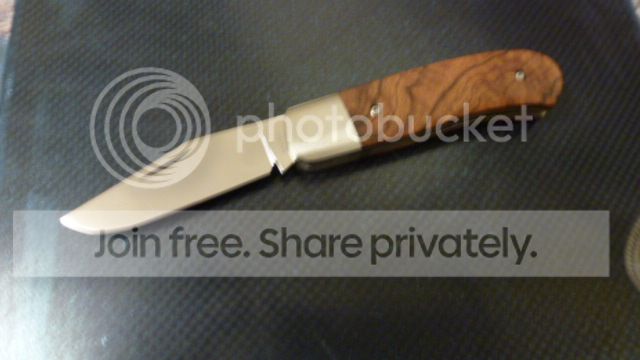
This is a very nice knife. I will be using screws also and a pivot. What kind of wood is that?
- Joined
- Oct 17, 2010
- Messages
- 2,424
I don't use acetone often, it can leave a residue, I typically use 94% isopropyl alcohol to do my cleaning with.
I don't do many soldered bolsters anymore, I used to for damascus bolsters on non integrals, and I use a high silver content hard solder in ribbon form (thin foil like strips) I'd simply cut 4 small squares and place at each corner of the bolster after brushing flux on (making sure your flux is appropriate for your solder is a big factor), clamp with a small spring clamp that won't absorb much heat, and heat the bolster and liner to cherry. Let cool, and it's done.
I do all this before I do any finish shaping on the liners, etc, and usually the bolsters are square pieces unshaped, except for cutting the dovetails.
This usually leaves a thin silver line, which I think looks attractive with mild steel liners and damascus bolsters, and it's pretty invisible with stainless. I'm not saying this is the optimal method, it's just the way I was showed, it was easy, gave the results I wanted, so I stuck with it.
I haven't soldered any in a couple of years honestly though, it's not my preferred method. I used this primarily because spot welding damascus would show the spots when the damascus was etched, but I've since figured out a way to keep this from happening, so I spot weld any bolsters now that aren't integral.
I don't do many soldered bolsters anymore, I used to for damascus bolsters on non integrals, and I use a high silver content hard solder in ribbon form (thin foil like strips) I'd simply cut 4 small squares and place at each corner of the bolster after brushing flux on (making sure your flux is appropriate for your solder is a big factor), clamp with a small spring clamp that won't absorb much heat, and heat the bolster and liner to cherry. Let cool, and it's done.
I do all this before I do any finish shaping on the liners, etc, and usually the bolsters are square pieces unshaped, except for cutting the dovetails.
This usually leaves a thin silver line, which I think looks attractive with mild steel liners and damascus bolsters, and it's pretty invisible with stainless. I'm not saying this is the optimal method, it's just the way I was showed, it was easy, gave the results I wanted, so I stuck with it.
I haven't soldered any in a couple of years honestly though, it's not my preferred method. I used this primarily because spot welding damascus would show the spots when the damascus was etched, but I've since figured out a way to keep this from happening, so I spot weld any bolsters now that aren't integral.

Bill DeShivs
Knifemaker / Craftsman / Service Provider
- Joined
- Jun 6, 2000
- Messages
- 12,892
I bought one of the 120 V spot welders about a year ago. It's still in the box.
- Joined
- Oct 17, 2010
- Messages
- 2,424
I'm no expert on spot welders, but if it's anything like MIG welders, you'd definitely want to go with 220V option. I will say that I've got the 220V harbor freight spot welder, and if you properly dress the tips, it works just fine. I've regularly used a nice Miller unit, and for the purpose of attaching bolsters, it doesn't seem to be significantly better. These are pretty simple machines. However, you need amperage to get penetration, and usually, you want to go with more capacity than the "rated" capacity, especially if you're talking about harbor freight's rating capacity, which I expect to be extremely liberal. I think the unit I've got is rated at 3/16 total, and I certainly wouldn't expect it to go any higher than that.
So no, I don't think you'll get adequate penetration from that welder personally. I wouldn't honestly expect to get great performance at 1/8, let alone closing on 3/16 as you are.
So no, I don't think you'll get adequate penetration from that welder personally. I wouldn't honestly expect to get great performance at 1/8, let alone closing on 3/16 as you are.
Hi Javand, do you normalize after spot welding or have another trick to let the spots disappear?
Acetone will remove very well any oil remained from the previous tuning. It does leave a white haze (oil chains fractured) unless you don't just use its vapours....or clean with alchool afterward as i do.
Suspending the pieces over an acetone becker that is on an hot plate lets the acetone vapours to condensate over the piece and remove any oil/grease. Even if the oil goes down into the becker, only pure acetone vapours will rise and do the job....that won't leave any residue on the piece and the best way ever to remove oil from a piece. Definitely overkill for our application, but nice before etching damascus or hot blueing.
Acetone will remove very well any oil remained from the previous tuning. It does leave a white haze (oil chains fractured) unless you don't just use its vapours....or clean with alchool afterward as i do.
Suspending the pieces over an acetone becker that is on an hot plate lets the acetone vapours to condensate over the piece and remove any oil/grease. Even if the oil goes down into the becker, only pure acetone vapours will rise and do the job....that won't leave any residue on the piece and the best way ever to remove oil from a piece. Definitely overkill for our application, but nice before etching damascus or hot blueing.

- Joined
- Oct 17, 2010
- Messages
- 2,424
Hi Javand, do you normalize after spot welding or have another trick to let the spots disappear?
Acetone will remove very well any oil remained from the previous tuning. It does leave a white haze (oil chains fractured) unless you don't just use its vapours....or clean with alchool afterward as i do.
Suspending the pieces over an acetone becker that is on an hot plate lets the acetone vapours to condensate over the piece and remove any oil/grease. Even if the oil goes down into the becker, only pure acetone vapours will rise and do the job....that won't leave any residue on the piece and the best way ever to remove oil from a piece. Definitely overkill for our application, but nice before etching damascus or hot blueing.
Yes, I just heat them up with a torch, a couple of times, and the spots usually go away. Like with everything you just need to get an even color and do it twice or three times, taking care not to warp your liners.
Good info on the acetone, I wasn't familiar with that, thanks Stefano!