Bolsters and scale fit

David W Babcock

Black Metal Forge
Joined
Mar 21, 2018
Messages
80
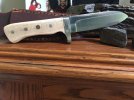
one thing I’m struggling with, regardless of how clean I cut the scale, if I use a bolster, I always seem to find a minor gap somewhere. I usually mix a bit of the same scale dust with some epoxy to fill and polish clean, most don’t notice. However it’s not to scale with the fit and finish I see on many knives here. Here’s a quick little drop point I did for a friend a couple days back, you can see what I mean. Not my greatest example! It was a cheap functional piece so I didn’t polish out the grinder lines on the blade, I’m looking for assistance with the handle scale/bolster fit, thanks.
 

Attachments

  • C4E3F386-26D7-4435-9164-591B6D022BF4.jpeg
    C4E3F386-26D7-4435-9164-591B6D022BF4.jpeg
    257.8 KB · Views: 248
I true up the booster edge with a file and then fit the handle material using a flat disc. Freehand, no jigs or workrests.

h8vL9WY.jpg


OMTDule.jpg


DLwMQhl.jpg
 
Gotta be flat, smooth, and square (unless dovetailing). A disk grinder with a properly squared table should make short work if this.
(This also assumes your guard is square to the tang.)
 
Basically there shouldn't be any raw, saw-cut edges or surfaces anywhere on your scales. You need good, flat surfaces with quality paper to make sure the backs are dead flat and polished. Then you can square up and polish the end that mates up to the bolster. You want these surfaces almost finish sanded before proceeding.
 
What TR said. David by your picture, it appears that your fitup issue is the tearout and angled cut of your handle scale where it meets the bolster.
If your knife has a tapered tang be sure to also get the correct angle to the front of the scale so it seats properply and snuggly to thr bolster.
Unless you get a smooth and singular plane finish to the end of the scale you’ll never get a tight fit.
 
You have to establish a baseline when it comes to assembly of things like this. Most people use the ricasso or the tang of the knife as their baseline. So first thing, make sure the tang is flat. <.005" flat preferably .001" flat over 5" or so. With a tang that flat, you'll then mate the scale to the tang and will see right way if your scale isn't flat because light will show through. Flattening the scale will give you a nice, uniform fit between 2 pieces, the tang and the scale.

Throwing a bolster into the mix you have to add another degree of constraint in. You start with the same flat:flat relationship between the bolster and tang, but now you must meet up the edges of the bolster to the edges of the scale. This requires the edges of each to not only be flat, but to also be (in this case, where you are not dovetailing) perpendicular to the flat surface. You can do this with a disc grinder, or a belt sander, or a file, or whatever, I find it easiest to accomplish on my disc.

The 3rd degree of constraint comes in when you start plunking holes in. Now the position, form, and orientation of those holes becomes critical to maintaining the surface to surface fit you established. Too much clearance in the scale holes can result in gaps around your pins. Too little clearance for the position and orientation deviation can result in pulling the scale or bolster way from each other. The easiest way to avoid this is to have sufficient clearance in the holes in the tang, and when you drill your second scale, drill it using the first drilled scale as the drill guide, so the holes are put in with the flat surfaces relative to each other and not depending on your drill to be perfectly perpendicular, etc.

Fit and problems with fit begins with flatness.

 
I clamp them into my carbide guide with a little protruding out and grind down to the carbide inserts on my disk grinder. You could do the same on a granite plate or even a sheet of glass. Do that to the mating surfaces and bye bye glue lines.

Same as the above poster I give the handle tangs a lick on the flat disc and then some hand lapping on the granite surface plate. Also the scales where they meet the tang.

Basically I use a disk/ hand lapping on the plate for every surface that meets now that I think about it. A small price to pay for nicely mated surfaces.
 
I don't know, If was me I'd file a pattern in the scale face to bolster fit up and fill that section with epoxy of a different accent color.
 
If at some point you have flattened your blade by holding it with a magnet against the flat platen with a 400 grit belt then all you need do is hold the inside of your bolsters against a disc sander with 400 grit on it and then install. They should be a tight fit after peening in a couple pins into chamfered holes. Larry

W1iOOHMm.jpg
BsamI5Gm.jpg
 
If at some point you have flattened your blade by holding it with a magnet against the flat platen with a 400 grit belt then all you need do is hold the inside of your bolsters against a disc sander with 400 grit on it and then install. They should be a tight fit after peening in a couple pins into chamfered holes. Larry

W1iOOHMm.jpg
BsamI5Gm.jpg
Larry what work rest is that on your disc? I like how low it sits
 
Larry what work rest is that on your disc? I like how low it sits
It is a a Beaumont Metal Specialties rest. You can get specifics on the KMG and Beaumont site. It is very heavy duty and somewhat pricey but worth it. It flips instantly to a 45 degree angle which is nice for dovetailing bolsters and scales. Larry
 
Thanks for all the tips guys, I think I’ll invest in a good variable forward reverse disc sander. I’m currently using a couple types of belt sanders. Ive been thinking of getting one or plans for one for a little while. I just read some past threads on here and seems that my shop could use this tool.
 
Thanks for all the tips guys, I think I’ll invest in a good variable forward reverse disc sander. I’m currently using a couple types of belt sanders. Ive been thinking of getting one or plans for one for a little while. I just read some past threads on here and seems that my shop could use this tool.
You don't need a disc sander to get a flat surface. Just use a flat piece of glass or better a granite surface plate. Put some sandpaper on top and sand the handle material mounted to a square block or just sand and check with a square. If you sand with it clamped to a square block or 123 block, sand with the handle material on the paper, and the block off, with the handle material raised slightly because of the sandpaper thickness.

A disc sander will get you there faster but is not necessary. I would reccomend doing what I mentioned above whether you start on a disc or not.
 
Out of curiosity, what are you using for handle material. It looks in the picture (I know you said this wasn't a good example) like you're using an unstabilized softer wood. That's going to give you more troubles than if you're using a very hard and dense wood like ebony (feel free to correct me Ben), stabilized wood or synthetic material.
 
You don't need a disc sander to get a flat surface. Just use a flat piece of glass or better a granite surface plate. Put some sandpaper on top and sand the handle material mounted to a square block or just sand and check with a square. If you sand with it clamped to a square block or 123 block, sand with the handle material on the paper, and the block off, with the handle material raised slightly because of the sandpaper thickness.

A disc sander will get you there faster but is not necessary. I would reccomend doing what I mentioned above whether you start on a disc or not.

Thanks I will probably get the grinder anyway, I had an old king Canada 1x42 with a 8 or 9” disc on it but could never get it true on the work rest. I was using it for wood and got rid of it, now that I fabricate other metal items (aside from knives) I’m gonna do some shopping.

Having said that, I just ordered a 12”x12”x3” precision black graphite plate for 50$ it’ll be something I try next and I can spend some time considering shopping or building a disc grinder!
 
You don't need a disc sander to get a flat surface. Just use a flat piece of glass or better a granite surface plate. Put some sandpaper on top and sand the handle material mounted to a square block or just sand and check with a square. If you sand with it clamped to a square block or 123 block, sand with the handle material on the paper, and the block off, with the handle material raised slightly because of the sandpaper thickness.

A disc sander will get you there faster but is not necessary. I would reccomend doing what I mentioned above whether you start on a disc or not.

Wanted to thank you! Since I’ve been using a piece of sandpaper, taped to the granite surface plate you recommended, my fit and finish has improved a fair margin! Thanks again!
 
Wanted to thank you! Since I’ve been using a piece of sandpaper, taped to the granite surface plate you recommended, my fit and finish has improved a fair margin! Thanks again!
You already get good advice here , but this is way I do that ...I grind front of scale in that way that I can not push pin with hand in place .And when I do final assembly I grind one side of first pin / longer then I need / cone shape .That way pin can go inside /maybe with help of light tap with hammer / but will PUSH scale IN bolster .....I do the same way when I work on hidden tang knife . I hope you understand my broken English :)
 
Back
Top