Bought an ironwood log - need cutting advice

Joined
Jun 22, 2006
Messages
814
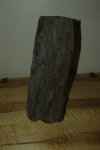
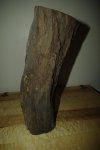
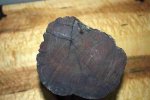
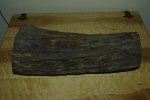
I picked up a nice ironwood log today, I need to ask what the proper blade pitch/method is for cutting something this dense. My little 4x6 saw obviously isn't gonna cut it, I have access to a proper vertical saw at a friends place but would hate to wreck material and/or blades doing things the wrong way.

I'm hoping burlsource or one of the other vendors will chime in here - I haven't tried to tackle anything this big before (at least in ironwood)

Have a good one,

Nathan
 

Attachments
  • IMGP4787.jpg
    IMGP4787.jpg
    45.8 KB · Views: 187
  • IMGP4789.jpg
    IMGP4789.jpg
    19.1 KB · Views: 165
  • IMGP4791.jpg
    IMGP4791.jpg
    22.1 KB · Views: 175
Last edited:
Hi Nathan, Looks like you scored!

What are the dimensions of the log?
Example; if it was about a foot long you would cut it in half for 2 easier to handle pieces.
Can you take photos of the ends and post them?
Ironwood will usually have some cracks. So if a cut can follow a crack it will help lessen waste.

It can be kind of scary cutting an irregular shaped piece like this.
You want to use a strong bandsaw with a sharp blade. I use an 18" grizzly bandsaw with a 3/4" wide blade.

If you can post the dimensions and end photos I will walk you through the cutting step by step so you can do it safely with minimal waste.
 
Last edited:
Dimensions:

-16" tall on longest side (Outside of the curvature)
-5 1/2" across the widest point on the small end
-6" across the widest point on the large end

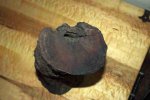
The small end has a large void that turns into a crack along approx 35% of it's length (tried to show it in the pic).

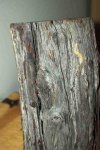
I will be cutting this up into scales not blocks (don't use blocks). I can't really photograph it, but going by the grain on the outside of the piece, there should be some really good stuff in here :D

Thanks for the help,

Nathan
 

Attachments

  • IMGP4792.jpg
    IMGP4792.jpg
    45.2 KB · Views: 145
  • IMGP4795.jpg
    IMGP4795.jpg
    51.4 KB · Views: 121
  • IMGP4797.jpg
    IMGP4797.jpg
    53.6 KB · Views: 157
When I cut a large log at school, what I did was joint two adjacent sides flat so that they can stay in cutting position firmly. Then I used a delta full-height bandsaw. I put on side on the table of the bandsaw and the other against the fence and then cut to size.

Of course, I was cutting ash and not ironwood.
 
Because of the curvature I would not try to cut off long strips.
If you cut the length into 2 pieces it will be a lot easier to handle. By leaving the 2 pieces longer than you need you will be able to trim away a lot of the checks that will go into the piece from the 2 ends. I would wait to trim away checks until the last.

You may need to use some scrap wood as a wedge to keep the log from rolling when you cut it in half and you make the first 2 cuts. Otherwise the blade can grab the log and roll it pulling your hands into the blade. Always plan for the worst thing that can happen.

After cutting in half I would set a piece on the table of your bandsaw with the flattest part against the table. Set the fence so you can cut off a bit of the edge to get a flat surface at a right angle to the surface against the table.

You only need to use a push stick when you are using fingers you want to keep. Use a good sturdy push stick!!!!


Next I would put the cut, flat surface against the table with surface that was previously against the table, now against the fence and make a thin cut to true up that surface.

Now you have a flat surface to go against the table to prevent the log from rolling or rocking when you make your cuts and a flat surface to go against the fence so you can cut flat strips. When you start cutting strips, remember the blade is going to eat about 1/8" and when you sand away the blade marks up to another 1/8" of loss.

It is up to you whether to cut strips scale thickness or block thickness. I like to cut a bit oversized blocks and then decide which surface I want to be the faces afterwards.

When cutting ironwood go slow and steady with your cut. Let the saw do the work. Do not force it or your cut will wander.

With the ironwood I have cut the most interesting pieces came from ones cut paralell to the outer surface of the log (flatsawn).

By having left the pieces longer than you need it allows you to trim away unexpected flaws and get some real nice pieces.

I forgot to mention. USE A NEW SHARP BLADE. It will still feel like you are trying to cut through a rock but you will get much better quality cuts and less waste.
 
Last edited:
Mark at Blade Source, did a great job lining you up, the only thing I can add is band saw blade choice. Ironwood is abrasive and can wear out a blade fast. You will want to use the widest blade your saw will handle, and use a Bi-metal blade. A 3/4" by 3 teeth per inch is a common choice for the kind of cutting you are doing. If you have trouble finding the blade you need in your area I can make one for you. Have fun. Mark
 
Thanks for the help guys! Thanks for the offer on the blade Mr Knapp, but it shouldn't be necessary, I've got people. I'll hopefully be cutting this tomorrow, we'll see how it goes.
 
Information for those who don't know:

Iron wood is a term applied to several species of wood. In different places it is an entirely different wood.

Desert Ironwood ,Olneya tesota, is the lovely brown and black wood that is used for high end handles.It is a fairly short scrubby tree in the Sonoran desert.

Common Ironwood,usually Hornbeam or Acacia, is used in making anything from wooden ship planks to furniture. Another type of ironwood is used for decking.
In many parts of the world, any hard wood type is called ironwood.
Stacy
 
That looks really nice a log that big would be at least 100 years old . they say ironwood lives up to 500 years so ive heard. kinda like the big ole redwoods. Im sure it will be nice I would cut it the way burl source says and Ide leave it thicker in case is a little wet inside so it wont warp.
 
Sonoran ironwood (olneya tesota) has a natural lifespan of 1200-1600 years (according to some studies). The interior of a large log can pre-date the medieval period. Respect the wood:cool:
 
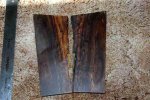
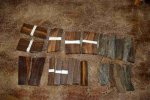
6 hours or so later, the log is cut!

I was surprised st how much usable material was actually in there, most of the checking was in the outer edge of the log and didn't go very deep.
 

Attachments

  • IMGP4826.jpg
    IMGP4826.jpg
    93.2 KB · Views: 163
  • IMGP4830.jpg
    IMGP4830.jpg
    85.1 KB · Views: 182
Looks great! Was that all you got from the log? John

The single set of scales in the first pic was sanded to 600 gr. to get an idea of the figure and measures approx 7 1/2 x 4 1/2x3/8". That set and the other 5 big bookmatched sets should yield between 2-3 sets of handle sized scales each + 2 smaller sets which will yield 1-2 handles each. I end up with 12-17 sets of scales + 3 blocks (approx 7x1 1/2x1 1/2"). The rough looking pieces on the right side are the off-cuts. Those will yield some folder sized pieces and smaller pieces for inlay or accents on future products.

Nathan
 
Back
Top