- Joined
- Mar 19, 2007
- Messages
- 7,443
After trying to make a fire using heart wood and taking a VERY long time - I wanted to try to make fire with the least amount of tools and in the shortest amount of time (within reason). I used only a SAK Farmer (my EDC) and a chunk of 550 cord.
Here are two branches that I broke a Mexican Sycamore (Platanus Hispanica), the same tree I used for the heart wood experiment.

Here you can see a perfect set of branches for making a bow drill fire. A bent branch (sectioned to make a bow) - a straight portion of the same branch (straight to make a spindle, a wider older branch to make the top bearing and the hearth.
NOTE: It is easier to find a harder piece of wood or a shell or a properly hollowed rock for a top bearing. It simply provides less friction.
I used a round piece of the large branch with a hole drilled into the middle to use as a top bearing. I lubricated the tip of the the spindle with some grease from the side of my nose.
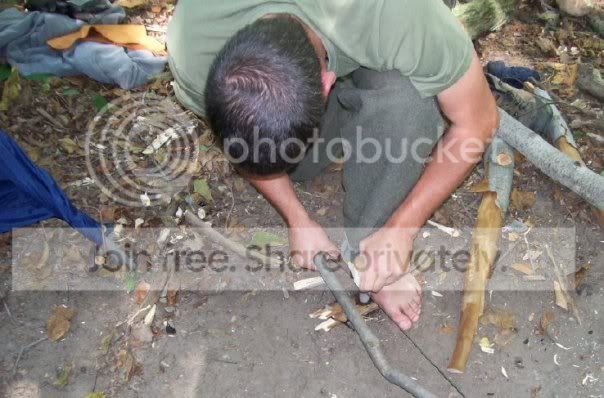
I also cut a section of the branch that was bent for the bow. I simply notched the top and bottom and tied on the 550 cord using two half hitches per knot.
With that said - I cut the spindle at above and below two knots. Knots are not only hard to cut - but are harder and make a more difficult to get dust from.

NOTE: It is important to get the longest spindle you can for these types of fire. Because the branch is smaller - speed is still easy - but a longer branch will produce less movement when your hand moves. Because the hearth is lighter and smaller - less movement will be less likely to move the smaller hearth and smaller coal.
After I cut the hearth and the spindle and flattened the hearth on both top and bottom.

Bottom:

This not only allows for a place to drill - but also flattens the bottom in order to make a stable hearth. It will lie flat - but you do not need to totally flatten the bottom. Simply make it stable - and save your time and energy for making the fire.

All that is needed in a hearth branch is that it is about double the width of the spindle. As seen here.
Note here - I did not trim the spindle much. I simply trimmed off the bark and made for a more octagonal surface to grip the 550 cord. However, I did not take much off to keep as much surface on the spindle as possible. Speed is important - but do not sacrifice width. You still need a lot of friction.

Note here that: 1) The bow is not to be in this position. I just took my hand off it and moved it out of the way to take the picture. 2) I trimmed the front edge of the hearth to make it square. This makes the V-notch easier IMO.

I scribed lines in a V (about 1/8th of a the 'pie') and then used my saw to cit it out. I cleaned that up with my blade.

Also note here that I cut off the tip of the spindle. This stops it from drilling too deep and makes the friction at the edge greater. The hearth will quickly adapt to this spindle geometry. With this thin of a hearth - you do not want to drill through the wood as much as make a coal.

To be continued...
Here are two branches that I broke a Mexican Sycamore (Platanus Hispanica), the same tree I used for the heart wood experiment.
Here you can see a perfect set of branches for making a bow drill fire. A bent branch (sectioned to make a bow) - a straight portion of the same branch (straight to make a spindle, a wider older branch to make the top bearing and the hearth.
NOTE: It is easier to find a harder piece of wood or a shell or a properly hollowed rock for a top bearing. It simply provides less friction.
I used a round piece of the large branch with a hole drilled into the middle to use as a top bearing. I lubricated the tip of the the spindle with some grease from the side of my nose.
I also cut a section of the branch that was bent for the bow. I simply notched the top and bottom and tied on the 550 cord using two half hitches per knot.
With that said - I cut the spindle at above and below two knots. Knots are not only hard to cut - but are harder and make a more difficult to get dust from.
NOTE: It is important to get the longest spindle you can for these types of fire. Because the branch is smaller - speed is still easy - but a longer branch will produce less movement when your hand moves. Because the hearth is lighter and smaller - less movement will be less likely to move the smaller hearth and smaller coal.
After I cut the hearth and the spindle and flattened the hearth on both top and bottom.
Bottom:
This not only allows for a place to drill - but also flattens the bottom in order to make a stable hearth. It will lie flat - but you do not need to totally flatten the bottom. Simply make it stable - and save your time and energy for making the fire.
All that is needed in a hearth branch is that it is about double the width of the spindle. As seen here.
Note here - I did not trim the spindle much. I simply trimmed off the bark and made for a more octagonal surface to grip the 550 cord. However, I did not take much off to keep as much surface on the spindle as possible. Speed is important - but do not sacrifice width. You still need a lot of friction.
Note here that: 1) The bow is not to be in this position. I just took my hand off it and moved it out of the way to take the picture. 2) I trimmed the front edge of the hearth to make it square. This makes the V-notch easier IMO.
I scribed lines in a V (about 1/8th of a the 'pie') and then used my saw to cit it out. I cleaned that up with my blade.
Also note here that I cut off the tip of the spindle. This stops it from drilling too deep and makes the friction at the edge greater. The hearth will quickly adapt to this spindle geometry. With this thin of a hearth - you do not want to drill through the wood as much as make a coal.
To be continued...