Bowies

cziv, the scratches must've been really deep on that blade, which means that most of the work must be done with the low number grits till those scratches are gone... if you want perfection.
For a user, I think you did fine.
You can see the scotchbright scratch pattern and pits on mine as well, but not so much in the photos.
 
cziv, the scratches must've been really deep on that blade, which means that most of the work must be done with the low number grits till those scratches are gone... if you want perfection.
For a user, I think you did fine.
You can see the scotchbright scratch pattern and pits on mine as well, but not so much in the photos.

That's what I was thinking. I have ALL of the pads that Scotchbrite makes. The most coarse ones will take the edge off a blade in a couple of strokes. Unbelievably coarse.

I figured to get it nicer I'd have to go down to the "next to last" in coarseness and get everything cleanly going one direction. Then, like sharpening, come up through all of the pads getting lighter in pressure and doing more repetitions until I hit the softest white pad.

The white is just a bit coarser than my oily 220 (or 230) sandpaper which I would then use next & continue to use lighter sandpapers up to the 600 which is the highest I have. It's baby fine but maybe I'll need to get some 800 too.

Does that sound like a plan? Also you told me in that other thread to only rub in one direction. Is it okay to speed up work time by sanding the same direction or line but pulling back and forth? Or, do you have to stroke down the blade, then pick up the paper and come back to the hilt for the next stroke? Thanks for the input. :thumbup:
 
yup, coarse to fine with most of the work being coarse until get the old scratches out.
One direction is a stroke down the blade, lift and repeat.

If you really want a good hand rubbed finish, sand paper is the way to go.
I would think that the sandpaper is much more consistent and controllable than the thick scotch bright pads.
This is not an easy or quick thing to do. That's why those knifemaker guys take such pride in (and charge for) a good hand rubbed finish.

The knife looks great as it is. You'll only use it and get it all stained and sappy anyway :)
 
How 'bout a folding bowie?

htm01.jpg
 
yup, coarse to fine with most of the work being coarse until get the old scratches out.
One direction is a stroke down the blade, lift and repeat.

If you really want a good hand rubbed finish, sand paper is the way to go.
I would think that the sandpaper is much more consistent and controllable than the thick scotch bright pads.
This is not an easy or quick thing to do. That's why those knifemaker guys take such pride in (and charge for) a good hand rubbed finish.

The knife looks great as it is. You'll only use it and get it all stained and sappy anyway :)

Thanks, I spent 4 hours on it yesterday and finally have everything going in one direction and rubbed up to a 600 grit sand paper. My problem was getting the deep up & down patterns from the coarse scotchbrite pads covered up. :yawn:

I'm going to the hardware or NAPA and getting some fresh 600, 800 & 1000 grit sandpaper to finish the blade soon. as my stuff is all worn out. Is 1000 grit high enough to rub it out to or what? :confused:

You mentioned that you didn't use any power tools on your Western W-49. I want to duplicate your handguard which is off the hook for that knife. :thumbup:

How did you cut the long hooks off the hilt and then shape them so nicely w/o any power tools? It looks so much better with the rub going all in one direction. I'm taking today off. Thanks for the help, it's a good project. :)
 
My pleasure cz.
1000 grit will be a nice finish.
1500 and then 2000 will approach mirror finish.
The higher the grits, the less use you get out of a sheet of sandpaper.
I know a guy who does his final (after the 2000 grit) polish with notebook paper :)
He also uses windex instead of oil for the finest grits.

Be careful when you lay down the sanding block at the start of each stroke, you don't want to get little 'J's or fish hook scratches around the base of the blade.

The guard was way easier than than finishing the blade.
Hack saw to take off the ends (trim a tiny bit larger cuz you can't put any back).
Square up the ends with a single cut mill bastard file.
Then file the point off each corner (at a 45º angle) so that you have 3 even facets.
File the remaining 4 points down to make make almost a half circle.
Even out the bumps and you are ready to sand it smooth.
Do cover the blade & handle with cardboard and tape in case you slip with the file.

As always take great care any time you have a knife in a vice.
Remove the knife from the vice when you walk away.


Take your time & go slow.
Enjoy the process & the results will come.

 
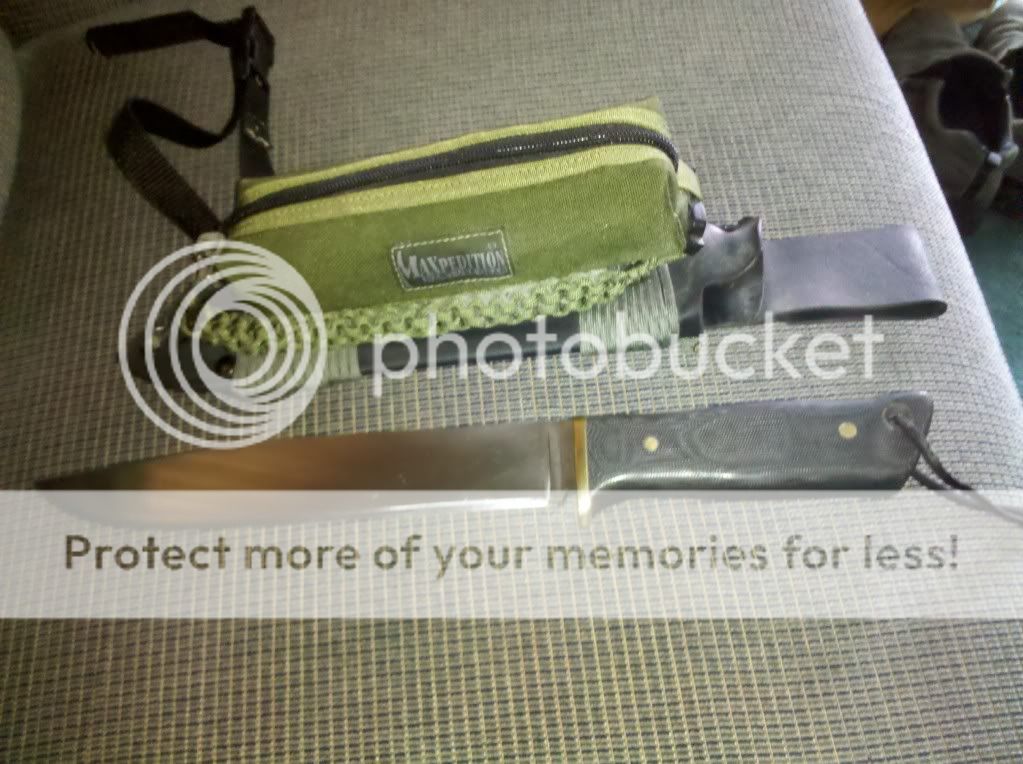
Here is a pic of my rehandled Trailmaster in G-10 along side its homemade kydex sheath...

IMG_20110502_163345.jpg
 
My pleasure cz.
1000 grit will be a nice finish.
1500 and then 2000 will approach mirror finish.
The higher the grits, the less use you get out of a sheet of sandpaper.
I know a guy who does his final (after the 2000 grit) polish with notebook paper :)
He also uses windex instead of oil for the finest grits.

Be careful when you lay down the sanding block at the start of each stroke, you don't want to get little 'J's or fish hook scratches around the base of the blade.

The guard was way easier than than finishing the blade.
Hack saw to take off the ends (trim a tiny bit larger cuz you can't put any back).
Square up the ends with a single cut mill bastard file.
Then file the point off each corner (at a 45º angle) so that you have 3 even facets.
File the remaining 4 points down to make make almost a half circle.
Even out the bumps and you are ready to sand it smooth.
Do cover the blade & handle with cardboard and tape in case you slip with the file.

As always take great care any time you have a knife in a vice.
Remove the knife from the vice when you walk away.


Take your time & go slow.
Enjoy the process & the results will come.

Thanks Ebbtide, your methods are excellent re: cutting of the hilt in stages like that :thumbup:

I have a problem that may not be able to be taken care of: right where my blade hits the hilt there's about a 1/16th to 1/8" of black spotty grundge that I can ony remove by going up and down across my rub pattern. Should I do that one tiny spot (on both sides) with the edge of some paper? It can't be reached in the hilt-to-tip rub pattern that I have now.

It probably won't show unless you're looking at it. It shows up real dark and I have to remove it somehow. Thought you might have a technique up your sleeve.

Thanks again! ;)
 
I like that K-19! I broke down and ordered a Laredo, thanks BryFry, the wife is actively hunting you now by the way. Any way I am looking to do some of the standard modifications, sharpen the clip point, Patina etc. I just have a Patina question. I have done the mustard on several of my blades but wanted to try something different this time. I am going to use the vinegar and spray bottle method for this one. How long do you let the vinegar stay on the blade once you spray it down? Then do you flip it over and do the other side or both at once?
 
I like that K-19! I broke down and ordered a Laredo, thanks BryFry, the wife is actively hunting you now by the way. Any way I am looking to do some of the standard modifications, sharpen the clip point, Patina etc. I just have a Patina question. I have done the mustard on several of my blades but wanted to try something different this time. I am going to use the vinegar and spray bottle method for this one. How long do you let the vinegar stay on the blade once you spray it down? Then do you flip it over and do the other side or both at once?

haha... just don't let your wife team up with mine, one accusing glare is enough!

For the patina, if you want actual pitting it's going to need to stay on for quite a while. I tried both vinegar and bleech. I believe I would spray on a coat in the pattern I wanted and leave it on for about 12 hours or more, then I would wipe it down and spray it again. Did this several times and got some pitting but not very deep.

It did give a nice dark color though, which I later added to with the gun blue. That was probably a good year or so ago, so I can't recall everything for sure, but I seem to remember trying one side at a time.

I have learned that if you do want some DEEP pitting try some PBC etchant, the kind they sell at Radio Shack. And if you only want the dark coloring, this liquid gun blue stuff works great.....

http://www.amazon.com/gp/product/B0..._m=ATVPDKIKX0DER&pf_rd_r=1YAQC16C494M2J2A32WZ
 
I will keep your location a secret. Thanks for your help, when it gets here I will get to work, I will keep bugging you while I work on it.
 
cz, got a photo of the spot?
Off the top of my head, I'd say take it off as best you can then revise/refine the scratch pattern back to what it should be.
Or leave it and come back to it after you scratch up the blade cutting stuff up.
:)

Customs?
:D
The flagship of the collection
RoseInBox.jpg


Rose_Sheath_inset.jpg


Rose_Book.jpg


Same knife maker that did the tutorials I linked to :D
 
BT97006,
Nice work, that is way above my skill level maybe one day. For now I will just attempt to sand the handle down and re shape it a bit for more grip. Any tips?
 
Back
Top