
-
The BladeForums.com 2024 Traditional Knife is available! Price is $250 ea (shipped within CONUS).
Order here: https://www.bladeforums.com/help/2024-traditional/
You are using an out of date browser. It may not display this or other websites correctly.
You should upgrade or use an alternative browser.
You should upgrade or use an alternative browser.
Boy's Knives
- Thread starter Codger_64
- Start date

- Joined
- Jan 31, 2012
- Messages
- 3,983
And here it is, a trademark used by the A. Kastor Bros in Germany 1886-1945. No writing on the metal handle but it looks to be painted, even on the bolster or fake bolster, I should say. Still has the original bail, very tight overall and retains all of it's snap in spite of being a little flattened/smashed at some point. Love that little shield shaped shield.

A friend of mine on another forum had this shot of what I believe to be the very same type of knife offered by Marshall Wells Hardware Co. catalog from 1912.

A friend of mine on another forum had this shot of what I believe to be the very same type of knife offered by Marshall Wells Hardware Co. catalog from 1912.
Last edited:

- Joined
- Oct 8, 2010
- Messages
- 8,340
Interesting history... I wasn't familiar with the "Boy's Knife" until I recently traded for this modern example:


Absolutely love it. I'm going to have to get more....


Absolutely love it. I'm going to have to get more....

- Joined
- Jan 17, 2011
- Messages
- 15,193
Very interesting thread. Just read through it. Thanks
- Joined
- Aug 24, 2010
- Messages
- 1,447
Here's one I just got off an auction the other day. ULSTER KNIFE CO. XL N.Y.
Great walk and talk but a little worn on the blade but it will still take an edge.

Thats a beautiful picture!
Thanks for sharing your very interesting metal handked knives. Would you please show a pic of the blade?
How long is the handle?
What does one weigh?
What are some of the different factors that make a boys knife, a boys knife, instead of a grandpas knife? Metal handle that wont break if dropped, blunt blade tip, barehead, teardrop handle, a bale and chain so it wont be misplaced...? And what makes Gecs short bolstered #15 Boysish?
Your Ulster looks a lot like this knife I think.
more info here on this knife
http://www.bladeforums.com/forums/showthread.php/1163058-Shapleigh-Diamond-Edge-pre-1920-Walden-made
I wonder who made these solid handled tear dropped, long pull knives, and what date ranges?


Last edited:

Codger_64
Moderator
- Joined
- Oct 8, 2004
- Messages
- 62,324
Thats a beautiful picture!
Thanks for sharing your very interesting metal handked knives. Would you please show a pic of the blade?
How long is the handle?
What does one weigh?
What are some of the different factors that make a boys knife, a boys knife, instead of a grandpas knife? Metal handle that wont break if dropped, blunt blade tip, barehead, teardrop handle, a bale and chain so it wont be misplaced...? And what makes Gecs short bolstered #15 Boysish?
"Attributes of the pattern"? Here is what I have noticed so far.
Pricepoint - Very inexpensive retail price befitting the target demographic... boys with limited income and parents introducing boys to knives not wanting to invest much in a first knife.
Handle - Usually painted stamped thin metal with some sort of decoration, sometimes but not always text, single bolster co-formed and often but not always polished.
Shackle - Sometimes, sometimes not. Same for the chain. When used, it generally is offset from the head pin rather than attached by it.
Pattern - Usually a barehead jack, one or two blades, Spear and sheepfoot being most common pocketblades, small pen being most common secondary when present.
Linings - Almost exclusively iron (steel)
Pins - Usually just three, pivot pin, spring pin and head pin, all iron (steel).
Source countries - Germany, England and U.S. With the first being most common, last being least common.
Timeline - Still undetermined at this time. Broadly speaking, 1890's thru late 1930's. The market seems to have been co-opted by Imperial and Colonial progressively from the mid-1930's until WWII. One can logicly assume that U.S. production came about largely due to the derth of the imported patterns during the 1915-1919 time period.
Here is an illustration from a 1924 jobber catalog showing that New York Knife made the pattern at that time domesticly under their own marks. Again, it is logical to assume that they also made them for jobbers with custom text and marks. I find no reference to the pattern in the Ulster archives, but the Divines may also have been a producer. Or they may likewise have had NYKC make them for them. Are both solid steel handles or thin shell?

Additionally, what do the experts such as Levine and Price et al have to say about the pattern? These are only my own observations and research continues.
ETA: A cut from a c. 1904 Supplee Hardware catalog showing a Walden Knife Co. boy's knife.

Last edited:
- Joined
- Aug 24, 2010
- Messages
- 1,447
ETA: A cut from a c. 1904 Supplee Hardware catalog showing a Walden Knife Co. boy's knife.

thanks for sharing all the great info Codger. Looks like the artiste drew the spring pivot on the pocket side of that Walden.. Funny stuff!
 Loving the Teardrop Handle shape. I note on your Camillus sheepfoot its backspring is mounted in Swayback orientation, the concave curve of the handle.

Codger_64
Moderator
- Joined
- Oct 8, 2004
- Messages
- 62,324
Well, we are still learning the production timeline for each design. The catalog appearances denote the availability in THAT YEAR, but don't tell us the number of years before or after that year. So far the latest I am seeing these patterns is 1941. But each pattern, while they fit in this genre, are individual to makers and time periods within the general timeframe. Of course when one has a knife with a tang mark only used for a brief few years, like Norvell Shapleigh, the individual knife's age is simple to bracket. I keep adding primary source catalogs, but filling in the catalog timeline blanks for individual jobbers is a slow process.
It's been awhile since a post in this thread, but I've learned a lot here, hope you don't mind my showing the knife I was doing research on.
It's pictured several times earlier in the thread, but since I just acquired this one I thought I would go ahead and post a photo here.
Cool knife, and as stated earlier surprisingly well made, with super strong half stop & closing snap, taking a hefty pull to open due to the beefy spring. Blade is still quite sharp, tight, and no wiggle at all. Blade appears to be SS, so I would assume it is of later production, but I have no idea when that would have been.
Thanks to all the earlier posters who provided all the historical info I now have on this knife.
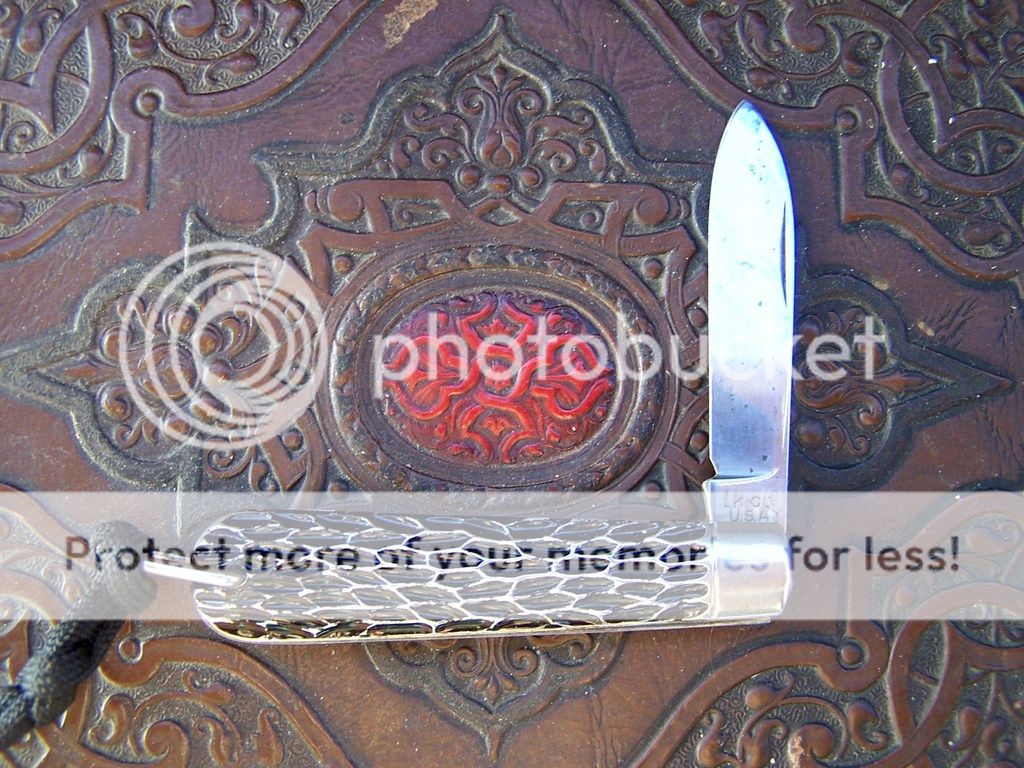
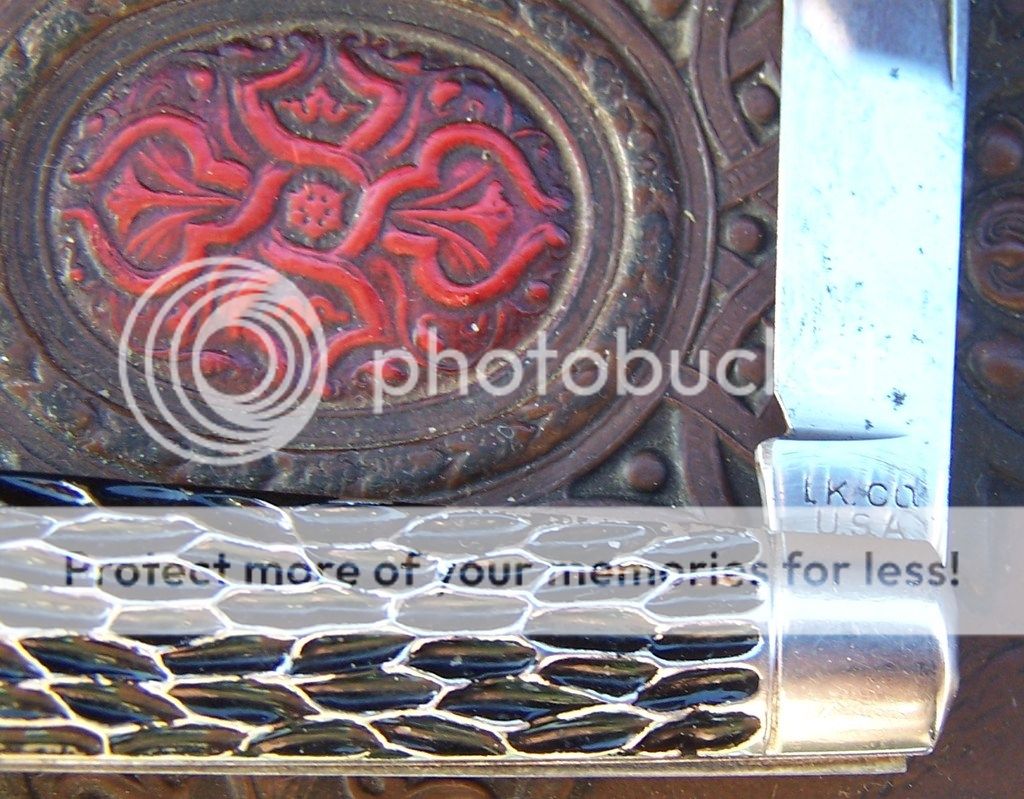
It's pictured several times earlier in the thread, but since I just acquired this one I thought I would go ahead and post a photo here.
Cool knife, and as stated earlier surprisingly well made, with super strong half stop & closing snap, taking a hefty pull to open due to the beefy spring. Blade is still quite sharp, tight, and no wiggle at all. Blade appears to be SS, so I would assume it is of later production, but I have no idea when that would have been.
Thanks to all the earlier posters who provided all the historical info I now have on this knife.


That's a great find! It's still pretty hard to find an old LK CO in decent condition. Well done!
Why thank you, I'm pleased with it.
It's been a good month, this is just the latest find, also found a New York Knife Co pre-1931 Hammer Brand pen knife in good condition this month, and a couple of other sharp treasures, (for cheap). This little jack knife cost me a little more than those, but still got a good deal on it. This one seems nearly indestructible, and is completely usable despite it's age. I put a paracord lanyard on it and will include it in my EDC rotation. I don't think there is much I could do to damage it, may as well use it.
. Blade appears to be SS, so I would assume it is of later production, but I have no idea when that would have been.
Ok, after going back and re-reading this thread I think I can date the knife via the tang stamp. As posted earlier, Imperial started using the Hammer Brand stamp after acquiring New York Knife Co, which I know folded in 1931. Apparently this stamp was being used only up to 1935, perhaps one of you more in the know than I can confirm that. I now suspect the blade to be carbon, (despite the mirror polish still evident), just well preserved. There are a few spots on the blade indicating to me it may not be SS, (knife gurus please confirm if possible).
Cool, snagged another good one!