Brass On Bowie Blade

Joined
Jun 13, 2006
Messages
202
This question is way above my skill level, but I've always been enamored with Bowies that have a brass strip. How is this done?

 
if you mean the brass on the back of the blade that was used to catch the other persons blade then you drill a couple of holes it the blade and then fold the brass over the back of the blade then insert brass pins and hammer the pins flat and sand the brass till the pins are flush and hidden then polish so evertyhing is blended so u cannot see the pins

lee
 
Or you can make it as a channel, and solder it on. Or you can make a cut out in the spine and braze it in. Or you can make a cut out in the spine as a long dovetail and solder it in.
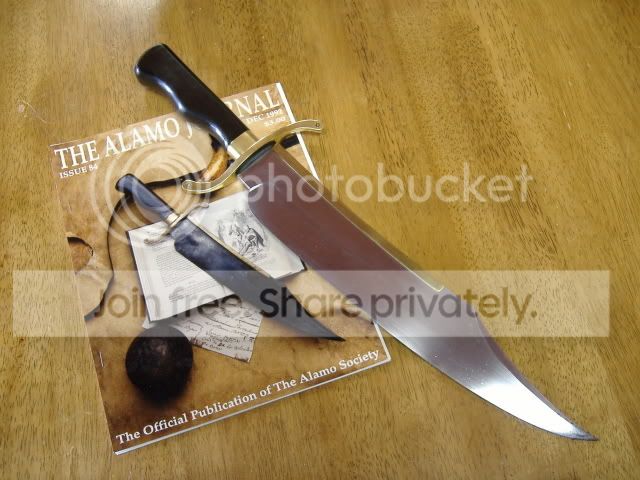
 
Or you can make it as a channel, and solder it on. Or you can make a cut out in the spine and braze it in. Or you can make a cut out in the spine as a long dovetail and solder it in.

all of these ways work very well also if the op has the skills to solder or braze i just do it the way they did it long ago 1830 era

lee
 
Hey guys, yes I meant the brass strip that was used to catch the other person's blade.
If you fold the brass over the spine, won't it be larger than the spine? If so, is it supposed to be wider than the spine width? Or, do you shave some off from each side of the spine and the top of the spine to accomidate for the brass thickness?
It would really be cool to do it the 1830 era way.
 
Here's a Musso I made. Mine is an exact copy, made from Joe Mussos blue print. However there is a problem with your statement that you do them as they were done in the 1830's. The problem is that there are no known documentable American knives with a brass strip on the spine from that time period. Bowies, or otherwise. As much as I think they look cool, and could have their uses, they just have not showed up on a documentable knife. Also, the Musso knife, and the Miller mate to it, had the strip soldered on, and neither of these knives can be unquestionably documented. I would like to believe in both of these, and they both have good believable stories behind them, but so far, cannot be proven beyond a shadow of a doubt as being authentic to that time.
pennyknife374_640x480.jpg
 
when i said that i make mine in the 1830 era style i meant is i make period and primitive style knives that are are done with hammer and peen not solder or brazeing

lee
 
Real bowie knives looked nothing like the Musso, and they didn't have brass backs-just so you know.
 
Real bowie knives looked nothing like the Musso, and they didn't have brass backs-just so you know.

You may be right, but that is just your very opinionated opinion. Acually it was not unknown for some of the 17th and 18th c. Scottish dirks to have the brass back, and Bowie was of Scottish descent, but I know of no American knives that have this feature that are irrefutably documentable, and just what is a "real" Bowie knife? The Carrigan types? The heavy bladed butchers that Rezin had made? The Searles knives? The spear pointed Bowies. All of these are real Bowie knives, and none look like the others. The most pure form of the real Bowie knife would be the heavy bladed butcher with no guard, and slab grips on a full tang. The next in line would be the Carrigan style knives, and the Searles, but there is no one type of design for Bowie Knives. What features of the Musso/Miller knives, other than the brass back, can not be found on others of the 1830's, and 1840's? I would find it no great stretch in placing them in that period, but I would like to see more research and testing done on both, rather than just going on the opinions of self proclaimed historical experts, of which some have been proven quite wrong in the past.
 
Wick,

I was thinking about the Musso the other day and wondering, wasn't it the musso style that was used in the movie The Iron Mistress ? And hence the popularity and widespread belief that this style is "THE" bowie when in fact Jim's original would have been more of a butcher style just as you said.

So where does Musso the knifemaker come into play ? I haven't done any research on the subject just curious.

Always good to see you sharing your expertise in this area.

Josh
 
Hi Josh. The Iron Mistress and the Musso are markedly different. It was the Iron Mistress that spurred a renewed interest in Bowies during the fifties, after the movie was released, I believe in 1952. In the sixties, and seventies this interest went ballistic with many makers doing their version of it. Joe Musso bought his knife in the mid, or late seventies, and made it public in the early eighties, after having testing done on it by White Laboratories, and another testing firm. The test results sound good on the surface, but in reallity, are a bit inconclusive. Joe would not allow any wood removal for carbon dating, and I doubt that would show more than the age of the tree anyway. Today there are new ways for testing, even steel can be dated, and the patina that may be on it, but Joe has not had this done. As of yet. If the opportunity arises, "THE IRON MISTRESS" is a very entertaining movie, in color, covering Jim Bowies early years mixed in both fact and legend. This movie also stirred interest in what today is called an Arkansas toothpick. The movie toothpick is a long V dagger type knife, with maybe a 12" blade, and the weapon of choice for the movies major villain.
 
Back
Top