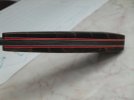
Brighter red for liner?

Joined
Jun 17, 2010
Messages
1,054
I've switched from vulcanized liner material to G10, but ran into an issue. The red is slightly translucent and loses much of its brightness and "pop" when put between dark materials. Any ideas for what I can use instead? I'm not unhappy with this on the knife shown, I knew when I put it together what it would look like, but my original intent when buying the red was for a bright red, like you get with the vulcanized material.

Obviously the problem is that G10 is actually slightly translucent in many colors, particularly at this thickness. I actually take advantage of that with the Ghost Jade Green material by putting a white liner behind it to really brighten it up and make it very responsive to the light hitting it.

jameslycaon23.JPG

Weird, I hadn't noticed it till just now, but with how the light hits it you can see the glue line. In person it's essentially invisible.
 
Personally, I like the subdued red on that one! Could it be sandwiched with a thin foil or even paper to get more light to the red?
 
You'd see it, and I'm not sure it would make a difference since the only way in for light is the edge. Just not enough surface to really help. I agree that the subdued red looks good in this situation, but it made it very clear that if I want a bright red I need to figure out another option, the minute I sandwiched the red g10 between two solid objects it went dull.
 
This is a good question, I too have been looking for a truly RED liner material that doesn't swell/shrink etc. Off the top of my noggin, it might work to use a brighter material behind the G10... in this case, a white liner that's 1/16" shy of the tang all the way around, with a red liner cut to fit around it and fit the final tang shape. Just thinking out loud, I haven't tried it yet.
 
Maybe, James. I'll have to figure out a practical way to test it without doing the whole process. I don't have any more of the materials on hand right now but have an order almost ready so once that comes in I'll see how that works.

It's weird, because the white is fairly solid, so is pink. Blue and yellow look like they are in the photographs... but red and the jade green are very translucent.
 
You could just look for some bright red plastic and cut it up into liner sized pieces. I don't think it really matters if it's as tough as G10, it's just a liner. As long as the glue won't "eat" it, as some plastics don't react well to some glues. Just an idea, I have not tried it.
 
I'm not promising anything, because I'm a bit swamped as it is... but I do have both red and white thin G10 on hand so maybe I'll get around to putting together a test piece between black micarta or G10 and see how it stands out. Did I say "maybe"? :p If anyone else feels like testing my goofy idea, please give it a try and let us know.

mgysgthath, you raise a good idea, and already identified the possible problems... not all plastics are the same. I've tried some that sort of melt when epoxy gets to them, and others that epoxy doesn't stick to at all. For an ongoing job, I need red liners that will stay stuck to removable micarta scales... so neither "melting" nor not-adhering is an option.

This is part of what makes custom work so much fun :)
 
I've seen a couple of knives made that had liners that used pieces from red plastic plates (I think Dixie makes some)...the liner material was ultra thin, but still worked for those particular knives.
 
I have some red and black g10 that I cannot get to show hardly any contrast either. it looks all black. I guess G10 is just that way.
 
I think it depends on the dyes used in the resin and the color of the glass material to start with. I think with certain colors both parts are colored and you get an almost solid color with little light transmission. When they only color one of them it isn't quite opaque and in thin layers it's just like looking through a colored filter.

I could be very wrong. I haven't looked into the details about how they make G10 in different colors, but that's my uneducated guess right now.

Good to know that the blue looks solid. That's one I'd like to use in the future. In fact, I just put some in my shopping cart for the order I'm making later today.

I've used the pink and it's opaque and retains it's color nicely. It's just not one I can see myself using a lot of.
 
The spine is dark because the metal got acid blackened. It's very smooth, that whole area was brought to 600 and then a bit more at 800 but I doubt I got ALL the 600 grit scratches out. It also got buffed slightly in the process of finishing the handles in general, no change. Basically, it looked that shade once up against the black micarta, and no finishing work changed it. I knew that going in, so I wasn't really trying to sand/polish it brighter. The texture somewhat visible in the pic is the linen in the micarta, then the streaking on the steel caused by how I applied the acid finish. It doesn't leave a perfectly smooth appearance. Sometimes I even daub it on to get more of a textured look. I haven't tried the paper towel trick yet but I'm thinking about it on a kitchen knife I plan to make soon for myself.

I didn't think my non "perfect" acid finish would be as popular as it is. I first started messing with it as an aged patina effect and it just went from there.

GTH11, what kind of material is that? Where would I find some?
 
I've never tried to add color to epoxy but what if you made some homemade "mycarta" with highly colored epoxy and brilliant red paper?

I wonder if the vulcanized liner material could be stabilized with the same process and resin that is used on wood to overcome its shortcomings?

- Paul Meske
 
Paul, that sounds like wayyyyy too much work. lol.
The home made micarta would be an idea, but I would have to make a fair bit at a time and cut it down, something I'm not really setup to do. Making even strips that thin requires far more precise equipment than I have access to.

Stabilizing the vulcanized stuff would be along the same lines as treating it with CA along the edge after putting it all together, just more complete a job. I'll leave the actual process to the guys familiar and equipped for it, but it's definitely a thought. I'm wondering if there's another way to get a similar result that wouldn't create problems when working with it. Something more practical for someone not equipped to do a traditional stabilizing process. Maybe a dip and wipe in a slow cure resin? Cover it in the resin for a certain amount of time, then remove and wipe off the excess, maybe squeegee slightly, then hang to dry. It's not like we need it to soak in very far, the material's pretty thin and the problem is that it's porous enough that it sucks up moisture so maybe it would easily get saturated with the resin.
 
Heres a pic of some white red white name tag stock, used next to some damascus. This knife is one of my personals, so excuse the dirtyness! Greg
 

Attachments

  • knives 313.jpg
    knives 313.jpg
    27.9 KB · Views: 100
Heres a pic of some white red white name tag stock, used next to some damascus. This knife is one of my personals, so excuse the dirtyness! Greg

Greg, that red does indeed pop! Those liners look great, I should try that stuff sometime.

Thanks for the pic.
 
Back
Top