brine tips and hints

Bailey Knives

Knifemaker / Craftsman / Service Provider
Joined
Oct 18, 2004
Messages
3,818
First of all, I am aware that I am tempting the *tink* fairy, but I really want to see all the wisps and activity in a hamon that W2 can bring, and I know that brine is the way to do it.

I did a search, and looked around a bit. According to Bladsmith, I should be using about 3.5 pounds per 5 gallons for the best mix, so that is my plan. I have the knife forged and ground out of W2 and will run through the three normalization cycles to take as much stress out of the blade as possible. I have it ground out now at 80 grit, have rounded all the edges, and will have it ready to quench tomorrow.

I guess, what I am really asking is are there any tips that will improve my chances of success and keep the tink fairy away. Would an interrupted quench help? In brine first then oil? Whatever you think will make this a success would be appreciated. I am planning on tossing out a few blades while using this technique, but I would like to keep that number to a minimum. I have access to the best knife minds around, might as well use them:)

Thanks in advance.
 
Well I dont know if I should be respnding or not:D The "Tink" fairy jumped up and slapped me in the face just a couple of days ago:o
That said I generally have pretty decent luck with water..This is what I do...I make sure the knife has been normalized, sanded to 120 grit, no stress risers and I like to leave the edge a little thicker than normal..
When I use water I use rain water heated to about 120* with an interrupted quench like Howard Clark uses..Three in, two out and then back too cool..Bolt and run for dear life to the tempering oven :D
 
Last edited:
Sounds good, I plan on having the oven preheated and ready for the knife.
When you say "then back" do you mean back in until the knife is cool? How long is the "then back" stage?
 
Im sorry, then back into the water until cool enough to handle..
Also I meant two seconds out, then back..Ill edit that..
I hate to say it even with all those precautions you still may loose 25% of your blades..BUT its a great feeling when it goes right..
 
Im my humble exp it absolutly does..Even cooling and helps break up the vapor jacket..Remember, Im just a dirty ol' blacksmith and far from an expert. Even with all the precautions water is still far from a sure thing with steels like 1095,W2,W1 etc..
Im hoping one of the real experts will chime in and give some more advice..75/25 is about the best I can do with those steels and water(I may be overly generous at that)..
 
Here is a pretty detailed read on a brine martemper:

http://www.navaching.com/forge/heattreat.html

What's interesting is that the quench (especially for W2) is insanely fast. Dunk it in for half a second. Between the immediate quench and the martensite transformation start, you probably have a small window to try to correct major warpages if present.

I don't know much about it all myself to be honest. I emailed the guy a couple times and he seemed to know a bit about the subject.
 
I guess a lot of guys are working with W2 now that Aldo's producing such good stuff. So, I've been trying to decide if I want to send my blades out to Peters or another Ht house, or...buy some parks 50, or...try the brine quench method myself. I'll probably give it a shot with a small knife first, just to see how it goes.

Don, the link you posted was a good read, the guy is very strongely in favor of brine quench's, isn't he? But, I don't have any idea who the man is.

Matt, have you tried it yet? How'd it go?

Dave
 
OK, I did the brine quench tonight. I tried to do the 3 in, 2 out and then back in deal, but I am not sure I hit it just right. When I heard the extreme sizzle of putting the hot steel in brine, I got a little antsy and yanked the knife out after only about 2 seconds, only to realize what I did, and put it back in for another second or so. The knife was screaming hard, not even a decarb layer when I hit it with a file. The hamon did not seem to follow the clay at first glance. It is in the oven tempering right now so I will tell you more about the hamon later. Anyways, no *ping* yet and no major problems at this point, everything seemed to say straight. I normalized the knife 3 times with an oil quench in the middle. I rounded everything to reduce the chance of stress risers and think at this point all is good. I will keep you posted on the progress.
 
Congratulations!!! Even with that two seconds Im sure it got fll hardness..Brine is less than a second under I believe..The steel screams for mercy when it hits that brine dont it? What salt-water ratio did you use?
 
I used the ratio that was suggested in one of the posts I used. It was about a 8-9% ratio. I figured about 8.5 pounds per gallon (I know that is a bit off, I think it is like 8.3 pounds per gallon) but I did two gallons of warm water and about 1.3 pounds of salt. That should be right in the 8-9% range if my math is ok. 8.5*.8 is like 1.3 or somewhere in that area. I guess I could have used a calculator. Anyways, it sure quenched fast. I am really curious about how the hamon turns out.
 
Matt,

Did you get some sori? Curious how much of an upsweep you got. Also, did you heat your quenchent and what temp? Good Going!

Dave
 
I am not sure what a sori is, but I am not sori I did it....hahahahaha. Man, first thing I'm the morning and I am on fire!

I didn't get any noticeable upsweep, but the blade is not too long, maybe 4 1/2". I just used tap water in an old bucket, and when I got it I made sure it was warm. I actually stuck my needle thermometer in it and it was reading 90 degrees.
 
Matt, I'm really anxious to see the pics. I dont know if I could find the courage to try that W2 in brine... but If I do I'll follow your's and Kentucky's example

Jason
 
Waiting for Photos Matt and Kentucky of your success! I am planning on using water in the near future, keeping an eye on this thread.
 
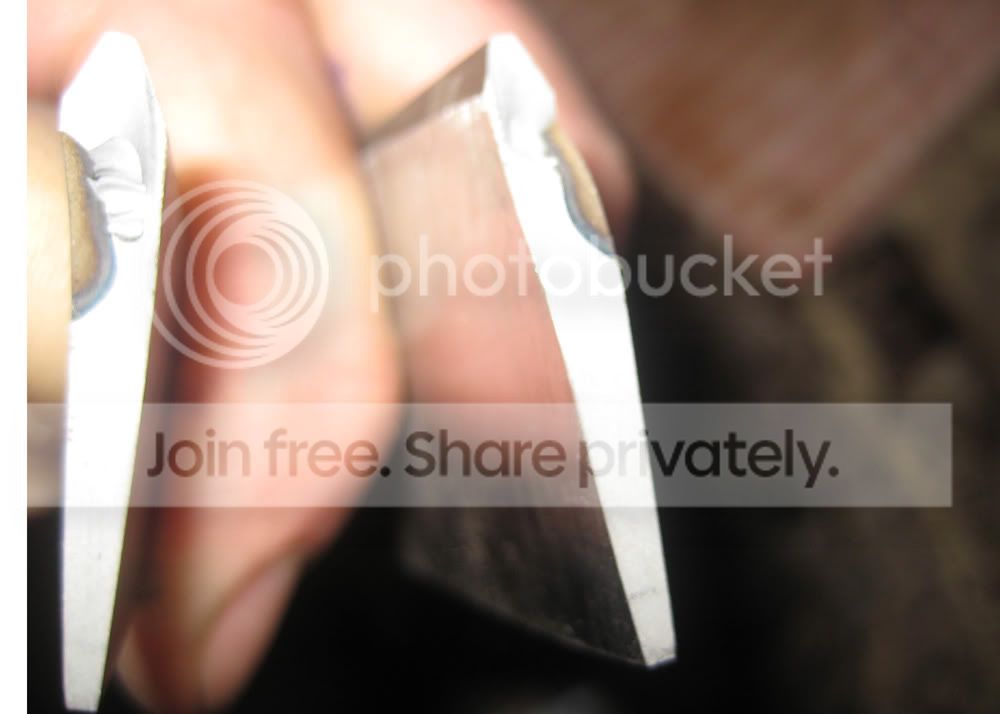
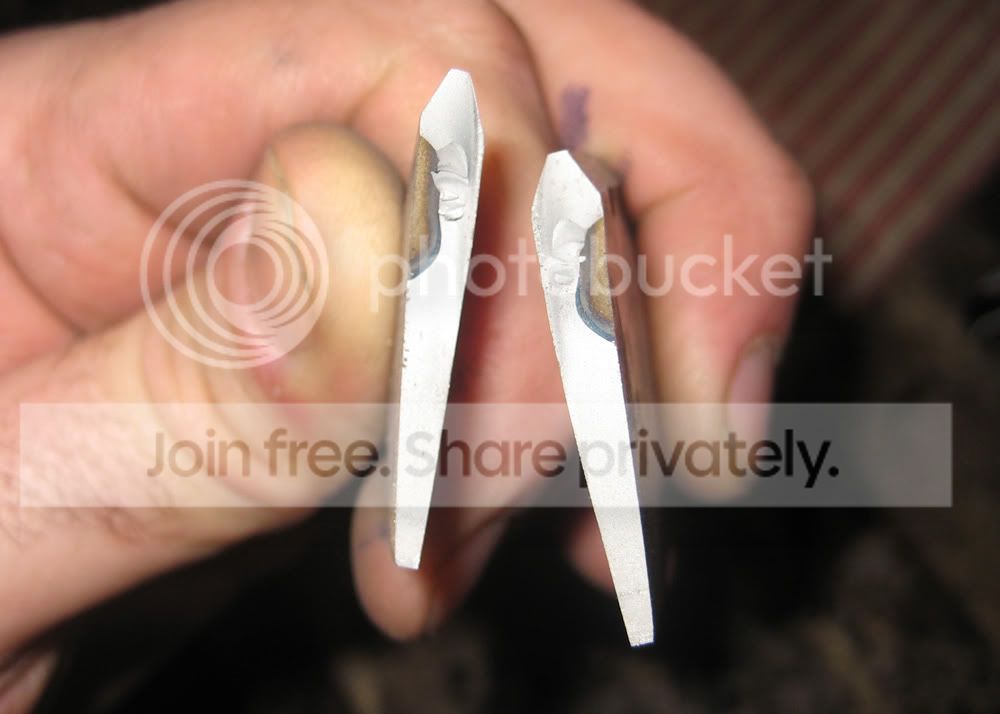
OK, I am kinda sori I did it now. I tempered it last night, and went to finish sand it this afternoon, but I noticed a small line that had tempered darker. I checked the other side and did not notice the matching mark. I looked at it more closely and thought it might be just an odd scratch, but when I went to sand it out...it stayed. It was wierd, it wasnt along the edge where I would have expected it, and it didn't go all the way through the steel, but when I put it in the vise, it snapped easily along that line. On a lighter note, the grain was as silky smooth as I have seen.

Here is a pic or two of the results.
IMG_2156.jpg


IMG_2155.jpg


I already have another ground out normalized and fitted to a guard, but I think I will stick to Park's for a while.

Might take a crack at that brine thing again someday soon.
 
Looks like a couple of really nice little Kiridashis to me! :D


Sux, though. Sorry bout yer blade. As much as I'd love to try and get all the extra activity, I believe I'll just stick to the Parks 50.
 
Perhaps someone could explain this failure to me? Why is there discoloration extending down into the blade, was this a flaw in the steel that was present before heat treat? Or was this failure caused by something else?
 
I am guessing that the crack occurred during the quench, and the colors inside are due to the tempering process.
 
Back
Top