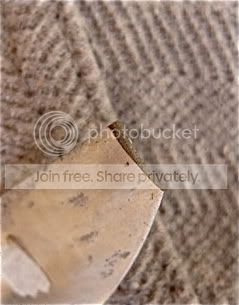
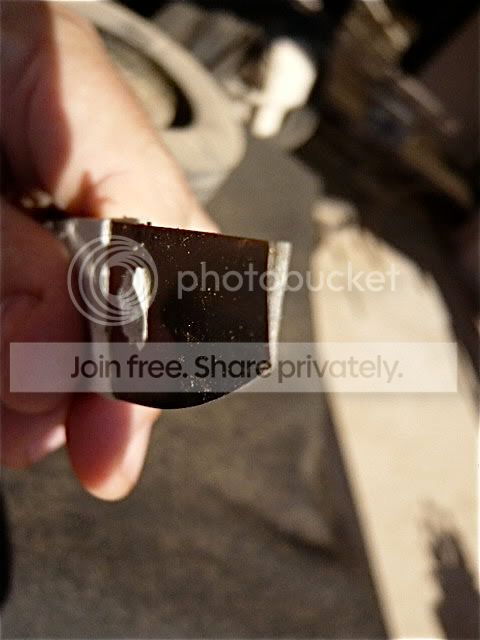
Broken blade...how does my grain look?

Joined
Sep 16, 2002
Messages
1,577
Unfortunately I managed to snap the tip off of this blade while trying to drive on the guard with a piece of hardwood and hammer. I'm pretty disappointed with this development, but I might as well try to get something out of it.

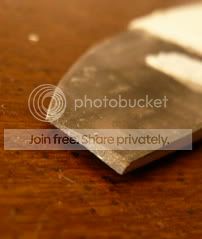
I know these pics aren't great, but they were the best I could seem to manage. If it's possible to do so from these pics, I'd appreciate some evaluation of how the grain looks. The steel is O-1, was forged by a friend of mine, and I heat treated it in my forge. For scale reference, it is approximately 5/16" wide and ~1/32" thick at the break point.

P1000773.jpg

P1000779.jpg

P1000755.jpg

P1000754.jpg
 
If you are not going to regrind the tip I would put in a vice and break it two more times, this way you can check uniformity and temper. It should bend and be really tough to break. I have to agree that it looks coarse but it is really hard to tell from the pics.

It also looks like there is some slight shading which would indicate there was a small crack. Could be light from the pic but if part of the break is discolored there was probably a crack to start with. You may want to soak in some vinagar before you make any more breaks to mark cracks, this way if there are any they will be stained.
 
ya it looks coarse to me as well. O1 should be a very smooth even gray color when broken. you should not be able to really see much grain growth. i also agree that it looks like you had a small quench fracture on the spine as indicated by the color difference.
 
That definately looks coarse. When I HT and snap my O1, the grain looks like a grey paste... so fine I can't even see the actual grain with my naked eye. It should be silky smooth. Bringing up to temp slowly, soaking a bit, and not letting it over heat will get you the grain you want.
 
Thanks guys for the feedback. I've since (at least I think I have) improved my HT methods by quenching at a lower temp and also using a forge muffle, which helps greatly with even controlled temperature of the entire blade. This one got hotter in the rather thin tip, and also was in the direct flame of the torch without the muffle in place. The grain frankly looks better than I thought it might and I think is exaggerated in apparent size a bit by the pics, but I can definitely see grain with my naked eye. I broke a file a looong time ago, and based upon my foggy memory this seems somewhat comparable to how that looked.

I think the crack theory is right now that I'm studying it further. The break is not straight across, but seems to be rounded from the surface of the bevel to the interior of the steel, and there was a little internal discoloration there. Also, I just noticed this in the spine near the break site:

P1000813.jpg


I don't recall this being there before quench, hard to describe and not showing up that well in the pic, but looks almost like overlapping layers or voids in the steel.
 
If it has been up to forging temps, it may need thermal cycling to refine the grain before your final heat. Remember, if you can't control the rate of cooling enough to guaranty pearlite (this is O1 after all) you might should aim for martensite, so the cycling would need to come all the way to room temp.

Also, if it has been annealed by leaving it to cool in the forge or in ash, being O1 you may have developed excessive grain boundary carbides. So your cycling may need to start fairly hot.

The cycling process has been described in several threads. O1 is capable of very fine grain.
 
Thanks for the info, Nathan; I'll read up on this and hopefully will get better results in the future.

If it has been up to forging temps, it may need thermal cycling to refine the grain before your final heat. Remember, if you can't control the rate of cooling enough to guaranty pearlite (this is O1 after all) you might should aim for martensite, so the cycling would need to come all the way to room temp.

Also, if it has been annealed by leaving it to cool in the forge or in ash, being O1 you may have developed excessive grain boundary carbides. So your cycling may need to start fairly hot.

The cycling process has been described in several threads. O1 is capable of very fine grain.
 
yep well done O1 will look milky grey in color and texture maybe milkshake texture


if the brake looks lumpy to the naked eye you can do better
 
Back
Top