I was wondering if anyone has any experience making bronze bladed tools. I've had some small experience doing art casting in college, and was considering the feasability of making a small folder made entirely of brass, brone and copper. I've been reading up on the BronzeAge methods, and it seems fairly straight forward, but i'd really like to know if anyone on the forums has any hands on experience making a decent edge with the stuff ?

-
The BladeForums.com 2024 Traditional Knife is available! Price is $250 ea (shipped within CONUS).
Order here: https://www.bladeforums.com/help/2024-traditional/
You are using an out of date browser. It may not display this or other websites correctly.
You should upgrade or use an alternative browser.
You should upgrade or use an alternative browser.
Bronze Blades?
- Thread starter SGP
- Start date
- Joined
- May 3, 2004
- Messages
- 979
I have made several bronze-bladed knives, I was able to put a shaving sharp edge on them, shaved hair no problem.
Thanks,
Del
Thanks,
Del
Thanks Del, good to know i'm not the only one playing with the stuff. Do you have any recommendations on what variety of bronze might work best? i've got a bucket full of scraps, mostly worn out bushings from semi trucks, and i'm not too sure of the exact alloys (silicon?), but if there's something else that might work better i'm all ears. This will probably be a cast blade with a work-hardened edge, so would alloying it with some extra bits during the melt be possible?
- Joined
- Dec 20, 2008
- Messages
- 1,937
I would think most bearing type bronze would be Aluminum but I'm sure the statue type bronze is Silicon though, I might be wrong so double check me on that!
Jason
Jason

Bill DeShivs
Knifemaker / Craftsman / Service Provider
- Joined
- Jun 6, 2000
- Messages
- 12,958
Casting may be OK for the blade blank, but you might want to do some cold forging at the edge to work-harden the bronze.

Nathan the Machinist
KnifeMaker / Machinist / Evil Genius
Moderator
Knifemaker / Craftsman / Service Provider
- Joined
- Feb 13, 2007
- Messages
- 19,510
Yeah, seriously. I don't let the beryllium stuff in the shop. Very bad stuff especially if you're grinding or sanding. People have gotten really sick and I think some have even died. Don't mess with it.
I wonder what the maximum hardness is for some of the hard stuff. I know some of the slide bearing stuff like 954 is a real pill to work with. It mills as if it were HRC mid 40s.
I wonder what the maximum hardness is for some of the hard stuff. I know some of the slide bearing stuff like 954 is a real pill to work with. It mills as if it were HRC mid 40s.

- Joined
- Dec 25, 2004
- Messages
- 1,363
I thought I may chime in cause I am somewhat "expert" on this subject as an neolithic and bronze age archaeologist. I have participated several excavations in Anatolia, dating from 8. millennium BC to Hellenistic period. Therefore I had a chance to investigate the methods of metallurgy in different periods first hand.
The first metal objects found are malachite (a copper ore), heated on wood fire and hammered to shape with stone hammers. They were usually for ornaments from neolithic age (10th to 8th mil. BC). This way people understood the difference of ordinary stone and metal. This lead to casting copper mostly from malachite ores in Chalcolithic (copper+stone) age. Anatolia was very rich for copper mines these times but some of copper frits were contaminated with arsenic. The early casters found that these ores with arsenic produced very strong and durable metals. This invention lead to the bronze age. The arsenic was not intentionally added to copper but it was thought that was a different metal. Arsenic bronze have diminished in use as tin bronze was introduced from Mesopotamia at 3rd and 2nd Mil. BC. This trade has empowered the Assyrian and Hittite empires. Tin was coming from southern Mesopotamia and Copper was coming from Southern Taurus Mountains and Cyprus. These developments have linked the empires of Hittite, Egypt and Assyrian Empires. The copper ingots were carried by large ships from Cyprus to the heart of Hittite empire. They were cast to weapons with the addition of tin from Assyria.
Casting was relatively simple method. Early times the molds were consisted from two slabs of soft stones. The inner parts of stones were carved negative images of weapons.
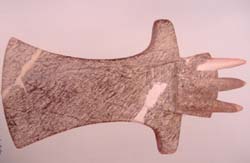
Here is an axe head, produced with two part mold method, from Sapinuva -an important imperial city at around 13th century BC.
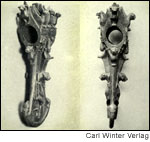
But the most intricate weapons with beautiful reliefs were cast with the "lost wax method".
Sorry for babbling, I wanted to share my knowledge on this subject...
The first metal objects found are malachite (a copper ore), heated on wood fire and hammered to shape with stone hammers. They were usually for ornaments from neolithic age (10th to 8th mil. BC). This way people understood the difference of ordinary stone and metal. This lead to casting copper mostly from malachite ores in Chalcolithic (copper+stone) age. Anatolia was very rich for copper mines these times but some of copper frits were contaminated with arsenic. The early casters found that these ores with arsenic produced very strong and durable metals. This invention lead to the bronze age. The arsenic was not intentionally added to copper but it was thought that was a different metal. Arsenic bronze have diminished in use as tin bronze was introduced from Mesopotamia at 3rd and 2nd Mil. BC. This trade has empowered the Assyrian and Hittite empires. Tin was coming from southern Mesopotamia and Copper was coming from Southern Taurus Mountains and Cyprus. These developments have linked the empires of Hittite, Egypt and Assyrian Empires. The copper ingots were carried by large ships from Cyprus to the heart of Hittite empire. They were cast to weapons with the addition of tin from Assyria.
Casting was relatively simple method. Early times the molds were consisted from two slabs of soft stones. The inner parts of stones were carved negative images of weapons.
Here is an axe head, produced with two part mold method, from Sapinuva -an important imperial city at around 13th century BC.
But the most intricate weapons with beautiful reliefs were cast with the "lost wax method".
Sorry for babbling, I wanted to share my knowledge on this subject...
Nathan the Machinist
KnifeMaker / Machinist / Evil Genius
Moderator
Knifemaker / Craftsman / Service Provider
- Joined
- Feb 13, 2007
- Messages
- 19,510
Cool stuff Emre.

- Joined
- Feb 28, 2006
- Messages
- 3,494
Cool stuff Emre.
Way cool, thanks!
Thanks for all the input guys, I think I'll be ordering some new stock to work with, at least for the blade and lock. Out of curiosity, are there any threads dealing with non-ferrous blades as a whole, flint, titanium, carbon fiber, ceramic, or any other interesting materials?

- Joined
- Oct 2, 2006
- Messages
- 3,238
I thought I may chime in cause I am somewhat "expert" on this subject as an neolithic and bronze age archaeologist. I have participated several excavations in Anatolia, dating from 8. millennium BC to Hellenistic period. Therefore I had a chance to investigate the methods of metallurgy in different periods first hand.
The first metal objects found are malachite (a copper ore), heated on wood fire and hammered to shape with stone hammers. They were usually for ornaments from neolithic age (10th to 8th mil. BC). This way people understood the difference of ordinary stone and metal. This lead to casting copper mostly from malachite ores in Chalcolithic (copper+stone) age. Anatolia was very rich for copper mines these times but some of copper frits were contaminated with arsenic. The early casters found that these ores with arsenic produced very strong and durable metals. This invention lead to the bronze age. The arsenic was not intentionally added to copper but it was thought that was a different metal. Arsenic bronze have diminished in use as tin bronze was introduced from Mesopotamia at 3rd and 2nd Mil. BC. This trade has empowered the Assyrian and Hittite empires. Tin was coming from southern Mesopotamia and Copper was coming from Southern Taurus Mountains and Cyprus. These developments have linked the empires of Hittite, Egypt and Assyrian Empires. The copper ingots were carried by large ships from Cyprus to the heart of Hittite empire. They were cast to weapons with the addition of tin from Assyria.
Casting was relatively simple method. Early times the molds were consisted from two slabs of soft stones. The inner parts of stones were carved negative images of weapons.
Here is an axe head, produced with two part mold method, from Sapinuva -an important imperial city at around 13th century BC.
But the most intricate weapons with beautiful reliefs were cast with the "lost wax method".
Sorry for babbling, I wanted to share my knowledge on this subject...
Emre, is any of your research published in a form that we could buy in the USA?
I am currently trying to reproduce early medieval bronze casting of buckles
-Page


jdm61
itinerant metal pounder
- Joined
- Aug 12, 2005
- Messages
- 47,357
Good info, guys. What I have read is that the addition of tin took a while to be worked out because. although copper was very common, tin was much more rare. Like the prefvious poster said, some of the tin was mined in what we would call the middle east today, but the people of Europe may have gotten the tin from as far away as Britain.
- Joined
- Dec 25, 2004
- Messages
- 1,363
Emre, is any of your research published in a form that we could buy in the USA?
I am currently trying to reproduce early medieval bronze casting of buckles
-Page
I found a good bibliography here online: http://dspace.dial.pipex.com/town/square/fe63/cat111.htm
But a simple DIY book with some detailed methodology would be essential for this kind of work IMO, like this: http://www.amazon.com/Lost-Wax-Casting-Old-Inexpensive-Methods/dp/0967960002/ref=pd_bbs_sr_1?ie=UTF8&s=books&qid=1236677502&sr=8-1
I actually don't have any info about medieval ages, however the process is fairly simple and straight forward. Any book on casting would benefit I guess. The most important issue is to make the artifact's mold. I guess the best method for this type of production would be using clay as mold material and casting lost wax. There are some details that does improve the casting quality. The location of air escape holes and letting the bubbles escape, preparing the mold, the cleanup process after casting.
jdm61 said:Good info, guys. What I have read is that the addition of tin took a while to be worked out because. although copper was very common, tin was much more rare. Like the prefvious poster said, some of the tin was mined in what we would call the middle east today, but the people of Europe may have gotten the tin from as far away as Britain.
The Bronze Age begins in Europe a couple of Millenniums later than middle-east also Europe didn't live the a long Chalcolithic period which lasted about 2 Millenniums in Anatolia, at this stage eastern cultures were finessing the metallurgy techniques(Europe Bronze age begins at around 2500BC, but Copper artifacts were used after 7700 BC in Asia). Therefore I guess they mostly learned the techniques and materials from middle eastern and Anatolian cultures. Tin maybe supplied by trade mostly from Cornwall, but also there were big deposits in Yugoslavian and Russian region, some of them discovered and mined at ancient times.

- Joined
- Jun 10, 2003
- Messages
- 15,288
On www.SwordForum.com in the Ancient Weapons Forum , Jeroen Zuiderwijk has been doing excellent work casting bronze !
- Joined
- Dec 25, 2004
- Messages
- 1,363
On www.SwordForum.com in the Ancient Weapons Forum , Jeroen Zuiderwijk has been doing excellent work casting bronze !
Wow, great site Mete, thanks. There are also very good articles...