Here are a couple youtube vids on forging "Brut De Forge" knives. Traditionally they have a flared integral finger guard forged in on them. Two guys off the top of my head who do them often and very well are Joe Keeslar and Lon Humphrey (who are in these vids). Another maker who I've seen some VERY cool ones made by is Karl B Andersen. :thumbup:
Joe Keeslar Forging Demo
[video=youtube;QT5c4-kGp-M]https://www.youtube.com/watch?v=QT5c4-kGp-M[/video]
Lon Humphrey Forging
[video=youtube;knGV4shZEmM]https://www.youtube.com/watch?v=knGV4shZEmM&index=55&list=PLRXwH4gb88trIMqQUiKSOsDPSMFEMAGs6[/video]
Here's an example of one of Karl Andersens' Brut de Forge knives... He makes same damn cool ones

[video=youtube;EDKJYzU0leQ]https://www.youtube.com/watch?v=EDKJYzU0leQ[/video]
.......................................................................
As for the brute de forge knives without the integral guard: Just as JPA88 showed, using a hammer to texture the flats of the blade helps give it that "rough forged" look. It also gives the scale/color from heat treating a place to stay in and not rub off too easily if it's only a thin oxide layer.
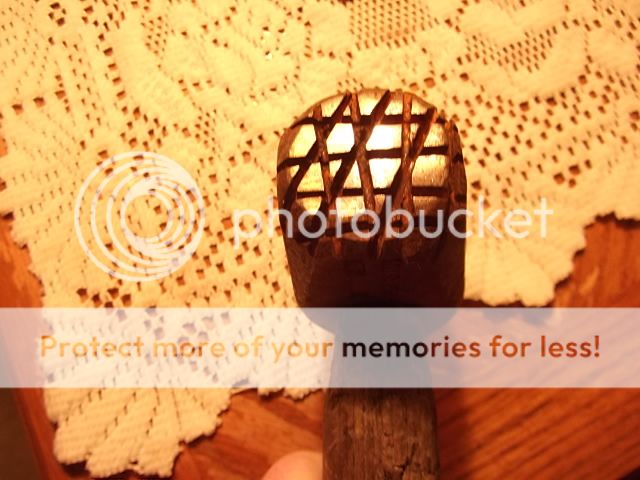
Here's a pic my texture hammer.. just use an angle grinder and cut a bunch of cross hatched type lines...
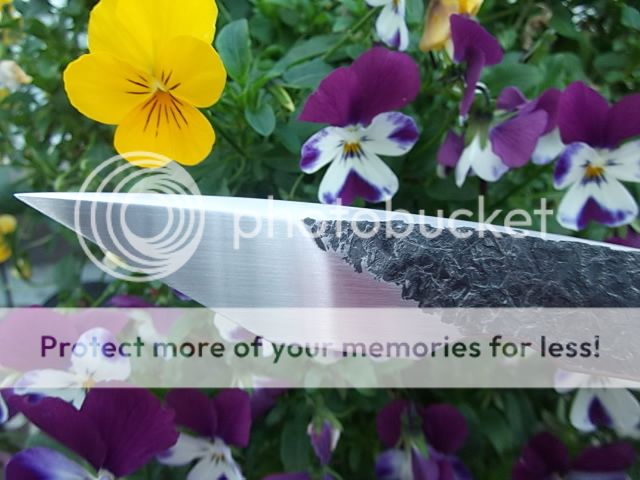
And here is the result of using it at forging temps after forging the profile just a bit, but not the bevel (It's a "chisel ground" kiridashi). (But you can do it at forging temp without forging to shape etc., just make sure to normalize and anneal the steel afterwards.)

And a close up of the texture next to the clean satin bevel... I love the effect.. It's like a crystal stone in the rough with one section cut flat and polished, like the ones they sell in those rock shops..

So yea, if you are doing only stock removal, after you have the general profile of the blade ground, either get it hot and hit it with the hammer, or do it while its cold and annealed. Grind your bevels after the texturing, and clean up only the bevel (not the flats) after heat treating it. I like doing it while at forging temp, after forging the blade profile , because you get a thicker layer of scale and just seems more "right."

Help all or any of this helps

~Paul
My YT Channel
Lsubslimed


