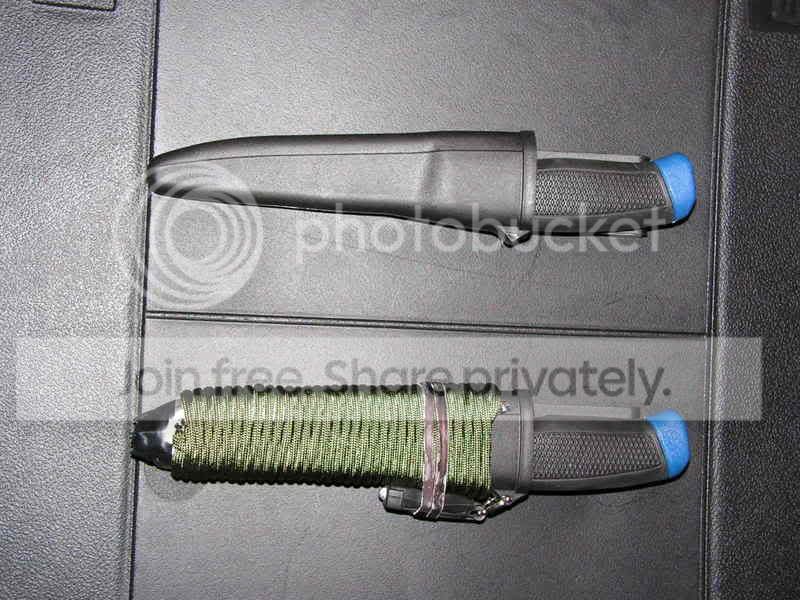
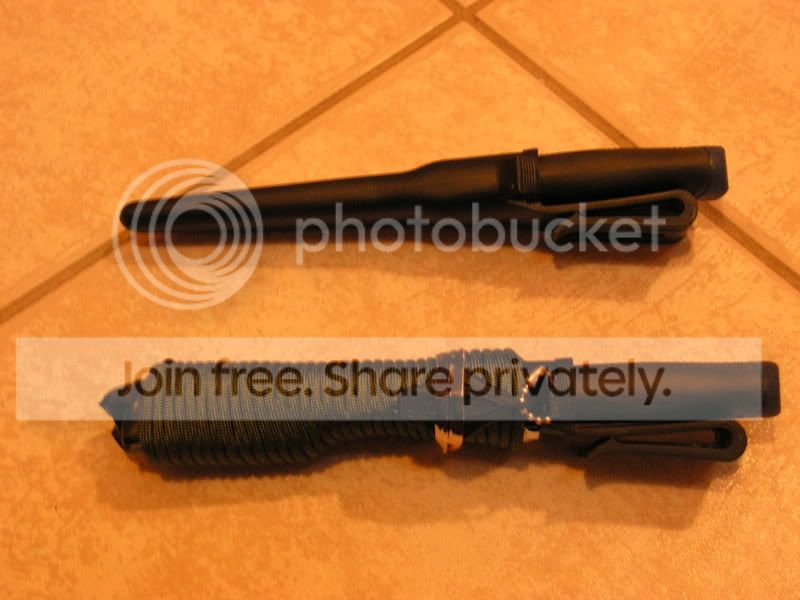
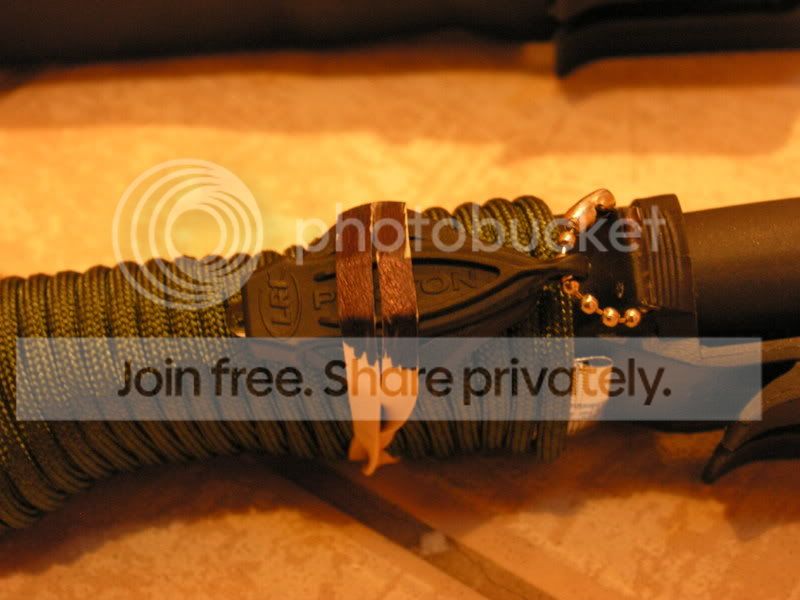
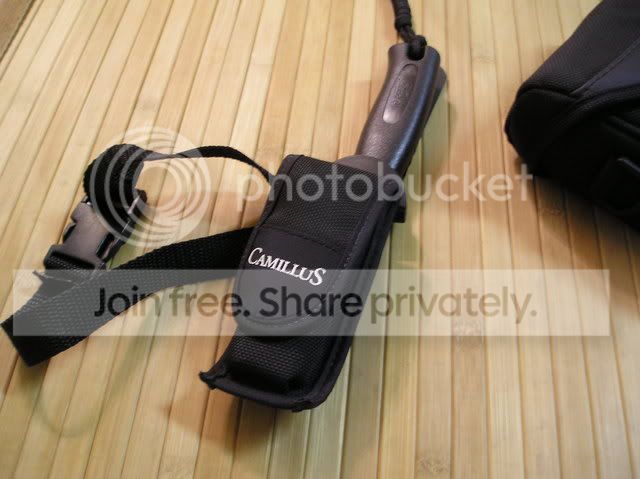
I've used the bike-tire-inner-tube-section thing instead of the duct tape, and find it works just great. I agree that the Clipper, in particular, has some retention issues (holding the knife into the scabbard). You might want to get creative about coming up with a means of holding it in more securely. One option might include drilling a lanyard hole toward the rear of the handle (no steel there), and threading something through that and the scabbard. If you had the Craftsman model (which is what SpookyPistolero has in his picture) instead of the Clipper, you'd find that the lanyard hole lines up perfectly with a hole in the belt tab of the scabbard, and you can thread a mini-carabiner through the lanyard hole and the scabbard hole and lock the knife in VERY firmly, until you actually need it, in which case you just remove the carabiner.
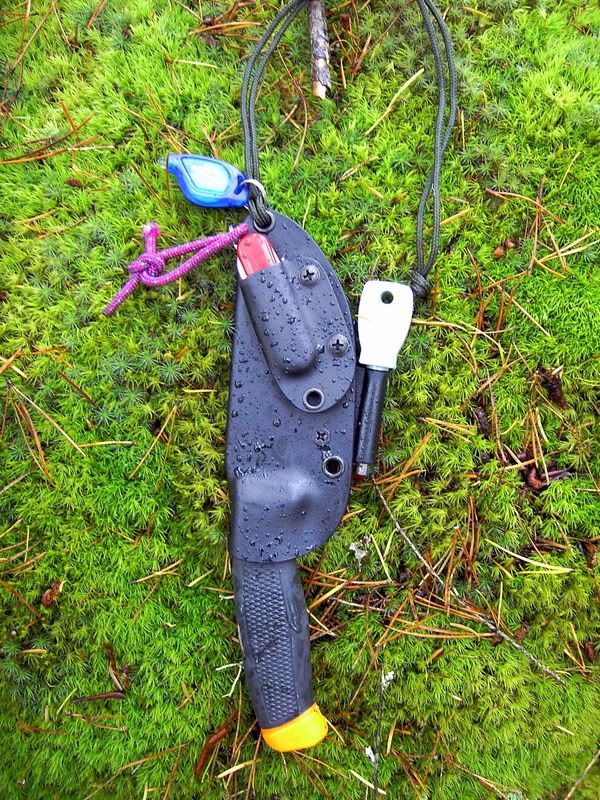
Personally, I'd leave out the prybar (I'd have other priorities for the weight and space that'd take up). For "carry-it-with-you-everywhere" purposes I love the Horseshoe Mountain firestarters better than the rectangular-slab kind, because the HM ones are about a quarter the size of the rectangular ones, but still come with enough magnesium to get you through weeks of wilderness survival. Before affixing the other stuff to the scabbard, you might think about masking-taping a few small fishhooks, maybe a couple of large sewing needles, and perhaps an X-Acto blade to the side of the scabbard, and then wrapping several yards of 60- or 80-pound-test BRAIDED fishing line around the lot, followed by another layer of masking tape. The tape is flimsy, easily removed, and just serves to hold everything in place while you wrap it up. This is a way of getting a great deal of tough, small-diameter cordage and a few useful little things like hooks into your kit, taking up almost no space. I like Fox 40 Micra whistles, too. If you include a compass, make sure it really works--some of the "button" compasses are so unreliable you'd be better off just navigating by sun and stars. (Anyone got a recommendation on a really-good, inexpensive "button" compass that actually works?) Water purification tabs might be a good idea. In a thread several months ago, a guy with a screen name like "Tiros" or "Tyros" posted a thread in which he'd pimped-up a mini-Bic lighter, taping needles and a blade to it, stretching an O-ring around it to keep the gas-release button from being pushed down accidentally, and other stuff like that. It might be worth adding a little lighter (with at least the O-ring addition) to your kit--which I think Lundin does.
If you're going to count on using a condom as a water container, as Lundin recommends, you might want to experiment beforehand and see if you can actually fill it with a significant amount of water--I hear it's hard to do.
A couple of firestraws, or fatwood sticks (best to round those off, to keep from cutting your inner tube) might be good.
Consider keeping the flashlight in a place that lets you have ready access to it without disassembling your whole kit.
Oh--one last thing: I am nervous about any survival-kit configuration that involves having a cord around my neck that has a higher breaking strength than my neck does. Survival situations are, by definition, chaotic and unpredictable. I figure that if there's any time in my life when I'm likely to be climbing out of a car window, jumping out of a building, climbing a tree, hanging upside down, crawling into a helicopter, squirming out of a submerged vehicle, etc., etc., it's most probably going to happen in a survival situation. When that is what's going on, I might really be glad not to have a pre-made noose around my neck to catch on whatever tree-branch or car-mirror and turn a chaotic situation into a fatal accident. Also, the neck rig allows the knife/kit to dangle at all kinds of unpredictable and dangerous angles if you happen to get upside-down or into an other-than-right-side-up position. What I prefer, then, is to make the cord a bit longer, and then deploy it over one shoulder and under the opposite arm. It can catch on stuff that way, but it won't strangle me or break my neck. The under-the-arm deployment means the knife is held in more or less one place. Might give those things a thought.
Have fun experimenting with building your kit! And if you come up with any new ideas, let us all know!



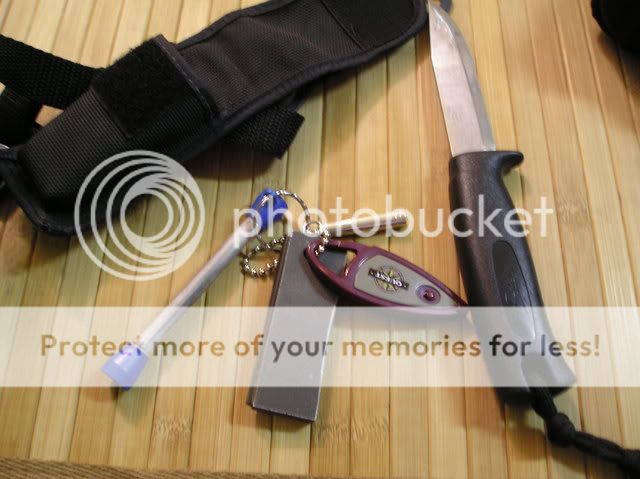



 :thumbup: