Building a work bench

Joined
Dec 30, 2011
Messages
24
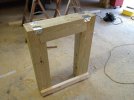
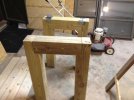
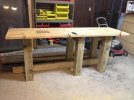
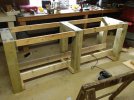
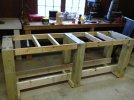
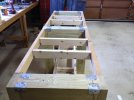
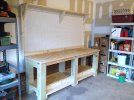
Dad and I are building my first work bench. It was supposed to be a simple design but we got a little carried away. After we cut the 6x6 legs we saw that there was several feet of scrap left over so we decided to make 6x6 braces. To make them work we had to notch out each leg and use brackets to fasten them into place. Most of the notch work we had to do by hand because our saws are not big enough to cut as deep as we needed. Also, the brackets I chose to use needed to be recessed into the wood to keep a level surface. For the table top we are using double stacked 3/4 inch plywood. This is as far as we could get this weekend. We still need to piece it all together and we are going to build a shelf underneath as well. I hope you like it.

bench 2.jpgbench 1.jpgbench 3.jpg
 
Last edited:
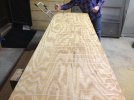
We used wood glue to put the two sheets of plywood together. We may also double up with finishing nails.

bench 4.jpg
 
That is a rather beefy bench. I would add a board or another 6x6 under the top between the legs, front and back. The way it looks now you could park a truck on it, but if you pushed on the end of the bench it would collapse.
 
Or an x bracing on the legs to cut the wiggle out.


Will the plywood sag like that ?
I would tend to put some sort of 2x4 framing under the top.
 
I'd go with a 2 X 6 frame underneath the top anchored to the legs. It would add a nice clean look and sure it up against any side to side or back to front movement.
 
He mentioned he was putting a shelf under the bench. X braces would be the strongest, but would get in the way of the shelf.

I suppose it depends on how you do that.


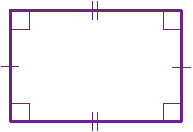
Right now the shape of the bench is a rectangle

quadrilateral-rectangle.gif


but there isn't much stopping it from becoming a parallelogram

para1.gif


I had in mind an X brace at the back of the bench where it goes against the wall and above the shelf
xbrace.jpg


I suppose that putting s shelf on the bottom could do the same thing,
,but it depends on how you do it.
 
A plywood back attached to the back of the legs and plywood end panels will give it a lot of stability. Bolting it to a wall is allways good.

Have you thought about a back-splash to keep things from falling off the back of the bench?
 
The plywood is not nailed down yet. In the pic the plywood is just lying across the legs while the glue sets. The legs are going to be evenly spread apart and if you look on the floor we still have several 2x6 boards we intend to use for bracing the legs. We are going to have to make some adjustments with the 2x6 braces because they take up so much room and leave us little room for a shelf. Instead we are thinking of using only two 2x6 long ways underneath the top and we split a 2x6 long ways down the middle to put on both sides of the bottom to support the shelf. What do you think??
 
i built bench just like that once, and the plywood edges always chipped/crumbled off. i added some 1"x1" trim around the outside to stop it.
 
JBS TOOLMAKER: lol Knives are on the way just let me get my bench built.

WOODWRKR221: No, doing a back splash never occurred to me. What kind of wood do you recommend for that? I planned on butting it up to framed pegboard that I was going to bolt to the wall. I will consider doing that. Thanks
 
A plywood sheet, screwed and glued to the back side of the legs will make that as solid as a rock. The bottom shelf will also help with stability. Adding a 2X4" piece of wood along the back side will make a good back-splash. It will also give you an easy way to bolt the table to the wall. If you think the table will be disassembled in the future for transport, don't glue the top,back plywood, or shelf in place - just use screws.

Adding and edge of hardwood ( oak) to the edges will make the table look and last better, but isn't absolutely necessary. If your dad has a table saw, here is the best way to make the edges really robust. Take a 2X4 piece of wood ( oak would be perfect, but even pine will work). Set the blade at slightly more than the table top thickness, and set the fence 1" from the blade. Cut the length of the board. Now change the the blade height and fence so it will intersect the cut you just made. Cut the board, thus making an "L" shape that fits the top so it forms an edge. If it fits right, clamp and glue it into place. A #10X3" screw placed about every 12" down the edge will also be a good idea, and look good. Once all of these edges are installed, sand or plane the slightly raised lip down to flush with the table top. Run a finishing plane down the edges at a 45° to "break" the sharp edges. The simple addition of such and edge can make a hobby bench into a craftsman's bench. It also makes your bench top look 3.5" thick.

Note: If making a bench with raised lips to keep things from rolling off, mount the "L" so the short leg is on the top side, thus making a 3/4-1" raised lip. Do this along the ends and back side, with a flush edge on the front side. Most craftsman's benches are made this way.

 
We got to work a little more on the workbench today. Dad had some handy Simpson ties sitting around that are made for 2x4s, so we used those to make braces for a more stable surface. We are going to put four more 2x4s in between those to reduce any sag from the plywood. We attached two 2x6 boards’ long ways to the bottom to brace and to support the shelf. All that’s left is to put in the shelf and to set on the table top. We want to do some kind of back splash and edging as recommended too. Before we can build anymore though, we have to transport it to my house while we can still lift it up to move it.

Thanks for all of your suggestions. I will be sure to post the final results soon.
workbench2.jpg
 
I've screwed a sacraficial layer of cheap and thin plywood om top of my workbenches.
This way I can abbuse my benches without wearing the actual bench down.
 
I've built a few benches and what I've learned is its not the mass of the bench but the placement of the braces that make it solid, as others have mentioned.

That sucker ought to be a nice one when your done. One thing I have done is have a piece of 14ga steel cut and broke to go over the front across the top and then a 90° break up in the back to give it a backsplash so little things don't get wedged between the bench and the wall. Its also a very durable work surface that I can tack weld things to, just cut the tack grind it smooth and it's like new again.

Kinda looks like a steel countertop.
 
I just built a bench out of 2x4s, 2x6s, and 1/2" OSB in layers.

Top ended up 3x8 feet by 3.5" thick and the thing probably weighs close to 500 lbs... haha
 
Back
Top