Bushcraft Knife = Scandi Grind? wtf...

Yep Leuku similar to the one in your pic. It is of Sandavik steel though as in stainless. I am tellin ya I bought it from Ragnar last year and took it with me camping in Penn. I also took a very cheap bowie that was razor sharp and of s.s. steel. Full flat grind and .250" at the spine. The Leuku I sharpened and it is litterally shaving sharp. Wedged everytime trying to split camp wood. Did a bit better chopping but not much. It is a straight grind right to the scandi edge, not flat tapered grind but straight down to the beginning of the edge.

Now I also use to have a UC Lainhart SEAL machete in ats34 with a similar edge maybe the primary grind was a bit higher but not much and that thing would split and chop as well as any knife I have ever owned. But it had a slight taper to the blade but not like a flat ground bowie. Less than my Leuku. Just going by what I have found in the tools I have used. I've done a ton of stump shooting way off the beaten track from sun up to sun down especially when I was "younger" and pretty much always used a big knife or small axe for digging arrows out of stumps. Ok that's all. keepem sharp
 
I'm still confused as to why people keep saying one specific grind type is better for one thing over another.
The overall thickness, length, and width of a blade can make a huge difference. A fillet knife and a log splitter are probably not compatible with each others jobs.
But beyond "deep hollow grind binds on stiff material" (even that usually isn't a big deal), the type of grind is virtually irrelevant.

Honestly I don't think I've ever been able to tell the difference between one grind or another in use. If the edge is too obtuse or too thin for a job, that I can tell.


(Warning! The following rant is not necessarily related to the topic at hand.)

And another thing...
ALL KNIVES ARE SHARPENED EXACTLY THE SAME WAY!!!
If you are trying to put a razor edge on the spine, that might take a while.:rolleyes:
Some knives are perfectly flat before the edge, some kind of curvy, some angled, most are a muddling of all thee above.
All of them are just a piece of metal that's really, really thin on one side.
Regardless of how you, or anyone else sharpens their knives, they are all adjusting the same aspects of the knife, and virtually any sharpening system can be used to achieve nearly any kind of edge.

Thanks for reading my little rant.
 
I think part of the issue is the difference between a bushcraft knife, or a knife useful for typical bushcraft tasks and a Bushcraft knife, which has come to represent a certain style of knife

This topic seems to have gone all kinds of squirely. The text quoted above sums it up. A cap "B" Bushcraft knife is a knife that looks early identical no matter who makes it. For examples see Koster's, Krein's, Spyderco's and just about every other maker here that makes a Bushcraft Knife. They are all the same shape, same size, same thickness, same grind and same steel.

It is all about context. ;):thumbup:
 
well, i spend a lot of time mucking around in the bush with a compound bow hunting pigs and other feral species.

i like to go camping. in fact, i often combine camping and bowhunting.

i'm trying not to take offence at your comment.

ah, here may be the rub.
bushcrafting is camping, but camping is not bushcrafting.

personally I think it's often a US-europe divide in views of what a "camp knife" should do. the US guys seem to go for larger designs that can chop better, but are not quite so good at the fine work. the european guys tend to go for a smaller knife, and rely more heavily on their axe for chopping duties.
since bushcraft very much has it's roots in europe, the european view on blades is seems to be the prevailing one. knives as you describe might better be termed "wilderness knives".
 
i chopped that quote out of another thread and i've seen a few other posts mention a similar attitude.

why does a "true" bushcraft knife have to be scandi ground?

no offence to SPXTrader, but i would never have thought to define a bushcraft knife simply by it's grind, but by it's overall design and functionality making it suitable for bushcraft use.

to my mind, a Fallkniven S1 or F1 (or even an A1) or a RAT RC-4 (or even an RC-6 for that matter) or similar knives would qualify as "bushcraft knives".

This topic seems to have gone all kinds of squirely. The text quoted above sums it up. A cap "B" Bushcraft knife is a knife that looks early identical no matter who makes it. For examples see Koster's, Krein's, Spyderco's and just about every other maker here that makes a Bushcraft Knife. They are all the same shape, same size, same thickness...

Thank you for clearing this up Spiral. Sambo, as Spiral mentioned a Bushcraft knife has a Scandi grind. Please look back at that thread, and look at all the pictures of Bushcraft knives. They all have Scandi grinds.

You can use any type of blade shape when in the bush or camping, but there is a distinct difference, and had you addressed your confusion in the thread you quoted me from, this mess wouldn't be here now. As for your "wtf" in the thread title, please don't confuse accurate information with "attitude", or others may be saying wtf about your posts. :cool:
 
Hopefully not to add confusion but some information.

After reading more on the subject I think that bushCarving might be a better term for such knives instead of bushcraft.

That's a good distinction because although they may excel in the carving realm they probably are not as versatile across the board as other styles.

Bushcraft knife, which has come to represent a certain style of knife .

A cap "B" Bushcraft knife is a knife that looks early identical no matter who makes it. ........ They are all the same shape, same size, same thickness, same grind and same steel.
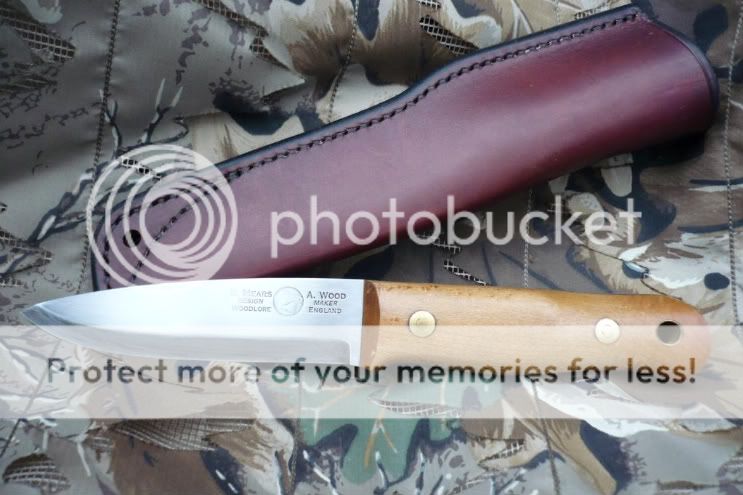
Agreed, a “Bushcraft Knife” has become known as a style of knife.


As far as I know the “style” evolved from this description and came to life with Alan Woods’ design marketed by Ray Mears as the Woodlore.

General Purpose Bush Knife

-Blade as long as the width of the palm
-Blade tip close to center line of the handle
-Back of handle and back of blade should be on the same line
-Back of blade should not be thinned or sharpened (able to baton/firesteel)
-Good carbon steel 2-2.5 mm thick (3/32) and 2-2.5 centimeters wide (about 1”)
-Steel soft enough for a shaving edge without frequent sharpening using common tools
-Blade should be full tang
-Handle should be durable, water resistant and if necessary can be shaped to user’s hand
-Pommel should be strong to protect handle when knife is driven tip first into wood
-Curvature of the cutting edge should extend full length of the blade
-Point should be sharp enough to penetrate deep into wood
-Knife handle should be about as long as the width of your palm
-Cross-section of the handle should be oval instead of round or rectangular
-A guard on a bush knife is in the way
-No breaking when driven 4 cm (1.5”) into a tree at right angle to grain and stood on**

Paraphrased from:
Kochanski, M. L. (1987). Bush Craft Outdoor Skills and Wilderness Survival. Canada: Lone Pine Publishing

**always a point of contention and ironically the next line is “First Aid for Knife Cuts”


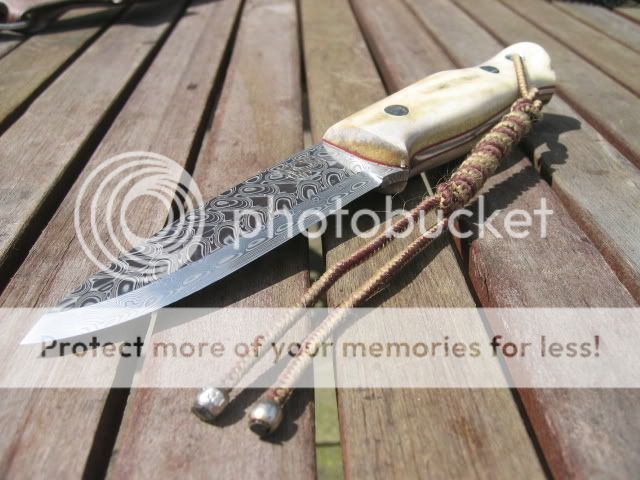
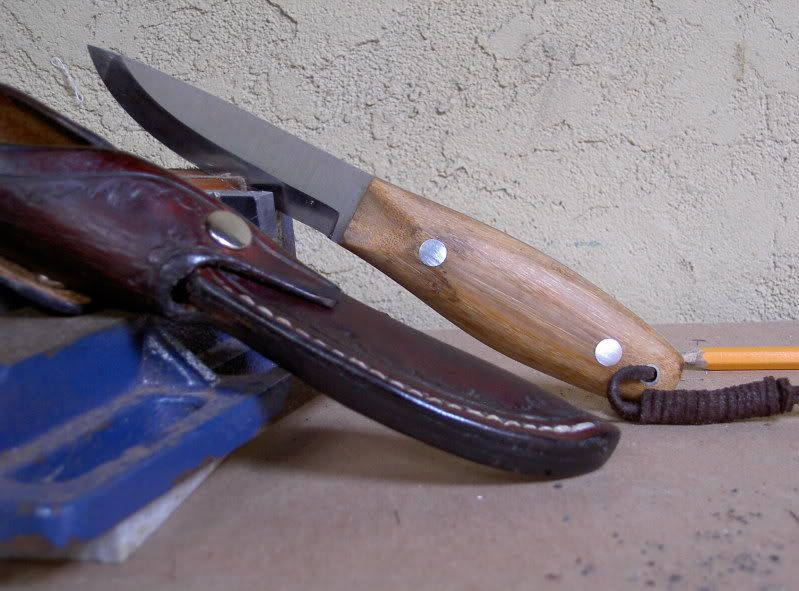
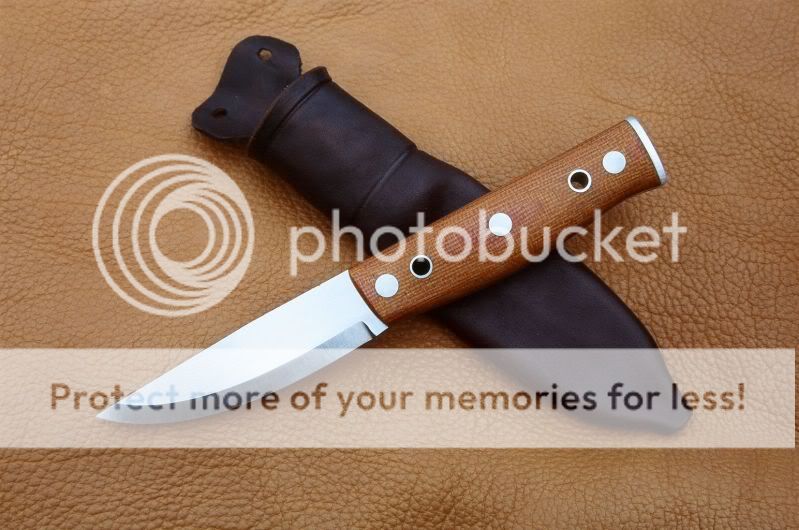
These are examples of “Bushcraft” Knives...certainly not the only knives for bushcraft activities.


Woodlore
allanWoodsbushcraft.jpg


BCNW-01
PICT1715.jpg


Skookum Bush Tool
skookumbushtool.jpg


damascusbushcraft.jpg


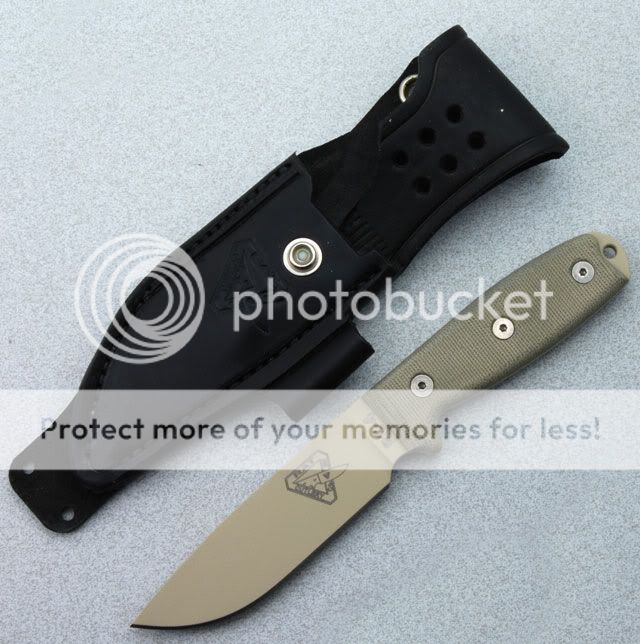
This one is not a “Bushcraft Knife” in style but perfectly capable of doing the same things.
rc-4esee.jpg


A comparison. A knife for bushcraft is not necessarily a “Bushcraft Knife” ...

IMG_0439.jpg


Here’s a good thread of pictures on another forum of bushcraft knives and only a portion are “Bushcraft Knives”.

http://www.britishblades.com/forums/showthread.php?40465-lets-see-your-bushcraft-knife.
 
Last edited:
As far as woodcarving is concerned, a scandi grind with a 20 degree inclusive will work better than a flat grind with a 40 degree inclusive edge bevel. But I have some very well done flat ground blades that have a 20 degree inclusive (and thin) edge bevel, as well as some with a thin convexed edge. They will outperform a scandi grind with the same angle because there is a lot less thickness behind the edge. If you are going to compare scandi grind with flat grind, make sure you are comparing the same final edge angle, otherwise you can't make a blanket statement that the scandi grind is superior to all flat grinds.
 
i chopped that quote out of another thread and i've seen a few other posts mention a similar attitude.

why does a "true" bushcraft knife have to be scandi ground?
It doesn't. The current "bushcraft" fad is about scandi's, but I've never warmed up to them. They are ok for a cheap knive, but my full flat ground knives outcut them by a large margin, whether it's in the woods or in the kitchen. YMMV. They are easy to sharpen, if a bit time consuming.

For woodworking, I'll take some of my stockman's or 2 bladed congress's over just about anything else.

I have gotten a second Spyderco Bushcraft, and I'm going to change it to full flat, and that way I'll be able to do a direct comparison between the two. Review coming... :D
 
I have taken a number of courses from this guy

Mors:Greg_Tuk.JPG


He has also been a house guest on occasion. I guess I'd blame much of the scandi grind thing on him. Students like myself show up with all manner of knives. We begin working heavy with wood making shelters, traps, kitchen implements, tools ect. The most stubborn take up to three days to be converted to the scandi-grind doctrine. In the end we all convert. The bevel locks into wood and acts like a guide when working wood. It's more accurate and easier to use on wood than any other. It also helps to see Mr. Kochasnki doing the impossible time after time with his 10.00 Mora. Very convincing. I was sold. Got rid of a lot of knives after the first course. Bought a few SBT's from a fellow Kochanski student Rod Garcia before he got noticed. Haven't bought a fixed blade since.

My guess is the leuku sticks when batoning because of it's thin blade not the grind. scandi's are fine batoners.
 
Considering the term itself: BushCRAFT, its about native, indigenous and traditional arts and skills that have allowed peoples and cultures not only to survive but to flourish within their immediate environments.

Although there had been many notable fellows who became seriously engrossed in learning these arts and skills, sometime ago, a wonderfully brilliant English chap (yes, Ray Mears) began to develop his own particular knife design as distilled from his personal knowledge and experiences. It was heavily influenced by the Nordic (Scandinavian) design which had a grind on the blade that specialized in shaping and processing wood. As many people admired him, this design caught on.

Personally, while I like his knife design, I tend to focus on his skills more, as he himself used the appropriate tool/knife that suited the occasion in whatever part of the world he was in.
 
Last edited:
ah, here may be the rub.
bushcrafting is camping, but camping is not bushcrafting.

personally I think it's often a US-europe divide in views of what a "camp knife" should do. the US guys seem to go for larger designs that can chop better, but are not quite so good at the fine work. the european guys tend to go for a smaller knife, and rely more heavily on their axe for chopping duties.
since bushcraft very much has it's roots in europe, the european view on blades is seems to be the prevailing one. knives as you describe might better be termed "wilderness knives".

Yep this and Ramm9 #27 post sum it up after all Kochanski is widly concidered the farther of modern bushcraft.

My 2 pence is something like the Woodlore or Enzo Trapper (I like it better than the Woodlore) is your classic modern take on a Bushcraft knife while something like the RTAKII and Bussie knifes are your more American take on an outdoor survival knife. Aslo for whai I've seen Americans seem to like a bigger blade.
 
I have a CS Master Hunter in Carbon V which is AISI 50100B or 50100 with a vanadium addition. I'd stack this up against O1 any day. O1 is just 1095 with a slight alloy addition.

All these steels are 1095 with a small alloy addition. CarbonV and O1 perform pretty similar.
 
I doubled over laughing when I was first shown a "bushcraft" knife. I was a big chopper type. After reading Mors' book and using a scandi for a while on wood and processing a deer (butchering too), I'm pretty well sold on the scandi for a small working blade. The 20 degree included edge shouldn't be bounced off any goose bones though.

That said, last year I used only a convex chisel edge humback skinner... that worked too! A lot depends on adapting your cutting habits to the design.
 
Back
Top