

- Joined
- Oct 3, 2004
- Messages
- 4,553
I've been meaning to do a post about bamboo for sometime now and, after the recent though brief small uproar regarding Busse I thought that now would be a good time to do so.
Bamboo is truly, imo, one of the most amazing and mysterious plants on earth. There are approximately 1200 species of it of which about 450 are found in the Americas. Additionally, there are nearly 175 species that are found in or are suitable for true winter (up to -20f) temperatures. One black culm bamboo is even found as far north as parts of Alaska.
Its use throughout history is truly staggering. Thomas Edison made filaments from bamboo at one point. In China it has been used as bridges, as troughs for waterwheels and much more for centuries if not thousands of years. You can make arrows out of it, or needles. or weave baskets from thin strips of bamboo fiber. Properly cured, it makes a fine vessel to store fluids in. Blowguns can be fashioned out of thinner canes. fences, for fishing or other animal barriers, can be fashioned from it. The polynesian mattang was made from bamboo. Because of its buoyancy, bamboo can be used to float a net out into places where it would otherwise be difficult, if not impossible, to string a net. Simple footwear can be fashioned from it if the necesssity arises. A usable knife/scraper can be fashioned from it by stripping the fibers at an acute angle from the hard outer wall. And on and on. its uses are limited chiefly by the imagination.
Its uses are truly staggering to me and, I think, knowledge of bamboo has its place in every survivalist's arsenal whether or not he knows of any growing wild in his general vicinity.
Ok, on to Busse. It ties in, really, it does. Shortly after I joined this forum I bought a Busse Natural Outlaw because I really liked the looks of the blade, I was interested in seeing what this INFI is all about, and because of the stunning accolades and warm welcomes I percieved from the members in the Busse forums.
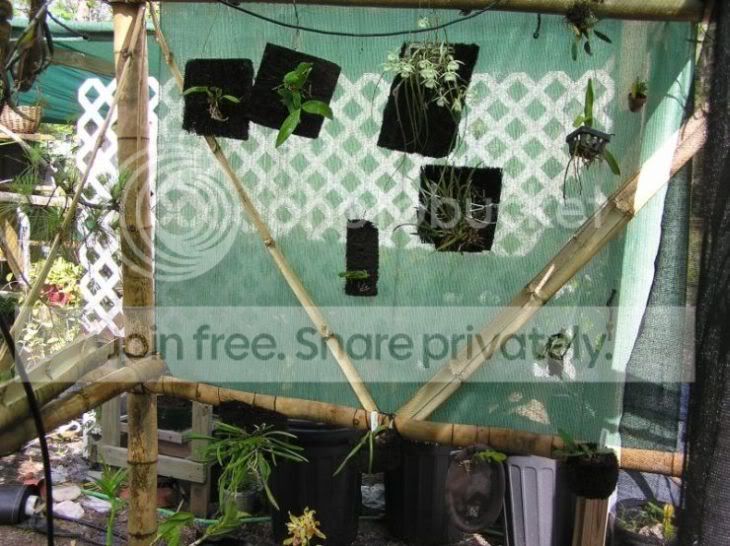
Now, I have a small nursery and decided that I needed an orchid hutch in order to grow my orchids as well as my limited funds would allow. Having a good supply of freshly harvested bamboo I decided to make it using the materials at hand, some paracord and my Natural Outlaw. Other than a wooden mallet, that is all the tools that were used.
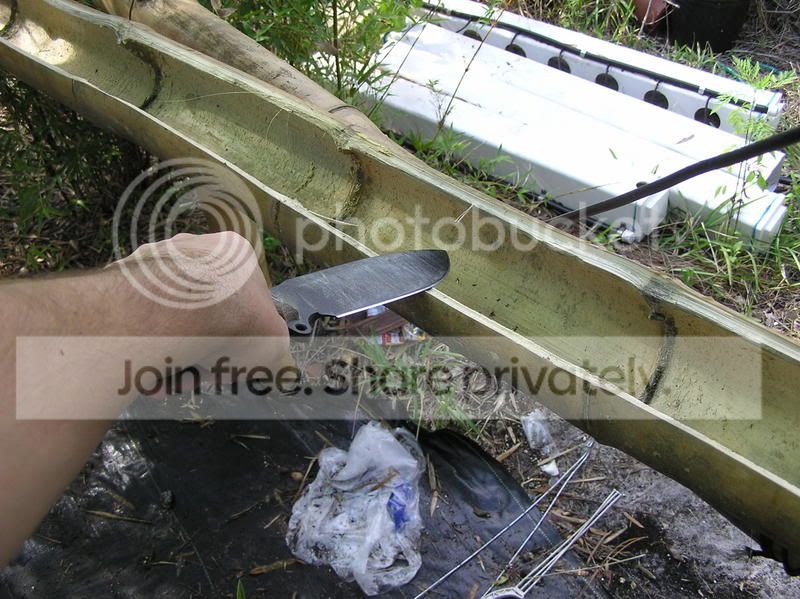
In the above photo you can see some of the bamboo that I split in the making of this hutch. To the left is a trough that held water that potted orchids could sit above to keep the humidity slightly higher than it would have been otherwise. Center are strips that were cut to add rigidity to the structure.
Now, I realize that an orchid hutch is not truly survival oriented but it is applicable, imo. For a survival shelter I would have made it shorter than the sloped 7 to 8 feet this hutch was and I would have thatched the roof (using palm fronds down here in South Florida) and sides instead of using shade cloth.
Anyway, I hammered the NO through at least 60 linear feet of bamboo. It, excepting one other Busse blade I own, are the only knives I have that I would feel comfortable batoning with as I did, alternatingly batoning near the tip of the blade and near the handle. Of course, there are other knives that this could be accomplished with but none that I own that are robust enough to handle the level of hard use I put this one through. That is not to say that they don't exist, just that I am not aware of them. I believe that this is an important feature in a survival blade as, in stressful situations, even an accomplished outdoorsman may find himself doing things that can only be termed, in polite company, as a poor choice.
Anyway, I had been clearing out some brazillian pepper and florida holly (a misnomer, it is not native and both are highly invasive down here) before doing this and the knife was no longer shaving sharp. After splitting the bamboo the edge on the NO was now able to shave arm hair with ease, something that highly impressed me. In analyzing this, I can only assume that a combination of the way bamboo is structured and the unique (to me at least) malleabilty of INFI caused it to sharpen up as I hammered it through the material.
In another thread someone referred to it as "hype". Well, that is no hype but just my own experience with it. And it made me a believer. I hope that I can be taken at my word as such.
The knife:
Now just to show that I am not (too ) biased I will say this. In the wilds, I would have used thin strips of bamboo fibers woven together to lash the hutch together rather than waste precious paracord to do the same. The NO, due to its size and edge geometry, would not be the best knife for this task. For that I would prefer a thinner blade along the lines of the Mora or, my first choice, my trusty old Blackjack Trailguide. I do think that the NO could handle the task but, much like using the Mora or Trailguide to split the bamboo, it would not be optimal, to say the least.
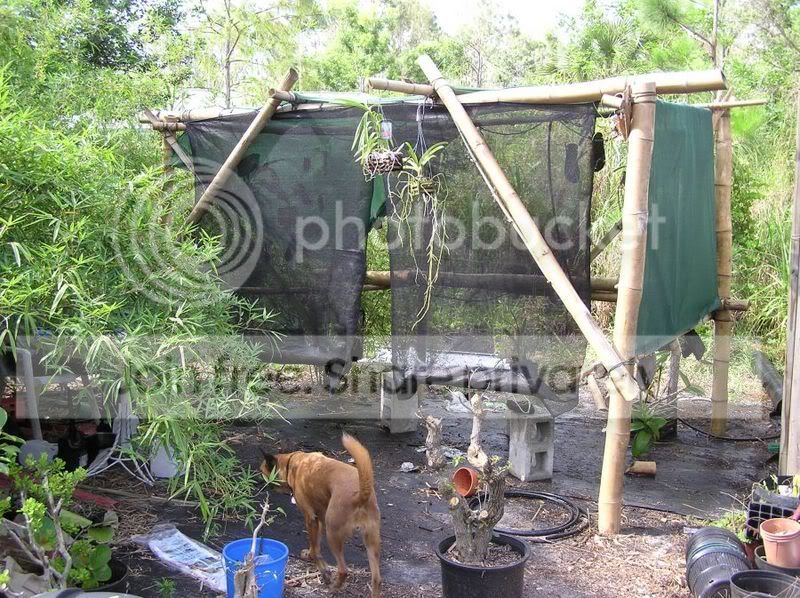
And the final product. I ran out of bamboo and had to finish off the cantilevers using some scrap 1x2"s that were laying around. This photo was taken several years ago after one hurricane (I forget which one!) had come through. Sadly, the hutch did not survive a second hurricane just weeks later.
My intent in starting this thread was to open discussion about bamboo and, possibly, make my fellow forum members aware of a most worthy survival tool (the bamboo!) that has a place in every survivalist's storehouse of tricks. And also, after reading and participating in the degeneration of another thread, to show one user's experience with the INFI steel. You may or may not like the marketing, to each his own, but the steel and heat treat (both together is what becomes INFI) are not, in this user's opinion, hype at all. I've had this knife for over two years now, used it nearly every day, and never yet had to actually sharpen it. Stropping on my pant leg or, if its really "dull", a leather strop has all that has been required to get it sharp enough to shave my arm bare.
Ok. So, I'm done now. It seems that the other thread has calmed down and retained an air of civility and I sincerely hope that this one does the same from the start. My intention is not to inflame anyone or any situation but merely to spread some experience on two subjects that may not be known to all that frequent this forum.
heh. if you read all of that I applaud you!
Bamboo is truly, imo, one of the most amazing and mysterious plants on earth. There are approximately 1200 species of it of which about 450 are found in the Americas. Additionally, there are nearly 175 species that are found in or are suitable for true winter (up to -20f) temperatures. One black culm bamboo is even found as far north as parts of Alaska.
Its use throughout history is truly staggering. Thomas Edison made filaments from bamboo at one point. In China it has been used as bridges, as troughs for waterwheels and much more for centuries if not thousands of years. You can make arrows out of it, or needles. or weave baskets from thin strips of bamboo fiber. Properly cured, it makes a fine vessel to store fluids in. Blowguns can be fashioned out of thinner canes. fences, for fishing or other animal barriers, can be fashioned from it. The polynesian mattang was made from bamboo. Because of its buoyancy, bamboo can be used to float a net out into places where it would otherwise be difficult, if not impossible, to string a net. Simple footwear can be fashioned from it if the necesssity arises. A usable knife/scraper can be fashioned from it by stripping the fibers at an acute angle from the hard outer wall. And on and on. its uses are limited chiefly by the imagination.
Its uses are truly staggering to me and, I think, knowledge of bamboo has its place in every survivalist's arsenal whether or not he knows of any growing wild in his general vicinity.
Ok, on to Busse. It ties in, really, it does. Shortly after I joined this forum I bought a Busse Natural Outlaw because I really liked the looks of the blade, I was interested in seeing what this INFI is all about, and because of the stunning accolades and warm welcomes I percieved from the members in the Busse forums.
Now, I have a small nursery and decided that I needed an orchid hutch in order to grow my orchids as well as my limited funds would allow. Having a good supply of freshly harvested bamboo I decided to make it using the materials at hand, some paracord and my Natural Outlaw. Other than a wooden mallet, that is all the tools that were used.
In the above photo you can see some of the bamboo that I split in the making of this hutch. To the left is a trough that held water that potted orchids could sit above to keep the humidity slightly higher than it would have been otherwise. Center are strips that were cut to add rigidity to the structure.
Now, I realize that an orchid hutch is not truly survival oriented but it is applicable, imo. For a survival shelter I would have made it shorter than the sloped 7 to 8 feet this hutch was and I would have thatched the roof (using palm fronds down here in South Florida) and sides instead of using shade cloth.
Anyway, I hammered the NO through at least 60 linear feet of bamboo. It, excepting one other Busse blade I own, are the only knives I have that I would feel comfortable batoning with as I did, alternatingly batoning near the tip of the blade and near the handle. Of course, there are other knives that this could be accomplished with but none that I own that are robust enough to handle the level of hard use I put this one through. That is not to say that they don't exist, just that I am not aware of them. I believe that this is an important feature in a survival blade as, in stressful situations, even an accomplished outdoorsman may find himself doing things that can only be termed, in polite company, as a poor choice.
Anyway, I had been clearing out some brazillian pepper and florida holly (a misnomer, it is not native and both are highly invasive down here) before doing this and the knife was no longer shaving sharp. After splitting the bamboo the edge on the NO was now able to shave arm hair with ease, something that highly impressed me. In analyzing this, I can only assume that a combination of the way bamboo is structured and the unique (to me at least) malleabilty of INFI caused it to sharpen up as I hammered it through the material.
In another thread someone referred to it as "hype". Well, that is no hype but just my own experience with it. And it made me a believer. I hope that I can be taken at my word as such.
The knife:
Now just to show that I am not (too
) biased I will say this. In the wilds, I would have used thin strips of bamboo fibers woven together to lash the hutch together rather than waste precious paracord to do the same. The NO, due to its size and edge geometry, would not be the best knife for this task. For that I would prefer a thinner blade along the lines of the Mora or, my first choice, my trusty old Blackjack Trailguide. I do think that the NO could handle the task but, much like using the Mora or Trailguide to split the bamboo, it would not be optimal, to say the least.And the final product. I ran out of bamboo and had to finish off the cantilevers using some scrap 1x2"s that were laying around. This photo was taken several years ago after one hurricane (I forget which one!) had come through. Sadly, the hutch did not survive a second hurricane just weeks later.
My intent in starting this thread was to open discussion about bamboo and, possibly, make my fellow forum members aware of a most worthy survival tool (the bamboo!) that has a place in every survivalist's storehouse of tricks. And also, after reading and participating in the degeneration of another thread, to show one user's experience with the INFI steel. You may or may not like the marketing, to each his own, but the steel and heat treat (both together is what becomes INFI) are not, in this user's opinion, hype at all. I've had this knife for over two years now, used it nearly every day, and never yet had to actually sharpen it. Stropping on my pant leg or, if its really "dull", a leather strop has all that has been required to get it sharp enough to shave my arm bare.
Ok. So, I'm done now.
It seems that the other thread has calmed down and retained an air of civility and I sincerely hope that this one does the same from the start. My intention is not to inflame anyone or any situation but merely to spread some experience on two subjects that may not be known to all that frequent this forum.heh. if you read all of that I applaud you!


 Whereas a field of freshly logged timber may take 30 to 50 years to produce wood again bamboo needs to be harvested, once maturity is reached, every 3 to 5 years, or the older culms go to waste.


