
-
The BladeForums.com 2024 Traditional Knife is available! Price is $250 ea (shipped within CONUS).
Order here: https://www.bladeforums.com/help/2024-traditional/
You are using an out of date browser. It may not display this or other websites correctly.
You should upgrade or use an alternative browser.
You should upgrade or use an alternative browser.
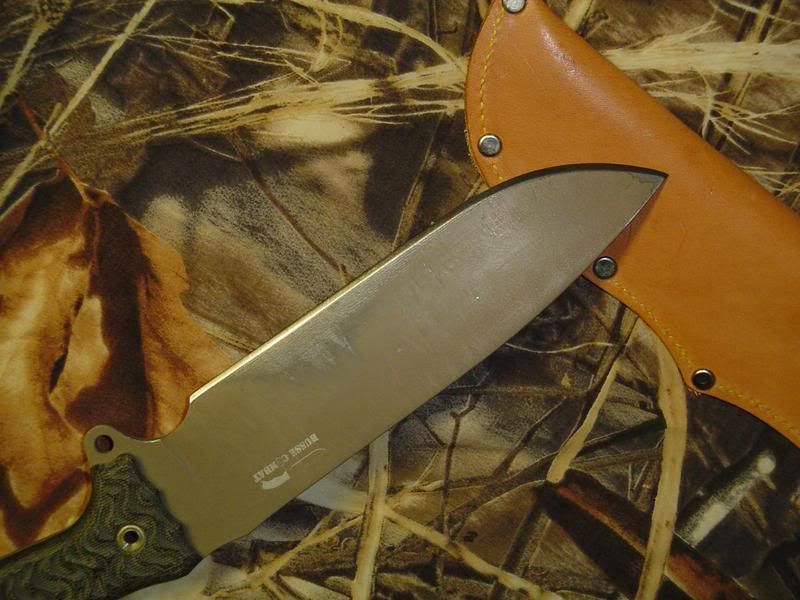
BUSSE FSH Stripped and Convexed( PICS)
- Thread starter Justabuyer
- Start date


- Joined
- Jan 8, 2004
- Messages
- 2,213
My "jungle shadow camo" CGFBM has a grey coating under the finish on the blade too. I can tell from where it's wearing off from use.
A Tan user FSH I had was kinda gray underneath... still not sure if it was a coating, or the natural patina from INFI after heat treat?
NICE EDGE on the FSH, justabuyer, simply awesome!
 :thumbup: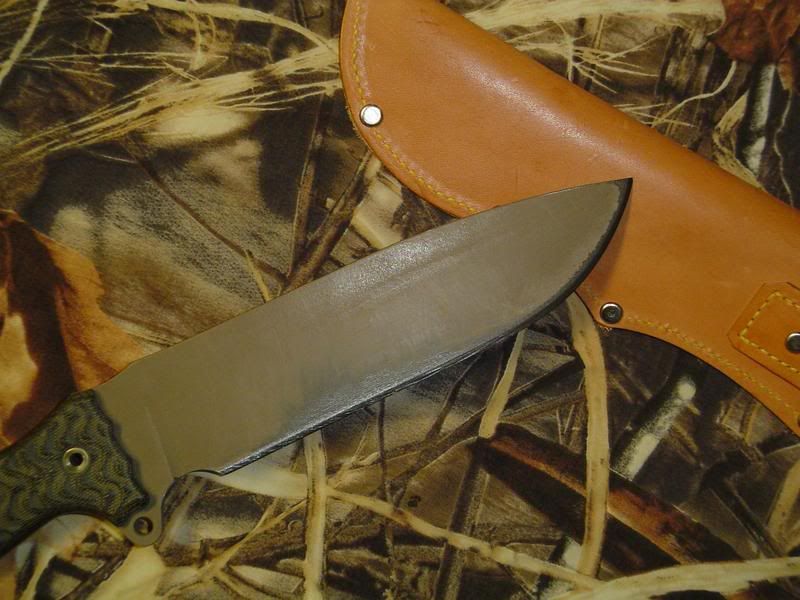

Ban
Moderator
- Joined
- Oct 14, 1998
- Messages
- 4,942
That edge looks WICKED! Nice Job! Like you I prefer thin and zero edges. I think you might be right about the parkerized finish. My Paul's Hatchet that I stripped had a black/dark grey finish under the coating also. At the time I also thought it was some sort of parkerized or oxide finish. But I am guessing that it can also be from the heat treating process when the Nitrogen is introduced to the blade.
Can anyone confirm that Nitrogen is introduced during the heat treat process. I thought I remember reading about that a long while back when INFI was first introduced.
Ban
Can anyone confirm that Nitrogen is introduced during the heat treat process. I thought I remember reading about that a long while back when INFI was first introduced.
Ban

- Joined
- Aug 24, 2006
- Messages
- 1,188
I am not an expert as far as knives go, so I'll ask the group here.
Is there anyone else that uses a similar blade coating?
I can't recall seeing anyone else with a crinkle coating on their knives.
It would seem to me that Busse is doing something somewhat uncommon, and maybe even proprietary.
Whatever it is that they do, it works.
Is there anyone else that uses a similar blade coating?
I can't recall seeing anyone else with a crinkle coating on their knives.
It would seem to me that Busse is doing something somewhat uncommon, and maybe even proprietary.
Whatever it is that they do, it works.
Ban
Moderator
- Joined
- Oct 14, 1998
- Messages
- 4,942
I'm no metallurgist, but I slept in a Holiday Inn once, therefore I am qualified to opine that nitrogen is not added during the heat treat.
Can anyone with a good memory remember the write up about INFI and its proprietory heat treat process on the forums way back? For some reason I remember something about Nitrogen being introduced during the heat treat. But then again I may have remembered wrong.
Thegratenate,
The baked on coatings are also currently being used by Fehrman Knives and TOPS. There may be others that I don't know of. I remember TOPS have been using it for some time. At least as far back as 1999.
Ban
- Joined
- Jan 5, 2007
- Messages
- 543
I have a question...
What is the difference between a thinnly convexed edge, and a zero edge?? Or is a zero edge just a very thinnly convexed edge anyway?
Cheers
What is the difference between a thinnly convexed edge, and a zero edge?? Or is a zero edge just a very thinnly convexed edge anyway?
Cheers
Ban
Moderator
- Joined
- Oct 14, 1998
- Messages
- 4,942
To me a thinly convexed edge and a zero edge is nearly the same. A zero edge is the primary bevel forming the edge in a straight line to the edge without a secondary bevel. This can be seen on the finnish puukkos. A convexed edge is a primary bevel smoothly transitioning to the secondary bevel to form the edge. But technically there is no secondary bevel on the convexed edge. On a thinly ground convex edge the transition from the primary bevel to the secondary bevel to form the edge is nearly non existant.
- Joined
- Jan 5, 2007
- Messages
- 543
Thanks Ban :thumbup: nice one
Justabuyer... what would you say was the key to the sharper than razor edge?? Does the 2000 grit paper make a lot of difference? I have only managed to get 600 where I live, so will need to speak with a car parts shop or something... also, what grit did you start at...?? Must have been very coarse to take the bevel out like that!
Cheers
Justabuyer... what would you say was the key to the sharper than razor edge?? Does the 2000 grit paper make a lot of difference? I have only managed to get 600 where I live, so will need to speak with a car parts shop or something... also, what grit did you start at...?? Must have been very coarse to take the bevel out like that!
Cheers
- Joined
- May 7, 2006
- Messages
- 3,338
Started with a sheet of 120 then 180 then 220 then 320 then 600 then 1500 then 2000. It was a pain in the ass and took all dang day. But it came out stupid sharp and wicked.... Vampire killer for sure... Hope the new owner digs it and chimes in here when he sees it. I would like to hear somebody elses opinion of the work.
Jim
Jim

- Joined
- Apr 10, 2005
- Messages
- 8,808
I have a question...
What is the difference between a thinly convexed edge, and a zero edge?? Or is a zero edge just a very thinly convexed edge anyway?
We frequently use the term "zero" to describe a convex edge on Busse knives. Most other enthusiasts consider a "zero" edge to be something like the chisel grind on an Emerson or a scandi-grind, which is flat gound but has no micro-bevel at the edge. It just goes straight back from the edge. I have a picture to explain this, but it is off-line right now. I'll try and get it up here later.
Rick
- Joined
- Jan 5, 2007
- Messages
- 543
We frequently use the term "zero" to describe a convex edge on Busse knives. Most other enthusiasts consider a "zero" edge to be something like the chisel grind on an Emerson or a scandi-grind, which is flat gound but has no micro-bevel at the edge. It just goes straight back from the edge. I have a picture to explain this, but it is off-line right now. I'll try and get it up here later.
Rick
Rick, that'd be great if you could... I understand what you mean, and I have just had some 1200 grit paper arrive at home, which I'll play with later... :thumbup:
I have a convexed and stripped home made satin finished FBM, and I wanna put an even sharper edge on it

- Joined
- Feb 19, 2006
- Messages
- 14,607
I have a Camp Tramp that I asked to be shipped to me uncoated. It had already been prepped for coating, and has an attractive gray finish of some sort, almost looks like a bead blasting.
That post is useless without pics!
