- Joined
- Aug 28, 2009
- Messages
- 7,951
The picture has nothing to do with politics, it is a picture of one of the most respected and feared military units in history. How many people would rather die then not be chosen to serve their unit/country?
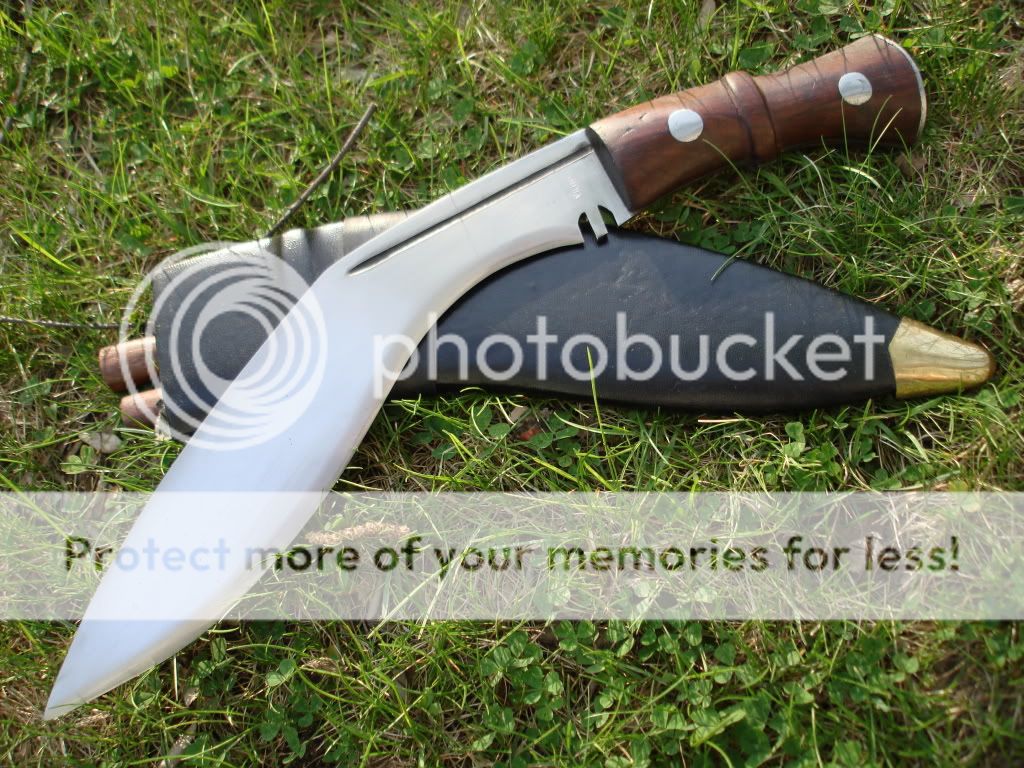
The blade's distinctive forward drop is intended to act as a weight on the end of the blade and make the kukri fall on the target faster and with more power. For attacking the kukri is most effective as a chopping, slashing weapon, though it can be used for stabbing.
In combat, the kukri is basically used in three different styles: stabbing with the point, slashing or chopping with the edge, and (rarely) throwing. Because it has an angular blade bending towards the opponent, the user need not create an angle in the wrist, which makes a kukri more comfortable as a stabbing weapon. Its heavy blade enables the user to inflict deep wounds and to cut through muscle and bone. Gurkhas were known for using the kukri to chop off an enemy soldier's head with one stroke.
A kukri may be used in stealth operations - to slash an enemy's throat, killing him instantly and also silently.
While most famed as for use in the military, the kukri is most commonly used as a woodcutting and general purpose tool, and is a very common agricultural and household implement in Nepal.
A kukri
Although a popular legend states that a Gurkha "never sheathes his blade without first drawing blood", the kukri is most commonly employed as a multi-use utility tool, rather like a machete. It can be used for building, clearing, chopping firewood, digging, cutting meat and vegetables, skinning animals, and opening tins.
The kukri also has a religious significance in the Nepali form of the Hindu religion. During the annual Dashain festival, kukris are ceremonially blessed.