Cliff Stamp
BANNED
- Joined
- Oct 5, 1998
- Messages
- 17,562
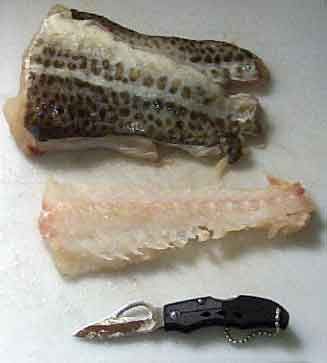
This is a really small knife :
Spyderco webpage :
http://spyderco.com/catalog/details.php?product=219
Making shavings the Finch bites in well. The edge is 0.017-0.018" thick and ground at 12.9 (2) degrees per side so the cutting ability is above average. One thing to be careful of is that with only moderate force it will sink very deeply into woods. Since the handle is small, a three fingered grip, this isn't a knife suited for really heavy carving, thus after the inital cut the knife is rotated up to keep the cuts shallow. Using the Finch and making a bunch of shavings a fire can be started from a single large stick in just a few minutes :
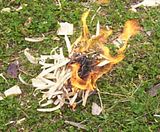
The problem then becomes how to keep the fire going. Shavings burn very rapidly and the knife is simply too small and too thin (0.077" thick) to break apart woods quickly. It can be used to carve wedges and take apart woods that way and in the long run that is pretty much the only option. However in the short term it works well on thick pitch filled barks :
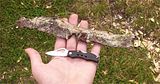
Just cut around the bark and work the knife under the bark and slice it off to start, usually it will just peel away them and can be pulled off. With a thick layer of pitch such bark can burn for a half hour or so (depends on the wind and amount of pitch). It also burns very sooty. To gather a lot of bark quickly it is best to carve a small spud. Which the Finch does easily from a broken branch :
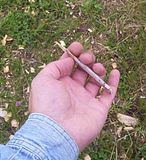
This can then pry off the thick barks very aggressively and the point sharpened as necessary as it blunts through contact with the wood. With thick barks a fire can be kept going while thicker branches and such are gathered. The smoke will also keep insects away and provide some light and heat. This bark was really wet as it had been raining a lot lately. When it is dry it doesn't last very long so large pieces only last minutes. The fire was mainly sustained buy the several pieces which had thick sections of pitch.
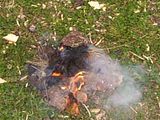
What became obvious when using the Finch for this work was that having any knife, even one as small as this one made a huge difference. It was easy to shaving off the outer layer of wood which was wet and get to dry wood. All the grasses and barks were too wet to light. However it was also just as obvious that a large knife, especially one with a handle big enough for a full grip and the blade strong enough to take significant prying force would be of tremendous benefit.
-Cliff

Spyderco webpage :
http://spyderco.com/catalog/details.php?product=219
Making shavings the Finch bites in well. The edge is 0.017-0.018" thick and ground at 12.9 (2) degrees per side so the cutting ability is above average. One thing to be careful of is that with only moderate force it will sink very deeply into woods. Since the handle is small, a three fingered grip, this isn't a knife suited for really heavy carving, thus after the inital cut the knife is rotated up to keep the cuts shallow. Using the Finch and making a bunch of shavings a fire can be started from a single large stick in just a few minutes :

The problem then becomes how to keep the fire going. Shavings burn very rapidly and the knife is simply too small and too thin (0.077" thick) to break apart woods quickly. It can be used to carve wedges and take apart woods that way and in the long run that is pretty much the only option. However in the short term it works well on thick pitch filled barks :

Just cut around the bark and work the knife under the bark and slice it off to start, usually it will just peel away them and can be pulled off. With a thick layer of pitch such bark can burn for a half hour or so (depends on the wind and amount of pitch). It also burns very sooty. To gather a lot of bark quickly it is best to carve a small spud. Which the Finch does easily from a broken branch :

This can then pry off the thick barks very aggressively and the point sharpened as necessary as it blunts through contact with the wood. With thick barks a fire can be kept going while thicker branches and such are gathered. The smoke will also keep insects away and provide some light and heat. This bark was really wet as it had been raining a lot lately. When it is dry it doesn't last very long so large pieces only last minutes. The fire was mainly sustained buy the several pieces which had thick sections of pitch.

What became obvious when using the Finch for this work was that having any knife, even one as small as this one made a huge difference. It was easy to shaving off the outer layer of wood which was wet and get to dry wood. All the grasses and barks were too wet to light. However it was also just as obvious that a large knife, especially one with a handle big enough for a full grip and the blade strong enough to take significant prying force would be of tremendous benefit.
-Cliff