
Cable damascus blurryness?

Joined
Feb 12, 2014
Messages
52
This is what came of that cable damascus that i did a couple weeks ago. I did some initial sanding and this is what it etched to. It looks ok except for the portion close to the edge. The pattern seems to smear together. And when it is in the etchant that portion comes our compltetly black then i take some used 1000 grit and clean it until i polish the high parts. Granted this is only 3 ten minute dips in the FeCl. its a very shallow etch for now until i have the rest of the sanding done. Can i get help on how to fix this probelm?

Garrett Elting
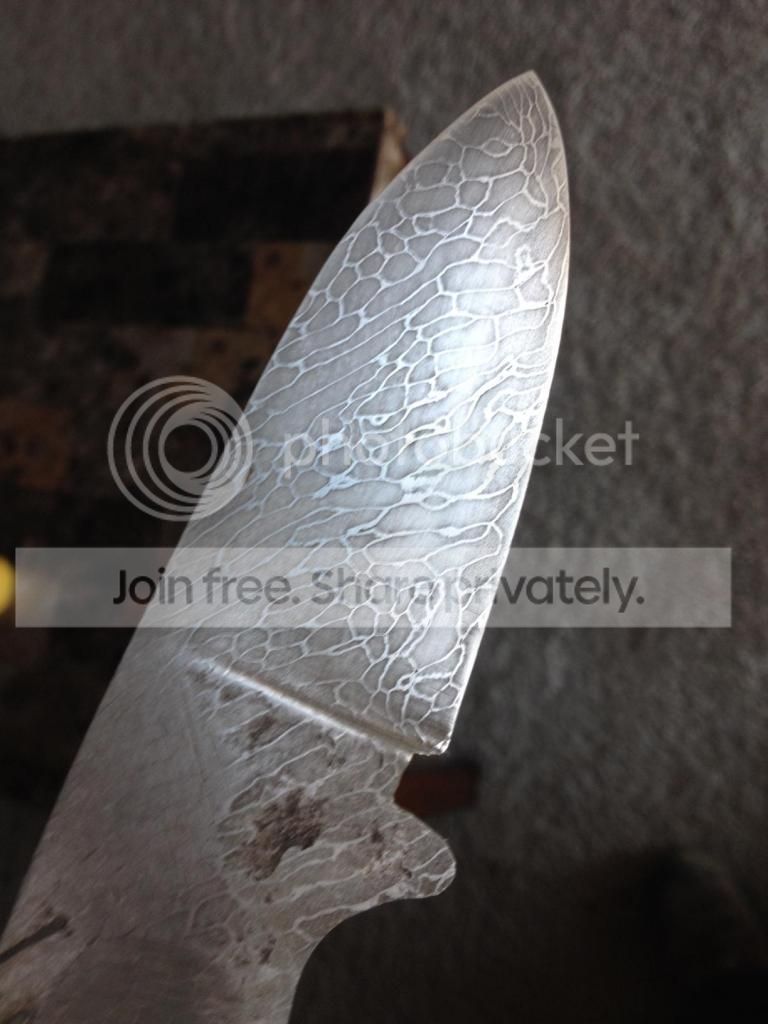

 
It looks OKish. It can be very hard to finish cable mascus evenly. Sometimes it is caused by only the edge portion of the blade having hardened. Have you tested all over with a file? Some cable won't harden much in oil, and needs brine. Or, you might have to mess with your austenitizing heat values.

Another thing to look at is your etchant. If it's excessively old, that can cause an uneven etch. Or if it's too strong, that can cause problems.

You will probably have better results once you have finish sanded, and really etch it pretty deep. Then the dark parts of the blade will stay dark better, upon polihing the highs with 2500/2000 paper.

It will help if, after the last etch cycle, you leave all the black on the blade and boil the blade in water with a tsp of baking soda for 15 minutes. Pull it out quick and let it dry, then do your light surface sanding/finihsing stuff. That sets the oxides good and dark and durable.
 
I just hardened the blade portion not the handle. My etchant is brand new. It could be that it is too strong. I used a 4:1 water to FeCl etch. I think a deeper etch would help it out alot. I will try this and see if it helps. Thanks for the tip for with baking soda. I ran a file across the edge and it just skated off and dug in on the handle so I know I got an ok quench.
 
Not to derail the thread and go off on a tangent, but would the baking soda trick work for forced patinas as well? Would it help "set" the finished made with vinegar or mustard for example?

Thanks,
Chris
 
Dunno, Salolan. Let us know if you try it!
Gting, your etchant sounds good. But did you file-check the spine, too? If the spine is soft, that's a clue.
 
I agree with Salem.

With a shallow etch and 1,000 grit follow-up sanding, you're essentially just "erasing" faint lines.

I think your best solution will be to do with a deeper etch and finer abrasives to highlight the high spots.

I think that's the most likely culprit, because typically you'll get a washed-out, "fuzzy" etch with the softer steel, not the hard edge.

Another thing that comes to mind, is what are you using for a sanding bar?

For final damascus finishing, you want something very hard that will keep your sandpaper riding on the high spots, and won't allow the sand paper to dip down into the valleys. A clean bar of steel with the paper wrapped VERY TIGHTLY around it is my personal choice. :)

And keep it really wet for the final sanding strokes... Windex, Simple Green, WD-40, even water...
 
Last edited:
Back
Top