Can I epoxy two thin scales together to make them thicker?

Shurik you can goto http://usaknifemaker.com/ (Midwest knife Supply) they are located right off 169 north side of Mankato kind of behind the Happy Chef, you can order online and choose Local Pickup it's what I do, great company. Also there is a West Marine near you in Minnetonka I believe.

Yep, West marine is next to Ridgedale mall, and I think I saw one off hwy 7, too. By Excelsior. That's a hike to get out Mankato, though. A 5 dollar order will not be worth a drive out there. My father in law lives there, maybe I can tap him to pick something up for me when he comes down to the city. I wish we had a store in town for items like that. Shipping is expensive.
 
I've had good luck with T-88 for some tasks. It mixes up to a viscous blob about the consistency of a soft bubble gum. It is really good for gap filling and it definitely stays in place and doesn't drip - but it takes a little work to spread it and it doesn't easily "wet out" the material you are applying it to. The squeeze out is easy to deal with, though, because it doesn't drip all over the place.

When I use the West Systems epoxy, I sometimes use their colloidal silica filler material to thicken the consistency. It seems to work pretty well, but the stuff goes airborne easily when you are mixing it and I wouldn't want to inhale it - sand in your lungs...:eek:

I like the idea of gluing the two scales together to get a composite/laminate. If the two rosewoods are different colors, the contrast would look really cool.

TedP
 
My scales are two different colors. I got a plank that was bright on one end and dark on the other with a diagonal transition line. It should look nice.

Problem solved :)
Dark on the tang, the light one n top of that?
 
Yes. People do that all the time. It's called laminates. Just don't use a glue that expands a lot like Gorilla glue. You will have a visible line though.

Gorilla glue makes a mix epoxy. its epoxy not glue, doesnt expand, and is quite tough. they also make some dang strong super glue
 
Of course you can. I have found that putting a very stable layer at the base helps to mitigate wood movement. Wood on wood, I find, moves quite a bit and joints suffer. Plus, since your portions are coming from ajacent portions of the plank, its going to be hard to match grain. If you use a liner or two to thicken it up, and those materials are stable, then your handle will be fine, and beautiful. I use superglue to do all my laminations. Then I use G-Flex epoxy to hold the scale to the steel.

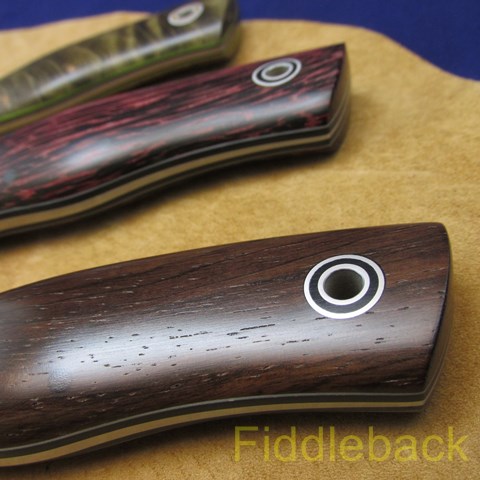
I love Rosewood. In the foreground of this pic, East Indian Rosewood over black g10 with a white g10 pinstripe.

20131011IMG_0924-vi.jpg


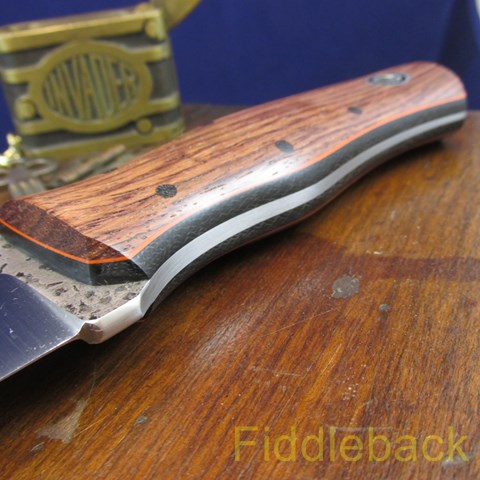
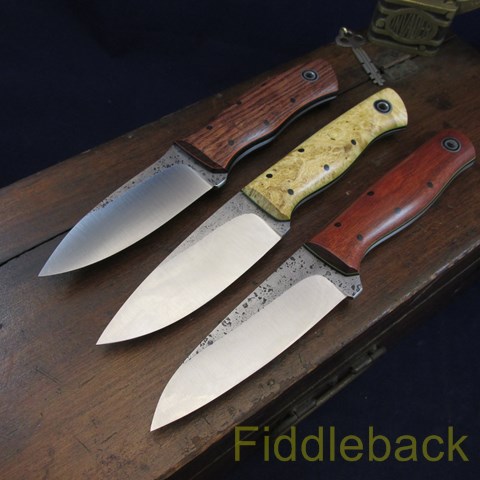
Honduran Rosewood over black canvas with an orange g10 pinstripe. Here the micarta is 1/8" thick, then there is a 0.020" thick orange g10 pinstripe. That adds a lot of thickness. I was able to use a very thin slice of the Rosewood to get this scale. That meant an extra knife off of a block. ($$$) Honduran Rosewood is my favorite.

20130906IMG_748-vi.jpg


20130906IMG_0749-vi.jpg


Here is a tip. When you are flattening micarta (it won't be perfect), one side is cupped and one side bulges very slightly. Flatten the cupped side first. Its way easier to do. Later on the other side is easier after you've cut away a lot of waste before glueup. To figure out which is which swirl the material on your surface plate lightly and check the pattern of scratches. If the scratches are in the center, flatten the other side. If they are round the edges keep flattening that side. The scratches should be level and even for the piece to be flat. Hold them together with two fingers and check for light around the edges, especially in the corner. The corners should be just as flat as the middle, or there will be a glueline.
 
I just wanted to say thanks to mr fiddleback I'm a new blade maker and always looking for tips and new techniques, this will come In handy with some upcoming projects. And by the way I love your laminated handles
 
what i did for one of my knives was use a piece of basswood (craft wood you can buy from craft/hobby stores) to use as a liner separating the tang from the handle. what i used was 1/8th inch thick. It turned out really well using minwax natural stain (handle was made from american walnut)
 
what i did for one of my knives was use a piece of basswood (craft wood you can buy from craft/hobby stores) to use as a liner separating the tang from the handle. what i used was 1/8th inch thick. It turned out really well using minwax natural stain (handle was made from american walnut)

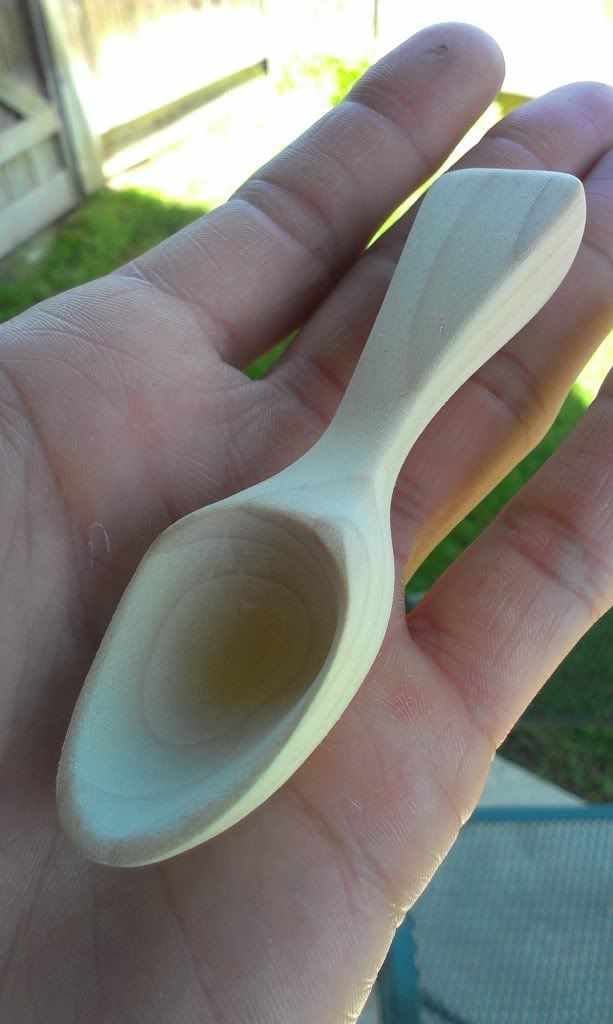
I find a simple beauty in "simple" woods like bass and poplar.

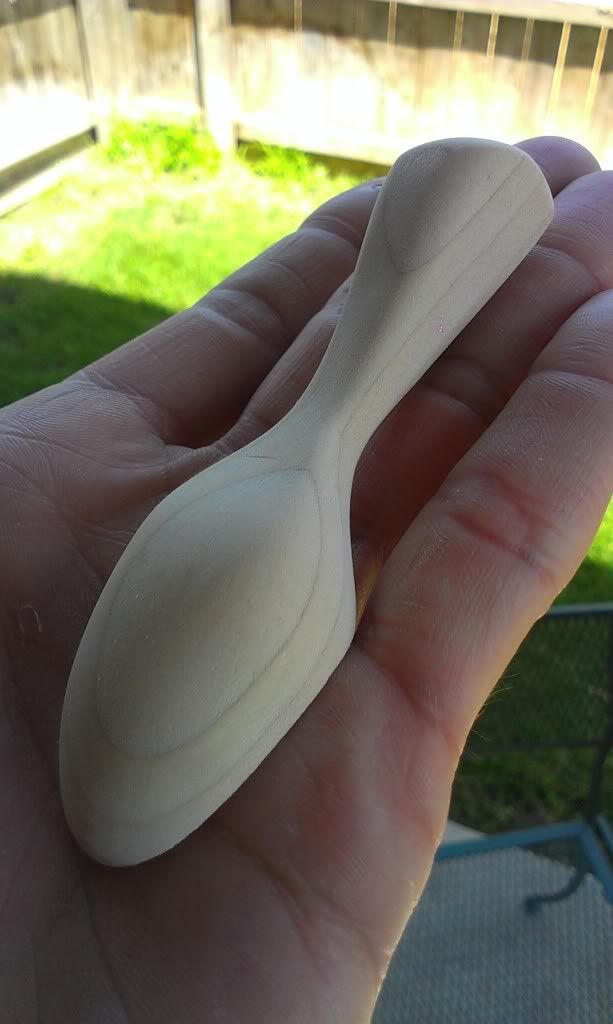
Carved poplar scoop.

IMAG1185_zps5d0d95eb.jpg


IMAG1184_zpsf58dd780.jpg


I'd love to see your bass laminate.

Thanks to Mr. Roy for the education. I had wondered about how you did that. Never would have guessed super glue.
 
I just wanted to say thanks to mr fiddleback I'm a new blade maker and always looking for tips and new techniques, this will come In handy with some upcoming projects. And by the way I love your laminated handles

You're welcome. You are in Alabama, you should come to the next GA Knifemakers Guild meeting. Out of state folks and non members are welcome to attend. The next meeting will be end of Jan, beginning of feb at the Twin Blades shop. You cannot imagine what you can learn just by visiting the shop of craftsmen of this caliber. They are the real deal, and their work makes mine look silly. Their shop is in Statesboro GA. It might be a bit of a haul for you (us both) but its worth it. There will be 60 or more knifemakers there, all better and more experienced craftsmen than me, all wanting to share their craft with new knifemakers. Wayne Hensley is going to do one of the Demo's. I have two more to schedule. If I was from anywhere as close as Louisianna, I'd make the trip to this meeting.

what i did for one of my knives was use a piece of basswood (craft wood you can buy from craft/hobby stores) to use as a liner separating the tang from the handle. what i used was 1/8th inch thick. It turned out really well using minwax natural stain (handle was made from american walnut)

The contrast between dark creamy Walnut and a light wood is very attractive. Basswood is a bit soft though. Next time, try using curly Maple for the base layer. Its harder, and just as light colored. Really pretty.

I find a simple beauty in "simple" woods like bass and poplar.

Carved poplar scoop.

IMAG1185_zps5d0d95eb.jpg


IMAG1184_zpsf58dd780.jpg


I'd love to see your bass laminate.

Thanks to Mr. Roy for the education. I had wondered about how you did that. Never would have guessed super glue.

Super glue is just what I've always used for this. We have to make a lot of laminations, and the quick cure time is beneficial to us. We can get a dozen or so scales glued up around the big steel workbench. We're turning out 30-33 knives a week now, so that means running the table threeish times a week.


Stacey, I ordered some of that M88 to give it a shot. Do you prefer this epoxy over West Systems G-flex?
 
Back
Top