can i modify my forge to only heat the edge of my knives?

Joined
Apr 1, 2007
Messages
10,080
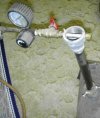
i want to use the burner from my forge which is horizontal and make it vertical so the flame will heat only the edge. i was thinking of getting a piece of 5" pipe and putting a plate on top so the burner can be attached.
then i want to cut a slot part way down so the blade can be ran through the flame and heated to the desired temp. i normally done my ht with a cutting torch but i want to change over to propane. will my idea work?
attachment.php

forge 3.jpg
 
Why not heat the whole blade up? It is easier with a torch to heat just the edge, it's a much hotter and quicker heat source- which lends itself to painting heat onto steel in zones. The propane flame outside of a forge will always disappoint you.

The propane burner will work best in the forge shell it was designed for. If the effect you seek is a hardened edge and soft back, why not heat the whole blade up and edge quench?
 
7 firebricks, stacked on for the floor 2 for the walls, 2 for each end then 2 for the top, blower comes in from the side or bottom, the 2 bricks on top can be slid to open or close the seam in between. blade goes into the top seam.
 
Japanese sword makers would form wet clay on the rib/back and side of their swords leaving only the blade edge exposed to the flame. As to answer your question, as long as the flame does not extend toward your fuel source, sounds practicle.
 
Just FYI,
The Japanese clay coating is not to protect the spine and sides from heating up. The whole blade is heated to the desired temp ( around 1500F), including the area under the clay. The clay insulates the covered area so it cools slower in the quench, thus the edge misses the pearlite nose ( and gets hard) while the spine/sides hit it ( and are softer)......yielding a differentially hardened blade showing a hamon.
 
Japanese smiths also work in a small heated area, they run the blade through the heat in repeated passes to get the entire blade up to temp.

Richard, just heat the entire blade, that way there is no doubt about the integrity of your heat treat.
 
will, i have been heat treating the edges only on my knives and it has worked all these years. my buddy who normally helps me do the ht asked me why i wanted to change since what i have been doing seems to work. i just want a way to do it here at home instead of going to his shop. sometimes it can be a few weeks before he can get time to help me do a ht.
 
Pull the burner out and old it in your hand? I have no idea and I've only edge heat treated using solid fuels.

Burners for forges and burners for AO set ups are a bit different because forge burners are used to heat a larger area instead of concentrating it like a torch. You'd have to think of the burner as a HUGE torch tip.
 
i get the results i want by heating only the edge. an edge quench is not what i want to do or will ever do so that is not an option.
 
I can't think of a good way to modify a forge that doesn't heat up the entire blade. That's kind of the way forges are built.

I do NOT recommend this but get some good welding gloves, apron and safety gear, clamp the blade tang in a vise in a fireproof area and use the burner on it. If your burner is like Charlies' it won't take long to heat the blade up. I think the issue will be quenching it in time.
 
Richard I know what you are doing and why so I'm going to take a shot at articulating it.
A lot of the steel Richard uses is work hardened and he likes the hardness and temper of that steel and just wants to increase the hardness on the edge. It has just plain worked for him and has for years.
The closest thing that I can think of that might work would be to remove the burner from the forge and make a stand to hold it then use the the burner as a substitute for the oxy/acetylene rig your used to. I think that edge hardening in that forge body is a non starter. You want the edge hot it wants every thing in it hot.
If you are hell bent on trying it in the forge I'd cut a groove in a refractory brick and shape it around the blade edge then pack the spine in with refractory cement. Put the blade in just long enough to get the edge hot then pull & quench. I'd do it once to see if it would work but long term its going to be expensive in labor & materials.
I was in Springfield today and should have looked you up but its been a long week.
 
You want a quick, HOT heat source to be able to evenly heat just the edge. A propane flame, no matter how big the burner tube, is not nearly as hot as an O/A flame. Not likely to ever be able to adequately heat the edge without heating the back as well.

As far as using work-hardened steel, any effect of the work hardening near the edge would be reversed by the heat/quench process anyway. If you mean that the work-hardened nature of the steel in the spine area is desirable and the aim is to try to preserve that while hardening the edge further, well that seems a little odd to me.

If you say it works, it works. The main thing IMO is that a gas forge is not suited to heating the edge alone. One way this can be done is to preheat the forge really hot, then heat the blade up from cold right away, the edge (and point) should reach critical well before the spine, as the steel is thinner. I've even seen a well known smith advocate this in print, to me it seems dicey and hard to control, as well as not affording any "soak" time at all.

A torch is what you want if you're fixed on the idea of heating the edge alone. Way less expensive than induction, and you have experience this way already. You can get an O/A torch secondhand off CL anywhere in the nation for under $500. Often well under.

That's just my opinion, you may indeed be able to come up with some kind of jig for use in a forge...
 
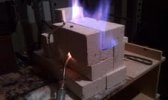
Okay, I played around with this in the Garage tonight taking what Sam said. I used the slapped together forge I made the other night. I cut firebrick plugs for the ends of the forge and separated the top bricks so the flame from the forge came up the crack along the center. There was a slight gap on the bottom of the forge, so I stacked it on firebricks. This is it running after 2 minutes, with my acetylene B-tank from my work truck. I didn't heat steel, but if you used refractory cement and the burner you have for your new forge it might work. It'd be worth a try.

Edge Forge2.jpg
 
the steel is not work hardening. i might make a couple of plates to clamp on both sides of the blade to slow down the entire blade heating up. i might even make something up from firebrick and see what that does. i might just use the forge for my small skinners since they can be fully heat treated. i just want to be able to do the edges on my larger blades and choppers i make so i might have to stick with the torch to do them. i talked to my buddy that has the torch and he said he will still help me do my large blades so i might as well take him up on that offer.
 
Just FYI,
The Japanese clay coating is not to protect the spine and sides from heating up. The whole blade is heated to the desired temp ( around 1500F), including the area under the clay. The clay insulates the covered area so it cools slower in the quench, thus the edge misses the pearlite nose ( and gets hard) while the spine/sides hit it ( and are softer)......yielding a differentially hardened blade showing a hamon.

The above is certainly true... but thinking about it, there is another way of using clay for HT. I've done it with 5160 with decent results. You put the clay on like you would for a hamon, but leave the thick part a little closer to the edge, and put the clay on the back way thicker. Like 1/4" or more, each side. Preheat the forge, then quickly heat up the blade. The thick clay will keep everything but the edge from reaching critical for a longer time than the method I mentioned above. Quench while only the edge is yet non-magnetic. You use 1070, right?

This is a bit like your "clamp two bars onto the blade" idea, just using thick clay. The bonus is that you quench with the clay on it. No fooling around taking a jig off of the blade while losing heat.

Just some more thoughts to play with. I'm not saying that's the very best way to treat 5160 or any steel. But it works.
 
i thought about thick clay also. my buddy who has a farm dug a small pond many years ago and the bottom is nothing but grey clay. i am going to get some of it and put some on a test piece real thick and see if that gives me the results i want. i figure if i leave it damp it will keep the blade cooler when i heat the whole blade up. i'll let you guys know how it goes.

on a side note. can i use some of the clay to line my forge or would it be a waste of time? i know coal forges have clay in the bottom of them.
 
FWIW, I hate a coal forge with any kind of clay in it. A steel pan is best. But I digress.

I don't really know about your pond clay, my guess is that it will shrink and crack a lot. Adding sand might help, but I've not seen many people who've used homemade clay recipes for gas forge refractory meet with success.

Satanite is so cheap and proven, I'd stick with that. As for trying it on blades, I say go for it. Much easier to re-coat a blade if it doesn't work, than a forge liner. I know the recipes for japanese style blade clay are usually powdered charcoal, clay, and sandstone in varying proportions. I think the charcoal affects the insulative properties, and the sandstone is a binder. I'm sure someone who knows more about it than I will expound upon this stuff.
 
i have plenty of 1075 scrap that i can do some experimenting on. i also have about 500 pounds of it to make knives from so i'll find out what works eventually :D.
 
Back
Top