Can we explain blade shapes/grinds in here please?!?

Joined
Oct 26, 2007
Messages
1,392
Can we please explain, preferably WITH PICTURES all the different blade shapes/grinds please?

I would like to be better informed about such things, so if we could collaborate here and get it all in 1 post I'm sure it would be helpful to a lot of people besides just me.

I'll start us off, this picture does a pretty good job of explaining some of the common grinds:
grinds2.jpg


What about a Sabre grind, I've heard that a few times?

What's the difference between a Wharncliffe and a Sheepsfoot :confused:
 
A true Wharncliffe has a perfectly straight sharpened edge, while a Sheepsfoot may curve up at the end, or have a curve of the spine coming to the tip.

A Saber grind is pretty much right between a Scandi and a High Flat grind. The edge bevel starts at the middle instead of the spine of the blade.
 
A true Wharncliffe has a perfectly straight sharpened edge, while a Sheepsfoot may curve up at the end, or have a curve of the spine coming to the tip.

Then what's the difference between a Sheepsfoot and a Drop-point?
 
What about a Sabre grind, I've heard that a few times?

A saber grind is essentially your high-flat grind, except lower.

Your "High flat:"
s21cgg.jpg


Saber Grind:
C10WH_L.jpg


What's the difference between a Wharncliffe and a Sheepsfoot :confused:

Wharncliffe (completely straight edge):
C66BK-4_L.jpg


Sheepsfoot (not sure what the advantage of this one is or how to describe it, but I know it when I see it):
550HG.jpg


Then what's the difference between a Sheepsfoot and a Drop-point?

Sheepsfoot Griptilian:
550HG.jpg


Drop-point Griptilian:
556.jpg
 
a high flat grind is a saber grind. Saber grind is a primary grind that does not go all the way up to the spine. IMO, it should be more than halfway.
 
Drop points have a pointed tip while sheepsfoot generally don't.


Drop points also have a belly, sheepsfoot blades are basically a Wharncliffe without a point. Spearpoint have the tip in the center of the blade, whereas the drop point has the tip above the midline. Some modified Wharncliffe and Sheepsfoot blades have the tip raised a bit, to add some belly- but still below the midline.
 
I'm starting to get it, but they also just sort of blend in to each other.

What separates a clip-point from a drop-point?
 
the diff. between a clip point & drop point is how the spine of the blade curves down to the tip - they are opposites

the clip point curves down concavely whereas a drop point curves down convexly.

clip point
buck110_stone_01_500x.jpg


drop point
Gerber-6064-rw-11596-886.jpg
 
Are there blade grind/shapes that are a better for certain applications? Or did the different shape/grinds develop out of personal preferences?
 
the diff. between a clip point & drop point is how the spine of the blade curves down to the tip - they are opposites

the clip point curves down concavely whereas a drop point curves down convexly.

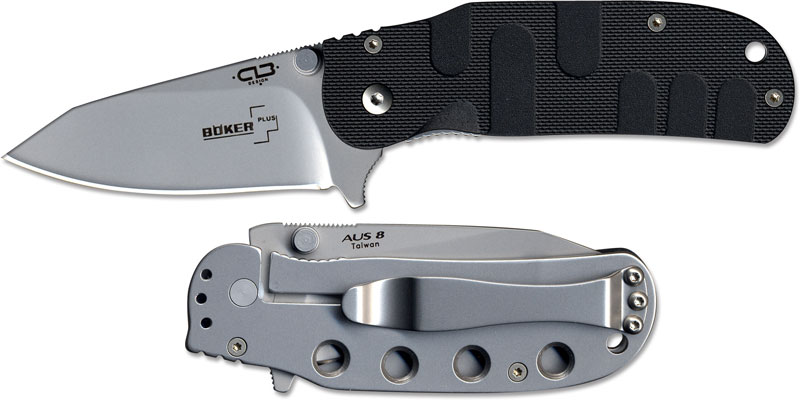
See but then I get confused by things like this:
Boker Trance Clip-point:
BK-BO590.jpg
 
This is why I just joined this forum, I want to become more educated and learn as much as I can.....thank you for this thread, I'll be lurking alot before I post again.:D
 
See but then I get confused by things like this:
Boker Trance Clip-point:
BK-BO590.jpg

That is a mistake. It is, in fact, a rather modified spey blade--a style much more commonly found in traditional folders, but also in some modern pieces such as the Benchmade 940 though they improperly call it a "reverse tanto" for marketing reasons. A spey blade is much like a drop point but with a straight, rather than curved, descent to the tip of the blade. Typically they have an equivalent amount of belly.

sp_ba.jpg


Photo courtesy Benchmade:
940.jpg
 
Back
Top