Can wood get to dry?

Joined
Dec 31, 2003
Messages
335
I am about to put the 5th handle on a knife. I have had 1 ironwood, 2 ebony, 1 redwood set of scales check on me in places where I had to remove the handle and start over. All the stock I'm using I have had in my shop or storage for at least 6 or 7 years out here in the dry atmosphere of Las Vegas.

The stabalized woods are not giving me a problem or the woods I have bought this year. They have all checked on different equipment. Grinder, drill press, and end mill. The only thing I can think of is to take the remainder of the old stock and have it stabalized or something. Anybody else ever have this happen and have an idea on how to remedy the problem.
 
I am about to put the 5th handle on a knife. I have had 1 ironwood, 2 ebony, 1 redwood set of scales check on me in places where I had to remove the handle and start over. All the stock I'm using I have had in my shop or storage for at least 6 or 7 years out here in the dry atmosphere of Las Vegas.

The stabalized woods are not giving me a problem or the woods I have bought this year. They have all checked on different equipment. Grinder, drill press, and end mill. The only thing I can think of is to take the remainder of the old stock and have it stabalized or something. Anybody else ever have this happen and have an idea on how to remedy the problem.

If I understand; I believe the un-stabilized wood is fluctuating in moisture content. This is usually the culprit when wood checks, cups, splits or twist. Its the change in moisture content. Wood is very similar to sponge, they react the same.
Most all wood species, will stabilize relative to local average humidity. In your region, I would guess the wood that has been residing in your shop for 6 years is around 10 percent, which is right for stabilizing.
 
Ironwood and ebony generally don't need stabilizing. Ebony, for one, probably wouldn't accept the resin.
 
Are these handles checking around pins or elsewhere? Ironwood and ebony can be very susceptible to checking esp around pins and even more-so if you are peening. Depending on the redwood, a good hard root burl will check in the same manner. Normally I am worried about sending unstabilized wood elsewhere in the country. The change in humidity is murder on wood and ivory.
 
Ebony, for one, probably wouldn't accept the resin.
Urban Legend!!!
Ebony takes stabilizing very very well. Does not bleed and holds in the stabilizing agent filling the pores.
Finishes super smooth, even end grain. My experience has been using K&G.

I am guessing with the unstabilized woods you would have better success if all surfaces were sealed including drilled holes. This would help eliminate moisture level changes.
 
Are these scales being cut from larger blocks and then used immediately? Or are they being allowed to normalize after being cut for a period of time prior to being used?
 
Are these handles checking around pins or elsewhere? Ironwood and ebony can be very susceptible to checking esp around pins and even more-so if you are peening. Depending on the redwood, a good hard root burl will check in the same manner. Normally I am worried about sending unstabilized wood elsewhere in the country. The change in humidity is murder on wood and ivory.

Only one checked around the pin. Another checked really badly when I was milling out the area for the tang. I figured it was my fault being new to the mill, but I have had another one check on the grinder. I'll be more careful in the future.
 
Are these scales being cut from larger blocks and then used immediately? Or are they being allowed to normalize after being cut for a period of time prior to being used?

These are scales already cut that have been in my shop a long time. I have a big block of ambonya burl I'm going to have cut and sent off for stabalization.
 
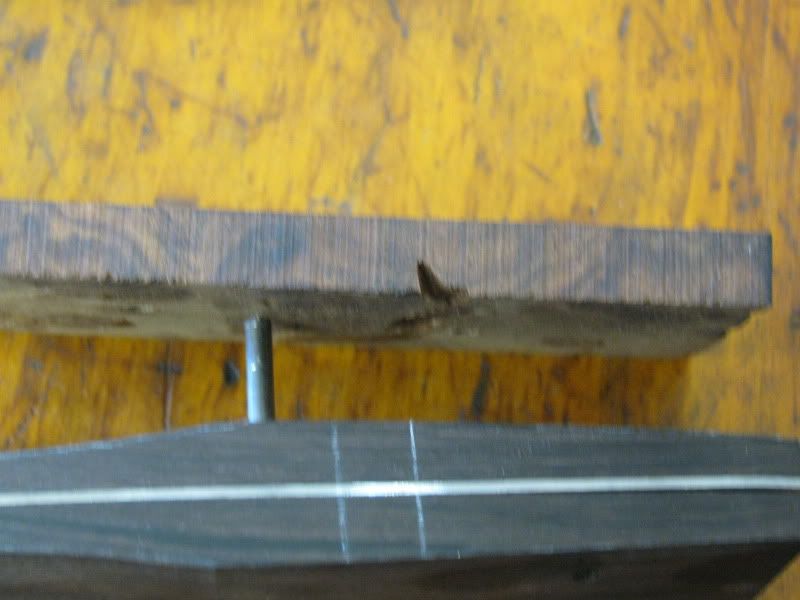
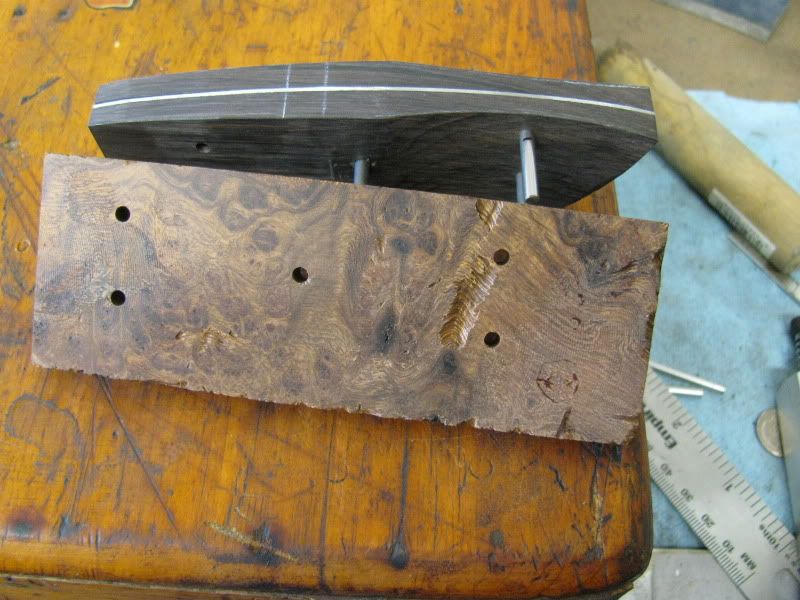
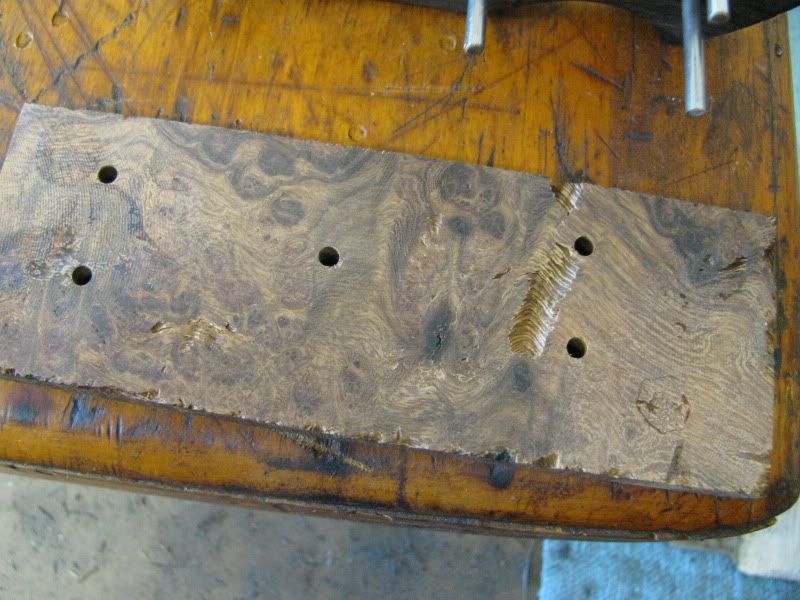
This is the only one left in the shop but here are the pics.

IMG_0513.jpg


IMG_0514.jpg


IMG_0515.jpg
 
That's strange looking. That just popped out? The one pop out looks like it's bordered by the one drilled hole. But that's an awfully odd chunk to go flying out. I'm confused! :)
 
That looks like tear out to me.
Are you milling, planing or sanding these flat?
Figured woods can have tear out when the edge of a cutter catches the wood and pulls out chunks.
I am not explaining myself very well.
 
That is not checking ( at least what I call checking). It is tear out. The wood is being split away from itself. Sharp cutters/drill bits/belts, proper feed rate and speed, avoid pressure. That is where the culprit lies.

Woods with burl and such will do this because there is already a stress in the wood. Heat is another part of the equation, causing the piece to pop right out. DI is particularly prone to pieces popping out.

BTW, checking is tiny cracks caused by uneven heating in grinding and finishing as well as by uneven drying.
 
Back
Top