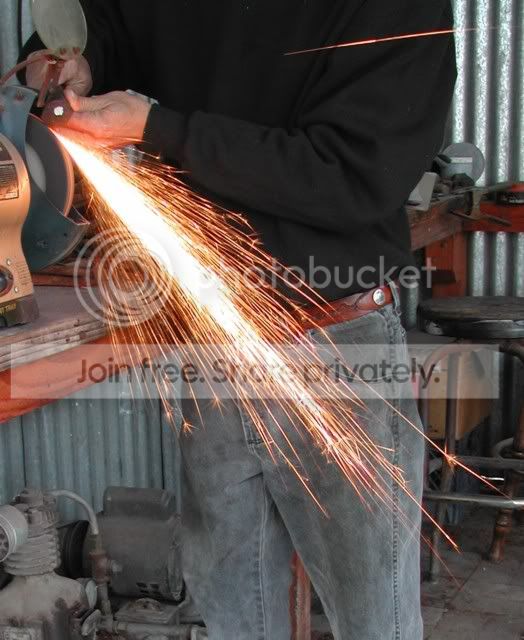
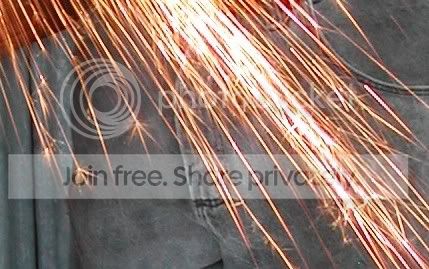
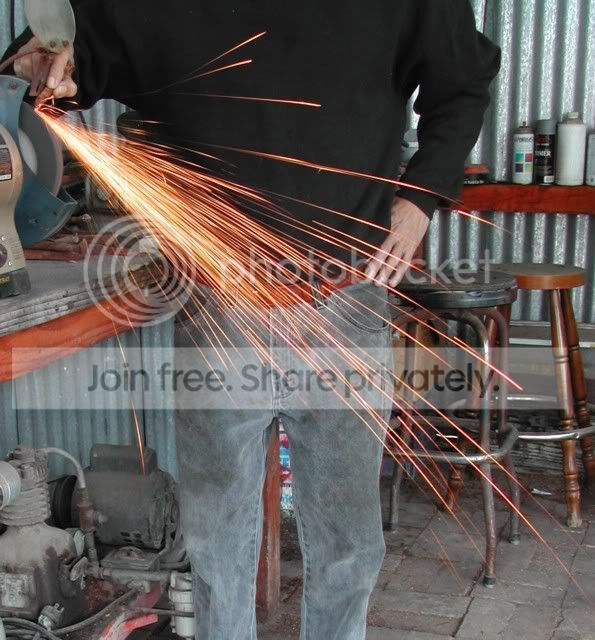
Can you tell by the spark?

11.5% Cr in D2 Don , you had me wondering there , had to look it up . 5% in A-2
__________________
Jack ONeill

You're right Jack, glad you caught it. Got my As' and Ds' confused :o
 
Looks like medium carbon to me, anywhere between .35 and .65,... be my guess. The medium carbon steels tend to spark a lot the same. I'd quench and hardness test it,… air, oil and water, before I'd try to make anything out of it.

If the sparks were burning out closer to the wheel, it would indicate higher carbon content. The medium and lower carbon steels throw sparks further from the wheel. You can't always tell by the branching and starbursts.
 
Here's a piece of railroad spike steel.
9663b0e5.jpg


starbursts.jpg
 
Here's virtually no carbon.

Look at the distance from the wheel, and the lack of starbursts...

d5ff17ce.jpg
 
Last edited:
Heh, this thread is making me want to go do some spark testing. :) Nice Pics!

If it wasn't this temperature I might just go do that.

The first time I ground a differentially hardened 1095 blade it took me a few seconds to figure out what was up with the different sparks from the hard and soft areas.
 
isn't it true that the grinder test will only really work for comparison when based upon the same (or similar) grinder being used? Something along the lines of the same steel will throw different sparks using a stone wheel grinder, and angle grinder, chop saw,etc. when i heard it, it made sense because if nothing else, the speed of the grinder would play a part in how farthe sparks were thrown.
 
Phil: That was very interesting showing the difference is spark when two samples were shown, hardened and unhardened were tested and compared using the same steel sample. I have noticed a difference in spark between soft and hard 52100 also.
 
isn't it true that the grinder test will only really work for comparison when based upon the same (or similar) grinder being used? Something along the lines of the same steel will throw different sparks using a stone wheel grinder, and angle grinder, chop saw,etc. when i heard it, it made sense because if nothing else, the speed of the grinder would play a part in how farthe sparks were thrown.


I find that the pressure applied has a lot to do with how far sparks will fly. light pressure = short distance, heavy pressure = longer distance. This is only verified on a belt grinder and regardless of speed of the media but a faster more powerful machine may make one more likely to use more pressure and thus make sparks fly further, not sure about the other possibilities with different grinding media.
 
isn't it true that the grinder test will only really work for comparison when based upon the same (or similar) grinder being used? Something along the lines of the same steel will throw different sparks using a stone wheel grinder, and angle grinder, chop saw,etc. when i heard it, it made sense because if nothing else, the speed of the grinder would play a part in how farthe sparks were thrown.

I know from doing these few that the Grade 4 Titanium needed much more pressure to make it spark and pop like what is seen in the photo I posted compared to the pressure of the others which where all done at the same speed @ 60 on a vari Burrking and used Norton Blaze 80g belt the other difference was the thickness of the scrap which I don't know if this changes things?...given all the material out there today both in belts and stock that would be one heck of a chore making a kinda-standard spark test gallery :eek: but fun:thumbup:
 
Yes,… pressure, amount of surface area in contact, and the wheel grit and speed do have an effect,... naturally. It's best to do comparison testing because of this. Comparing pieces of known steels to the sample being tested and trying to keep the variables constant.
 
W2 from Don Hanson:

W2%20from%20Don%20Hanson.jpg


O-1 Soft:

O-1%20soft.jpg


O-1 Hard:

O-1%20Hard.jpg


1084 bar HR as rolled, from admiral:

1084%20soft.jpg


1084 hardened:

1084%20hard.jpg


1095 bar as rolled:

1095%20bar%20as%20rolled.JPG


1095 bar hardened:

1095%20Hardened.jpg


52100 annealed round bar:

52100%20round%20annealed%20admiral.jpg


52100 Hardened:

52100%20hardened.jpg


more to come...
 
CruForge V Bar as rolled: I took this shot twice and both were the same...

cruforge-v%20bar%20as%20rolled.jpg


CruForge V Hardened:

CruForge-V%20Hard.jpg


1962 Ford Galaxie Leaf spring:

1962%20Ford%20Leaf%20Spring.jpg


Circular Saw Blade (hardenable):

circular%20saw%20blade.jpg


M42 End Mill:

m42%20end%20mill.JPG


Hss Drill bit:

HSS%20drill%20bit.JPG


Fence Post:

fence%20post.JPG


Bed Frame:

bed%20frame.JPG


Cheap Chinese File - I ground quite a bit away before taking the pic, to see if it was just carburized or case hardened.

cheap%20chinese%20file.jpg


Rebar:

rebar.JPG
 
It sure does look like HC steels fairly consistently spark more dynamically when hardened than when soft. The hardened 52100 spark density and intensity was amazing. It's nearly pure white light, almost as if magnesium was burning!
 
Makes me wonder if tempering to more or lesser degrees would affect the spark too. I know for a fact that the 1084 and 52100 hardened samples were not tempered, both were blades that I broke after hardening, as far as I recall, the other hardened blades were tempered.
 
Great pix! I've found the drill bits don't spark much either.

Generally when spark testing, higher wheel speeds work best... the faster the better. Also, try not to throw the sparks straight down, but out more horizontally. This makes it easier to judge the distance from the wheel.
 
Back
Top