Carbon Fiber 101

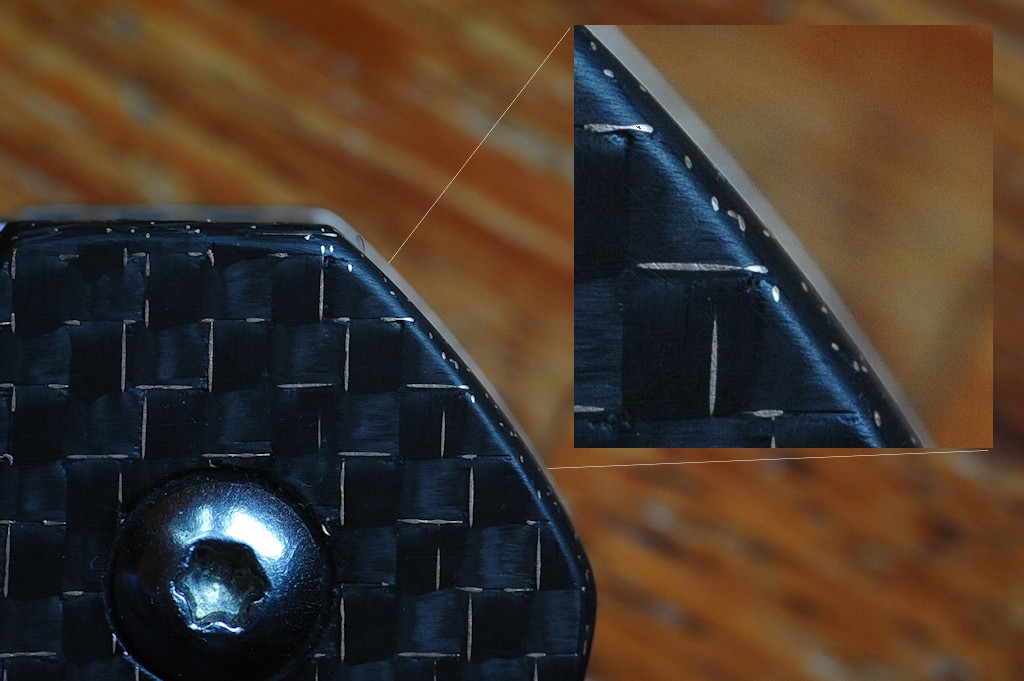
Well, seeing is believing so I grabbed a macro lens and took a quick and dirty closeup for you (natural light, freehand, so it's not perfect):

88rUws4.jpg


The stuff is pretty nasty looking at this magnification, but it's gorgeous in person. The surface on top of the weave is perfectly smooth, and you can see where Barry shaped the edges that the copper wire doesn't protude at all.
Thanks. That's probably why Rycen put the condition in his statement that LSCF has to be finished properly.
 
I always thought CF would make a knife considerably more expensive. But after checking out the Sage and Chap (and their more than reasonable prices) , I couldn't be more wrong.
 
As someone that has used LSCF extensively, as well as regular carbon fiber, the material has to be sanded with several different grits of sand paper to get rid of the tips of the copper. And I've gotten my share of nasty slivers of copper in my fingers. They hurt. Alot!. I've gotten slivers of regular c/f, too. One of these days, I gotta retire:rolleyes:

Greg! Thanks for posting pics of my work. You're a PRO!
 
Last edited:
As someone that has used LSCF extensively, as well as regular carbon fiber, the material has to be sanded with several different grits of sand paper to get rid of the tips of the copper. And I've gotten my share of nasty slivers of copper in my fingers. They hurt. Alot!. I've gotten slivers of regular c/f, too. One of these days, I gotta retire:rolleyes:

Greg! Thanks for posting pics of my work. You're a PRO!

No, thank you--I love this knife.

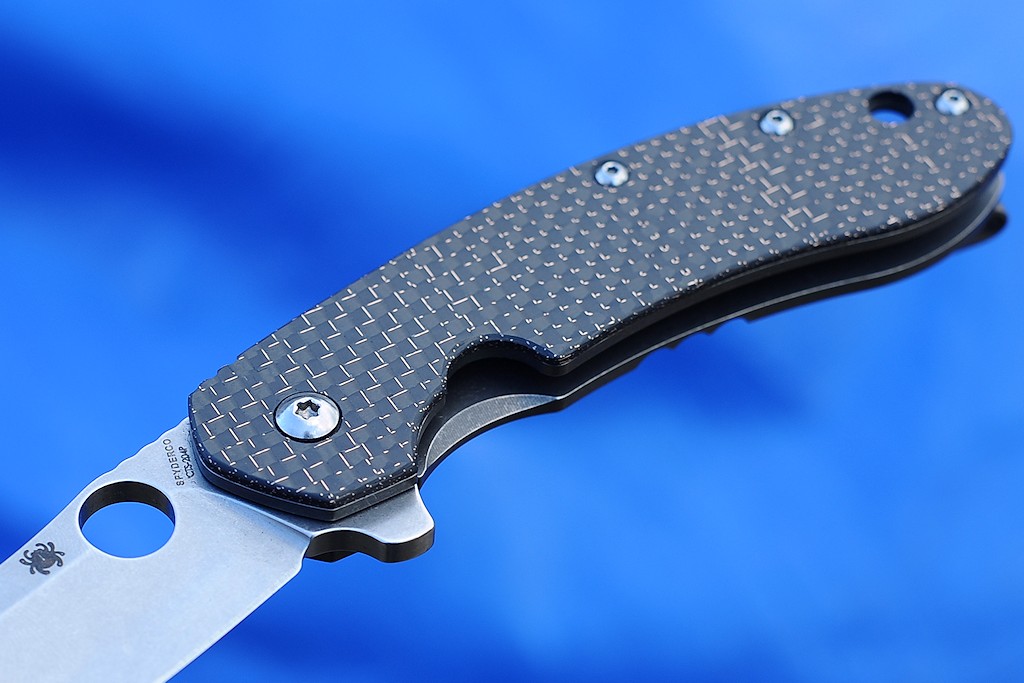
Here's one more shot. I was grabbing a beverage this evening and set up an impromptu portrait of your work:

XaxFz5s.jpg


Couldn't be much happier . . .
 
I have absolutely zero experience with carbon fiber as a handle material. From what I have read I understand that it is very strong and very light. But before I pull the trigger on the sexy Sage 1 , I had some questions for any CF pro out there :

(1) Is carbon fiber made of actual fibers of just carbon ? Is it blended with anything else ?

(2) What does "peel ply" cf mean ?

(3) Are there any obvious draw backs to owning a knife (like the Sage 1) with a cf handle ?

Let the learning begin ...
"Carbon Fiber" is a somewhat misleading term. Carbon fibers themselves are just that, very thin strands of carbon. Like other fibers, carbon fiber can be woven into fabric or chopped up into short lengths called flock. Like other fabrics, carbon fiber fabric can be stacked in layers and coated with a resin of some kind to for a composite material. Like other composites, that composite can be made in various thicknesses. As with other flocks, carbon fiber flock can be mixed with plastics, like nylon, to form a reinforced version of that plastic. Like many other materials, multiple thin layers of CF composite can be laminated together or a single layer of carbon fiber composite material can be laminated with another material. Like its G-10 counterpart, peel ply CF composite simply adds a surface texture to the resin before it hardens. I will say that, in my experience, peel ply CF retains its texture much better than peel ply G-10.

As for drawbacks, I can't think of a single handle material that doesn't have some but, IMHO, CF composites and laminates have fewer than most.
 
I've fondled every millimeter of this one and there are no copper pokey bits. It's smooth and perfect, as far as I can tell. That may just be Barry H. doing a great job of finishing it, but thought I'd give you another data point:

2VZ3ZqP.jpg


I do like the appearance of the LSCF, it gives it a warmer color, but then again I really like normal CF also.

That looks clean. I like it.
 
Just found this recent thread looking for something else, and feel the need to interject. "Peel ply" is a term that few here on BF seem to understand properly. While I was in college for my Aerospace Engineering degree, I worked at a composites shop for a couple years building small carbon fiber wind turbine blades (relatively small; these were roughly 7' long).

The stuff that gives the "peel ply" texture is actually a type of thin plastic film called, surprisingly enough, peel ply.

Peel ply has that texture you see in the final composite molded into it when it is made, epoxy will not stick to it (the primary reason it is used), it is porous by design, and it is the final (top) layer in the laminate prior to vacuum bagging. There are many, many different textures of peel ply available, and some are even smooth. There is an absorbent pad added on top of the peel ply, and then you stick everything in a special bag and apply a vacuum to suck the excess epoxy up and out of the laminate, through the peel ply, and into the absorbent matting. An ideal composite has the absolute minimum amount of epoxy left in it; ideally just enough to bond the fibers.

This process is how you get the air voids out of the carbon fiber (ideally), and after it has cured the peel ply is peeled off of the composite laminate leaving that texture you are familiar with behind. Unless you are using a really finely woven fiber cloth in the composite, the actual texture is nothing more than cured epoxy resin. Thusly, this texture will eventually erode away due to wear.

So that's that. :D
 
Just found this recent thread looking for something else, and feel the need to interject. "Peel ply" is a term that few here on BF seem to understand properly. While I was in college for my Aerospace Engineering degree, I worked at a composites shop for a couple years building small carbon fiber wind turbine blades (relatively small; these were roughly 7' long).

The stuff that gives the "peel ply" texture is actually a type of thin plastic film called, surprisingly enough, peel ply.

Peel ply has that texture you see in the final composite molded into it when it is made, epoxy will not stick to it (the primary reason it is used), it is porous by design, and it is the final (top) layer in the laminate prior to vacuum bagging. There are many, many different textures of peel ply available, and some are even smooth. There is an absorbent pad added on top of the peel ply, and then you stick everything in a special bag and apply a vacuum to suck the excess epoxy up and out of the laminate, through the peel ply, and into the absorbent matting. An ideal composite has the absolute minimum amount of epoxy left in it; ideally just enough to bond the fibers.

This process is how you get the air voids out of the carbon fiber (ideally), and after it has cured the peel ply is peeled off of the composite laminate leaving that texture you are familiar with behind. Unless you are using a really finely woven fiber cloth in the composite, the actual texture is nothing more than cured epoxy resin. Thusly, this texture will eventually erode away due to wear.

So that's that. :D

Great info. I'll just add that, based on personal experience, I think the texture created by the epoxy resin used with peel-ply CF, and specifically pee-ply CF from Japan used on the CF Stretch, stands up better to pocket wear than the texture from the epoxy resin used in Spyderco's G-10. I have a CF Stretch that has seen several years of pocket carry and another that's never been carried and, to me at least, they look and feel identical.
 
SpyderPhreak , good stuff right there. You really know your CF. Glad you're here to teach me this stuff.
 
Back
Top