I am new to collecting knives. I'm really enjoying the diversity and designs. Incredible artwork and talent out there with so many choices. I've noticed a lot of carbon fiber versions of a knife with otherwise a titanium, G10, or aluminum handle. The carbon fiber version fetches a higher price. Is this a new trend? Are they desirable from a collector standpoint? Reason I ask is that it seems to me that carbon fiber would be less expensive to manufacture than metal. It does have an exoctic appeal, but I'm surprised that a carbon fiber version commands a premium over a machined metal part. Am I wrong on this?

-
The BladeForums.com 2024 Traditional Knife is available! Price is $250 ea (shipped within CONUS).
Order here: https://www.bladeforums.com/help/2024-traditional/
You are using an out of date browser. It may not display this or other websites correctly.
You should upgrade or use an alternative browser.
You should upgrade or use an alternative browser.
Carbon fiber value
- Thread starter Chessie
- Start date

- Joined
- Nov 10, 2013
- Messages
- 189
Welcome! Carbon fiber has become more readily available and less expensive, so that's usually not the main reason for the premium in cf versions of knives. Carbon fiber is harder on certain tools (bandsaw blades and/or carbide bits, etc.) and there's additional cost with that. It's also pretty much the messiest handle material to work with and the dust is a health hazard. For those reasons, the bump in price is often justified, imo.

- Joined
- Jul 30, 2006
- Messages
- 45,245
I am new to collecting knives. I'm really enjoying the diversity and designs. Incredible artwork and talent out there with so many choices. I've noticed a lot of carbon fiber versions of a knife with otherwise a titanium, G10, or aluminum handle. The carbon fiber version fetches a higher price. Is this a new trend? Are they desirable from a collector standpoint? Reason I ask is that it seems to me that carbon fiber would be less expensive to manufacture than metal. It does have an exoctic appeal, but I'm surprised that a carbon fiber version commands a premium over a machined metal part. Am I wrong on this?
They look nice. They are less dense than metal, so the knife is lighter.
BUT, Carbon fiber handles cost more to produce than a machined piece of metal.
They are laminates made of carbon fiber reinforced epoxy resin.
The carbon fiber itself costs a lot to fabricate. It's a complex process.
Then the fiber has to be woven into fabric.
Then the fabric has to be impregnated with resin to form "prepreg".
Then you have to form the laminate out of layers of prepreg and cure it in either a heated press our an autoclave.
Then you have to cut blanks.
Then you have to machine the blanks into the final handle shape.
As an aerospace materials engineer, I am familiar with the materials and processes.
Very informative...They look nice. They are less dense than metal, so the knife is lighter.
BUT, Carbon fiber handles cost more to produce than a machined piece of metal.
They are laminates made of carbon fiber reinforced epoxy resin.
The carbon fiber itself costs a lot to fabricate. It's a complex process.
Then the fiber has to be woven into fabric.
Then the fabric has to be impregnated with resin to form "prepreg".
Then you have to form the laminate out of layers of prepreg and cure it in either a heated press our an autoclave.
Then you have to cut blanks.
Then you have to machine the blanks into the final handle shape.
As an aerospace materials engineer, I am familiar with the materials and processes.
I am new to collecting knives. I'm really enjoying the diversity and designs. Incredible artwork and talent out there with so many choices. I've noticed a lot of carbon fiber versions of a knife with otherwise a titanium, G10, or aluminum handle. The carbon fiber version fetches a higher price. Is this a new trend? Are they desirable from a collector standpoint? Reason I ask is that it seems to me that carbon fiber would be less expensive to manufacture than metal. It does have an exoctic appeal, but I'm surprised that a carbon fiber version commands a premium over a machined metal part. Am I wrong on this?
Does carbon fiber hold the same premium in resale as it does when buying new? I have been collecting knives more as tools for use as opposed to treasure and store. I have a couple Sebenzas that I leave in the drawer for the most part. From the perspective of intrinsic value of the material itself being a composite, do you think it makes the knife more valuable than its metal version in the future? I guess what I'm getting at is that carbon fiber in a knife doesn't seem like it stands the test of time, similar to plastics. Another analogy is a mechanical watch. While circuitry is great, a quartz watch rarely appreciates, but all metal mechanical watches (Rolex, AP, etc) go up in value.
I can see wood, titanium, steel, and even aluminum holding value, but carbon fiber seems to lack a "soul" so to speak. Am I completely off base?
I can see wood, titanium, steel, and even aluminum holding value, but carbon fiber seems to lack a "soul" so to speak. Am I completely off base?

- Joined
- Feb 27, 2014
- Messages
- 17,936
I've noticed a lot of carbon fiber versions of a knife with otherwise a titanium, G10, or aluminum handle. The carbon fiber version fetches a higher price.
CF more than titanium? No, that's incorrect. Most knives (framelocks, for example) with a CF presentation side and titanium lock side will cost less than the same knife with dual ti handles.
Does carbon fiber hold the same premium in resale as it does when buying new? I have been collecting knives more as tools for use as opposed to treasure and store. I have a couple Sebenzas that I leave in the drawer for the most part. From the perspective of intrinsic value of the material itself being a composite, do you think it makes the knife more valuable than its metal version in the future? I guess what I'm getting at is that carbon fiber in a knife doesn't seem like it stands the test of time, similar to plastics. Another analogy is a mechanical watch. While circuitry is great, a quartz watch rarely appreciates, but all metal mechanical watches (Rolex, AP, etc) go up in value.
I can see wood, titanium, steel, and even aluminum holding value, but carbon fiber seems to lack a "soul" so to speak. Am I completely off base?
Yes, completely...
ZT models 0454 and 0777 are entirely CF and they can resale (new) around 1.5x their original price or more. It's not about what the handle is made of, it's more complicated than that. I'm not sure what you're basing your questions off of

- Joined
- Nov 10, 2013
- Messages
- 189
Cf's resale value is dependent on a number of things. Personal preference of materials and its rarity are big factors. Say, there are 500 units of a folding knife and 450 of them have completely titanium handles while the remaining 50 have cf scales. In this case, only 10% of the available knives are cf and I'd say that more than 10% of the population would prefer cf (perhaps a longrunning fad, but cf is still extremely popular) over titanium. Now it's a matter of supply and demand where the cf versions would command a higher resale value.
If it was the other way around, 450 cf and 50 Ti, then the Ti versions might appreciate more or depreciate less compared to the cf.
If it was the other way around, 450 cf and 50 Ti, then the Ti versions might appreciate more or depreciate less compared to the cf.
But if 10% of new buyers preferred carbon fiber initially, and 90% went metal, doesn't that mean that 90% of the buyer pool in resale would drive a higher demand for metal? In this case, the cf supply is less, yet so to is the demand?
By the way, Merry Christmas!
By the way, Merry Christmas!
Last edited:

- Joined
- Jan 31, 2012
- Messages
- 4,704
Does carbon fiber hold the same premium in resale as it does when buying new? I have been collecting knives more as tools for use as opposed to treasure and store. I have a couple Sebenzas that I leave in the drawer for the most part. From the perspective of intrinsic value of the material itself being a composite, do you think it makes the knife more valuable than its metal version in the future? I guess what I'm getting at is that carbon fiber in a knife doesn't seem like it stands the test of time, similar to plastics. Another analogy is a mechanical watch. While circuitry is great, a quartz watch rarely appreciates, but all metal mechanical watches (Rolex, AP, etc) go up in value.
I can see wood, titanium, steel, and even aluminum holding value, but carbon fiber seems to lack a "soul" so to speak. Am I completely off base?
This is completely incorrect, watches don't go up in value unless they are some kind of crazy limited release or something. Just like in knives, the construction/materials in a knife have almost nothing to do with the post purchase value.
It's about brands, overall desirability, availability etc.
- Joined
- Nov 10, 2013
- Messages
- 189
But if 10% of new buyers preferred carbon fiber initially, and 90% went metal, doesn't that mean that 90% of the buyer pool in resale would drive a higher demand for metal? In this case, the cf supply is less, yet so to is the demand?
By the way, Merry Christmas!
You're correct, for the most part. In that scenario, the makers made an accurate call and satisfied the market. Supply met demand. However, current trends suggest that cf preference is often higher than what's available. Spyderco released the M4 Para 2 in jade G10 and carbon fiber versions this year. Material and manufacturing cost was higher for the cf version and had a higher retail price. Both versions have appreciated in resale value because of their limited run. Since the resale values of each haven't equalized, this is a testament to the popularity of the cf even with its higher start price (retail value).
Merry Christmas to you as well!
Last edited:

- Joined
- Apr 4, 2007
- Messages
- 8,578
This is completely incorrect, watches don't go up in value unless they are some kind of crazy limited release or something. Just like in knives, the construction/materials in a knife have almost nothing to do with the post purchase value.
It's about brands, overall desirability, availability etc.
Quoted for truth. I wear a $3,000 glycine with 7750 valjoux that I would struggle to get $400 for. I see certain quartz invictas become more collectable and fetch more money. And that is a crap brand that just happens to have a large following.
This is completely incorrect, watches don't go up in value unless they are some kind of crazy limited release or something. Just like in knives, the construction/materials in a knife have almost nothing to do with the post purchase value.
It's about brands, overall desirability, availability etc.
Watches absolutely can go up in value. Generic movements shared between brands, no. In house movements, yes....in many many cases. Takes time. If you bought a Submariner in the 80's and still have it, you have a substantial return and it can be considered an investment. I was relating the same to knives. Limited productions and the materials used per se.
Thanks for the insight from all the replies. I was looking at knife collecting from the standpoint of investment and wanted to see how the community felt about materials like carbon fiber and even G10 to a certain extent.
- Joined
- Feb 27, 2014
- Messages
- 17,936
I was looking at knife collecting from the standpoint of investment...
Unless you're buying solid gold blades, knives are a terrible "investment"...
The market for knives is driven by demand, not material.
- Joined
- Jan 31, 2012
- Messages
- 4,704
Watches absolutely can go up in value. Generic movements shared between brands, no. In house movements, yes....in many many cases. Takes time. If you bought a Submariner in the 80's and still have it, you have a substantial return and it can be considered an investment. I was relating the same to knives. Limited productions and the materials used per se.
Thanks for the insight from all the replies. I was looking at knife collecting from the standpoint of investment and wanted to see how the community felt about materials like carbon fiber and even G10 to a certain extent.
Citing one example of a watch from 30 years ago is not anywhere close to saying ALL mechanical watches go up in value.
Also, I can almost guarantee that had you put that money for a Submariner in an investment fund or bought gold with it 30+ yrs ago, it would be worth way more than the Sub.
Same thing with cars, guns, knives, whatever, they will rarely, if ever beat investments.
CF now is very common thing. It's even in some cheap Asian knives. And btw G-10 dust isn't healthy either.
I remember how people react at CF in ~2008. It was something very exclusive and special. Spyderco Military CF with BG42 steel for example. Now some of us are bored with CF, titanium etc. So manufacturers and makers have harder job to impress customers.
My CF custom from LKW Knives, it wasn't more expensive because CF. CF is nice but I don't think that's more practical than G-10 or linen micarta.
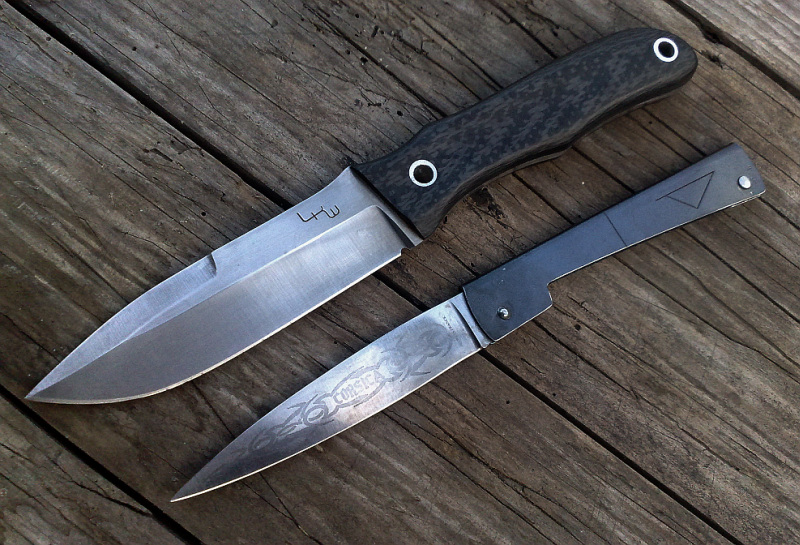
I remember how people react at CF in ~2008. It was something very exclusive and special. Spyderco Military CF with BG42 steel for example. Now some of us are bored with CF, titanium etc. So manufacturers and makers have harder job to impress customers.
My CF custom from LKW Knives, it wasn't more expensive because CF. CF is nice but I don't think that's more practical than G-10 or linen micarta.
Last edited:
Aesthetically, these materials are appealing. Depending on the way the fibres are arranged, or add in colours produces beautiful pattern to compliment a blade. Samelike damascus, they are amazing and imo more for collection rather than practical usage. As an engineer by trade, i'd prefer a full cf handles rather than combination. They are difficult to produce and machined, hench the higher cost, and some folders do suffer dimensional issues such as centering etc. Exposed cf if rubs against itself or other materials do wear out. I used to have a folder with cf handles, over the years, the pivot area wore out and blade cetering suffers. Even the countersunk area where the screw sits do wear when mating surfaces meet with the hardware which is usually titanium or stainless steel variant. Personally, I wouldn't mind owning a few pieces with cf handles, but at current pricing they are too costly for me. At the moment, I'll stick to those with micarta, g10 or titanium.
In a way that's true,?.. I've noticed a lot of carbon fiber versions of a knife with otherwise a titanium, G10, or aluminum handle. The carbon fiber version fetches a higher price... It does have an exoctic appeal, but I'm surprised that a carbon fiber version commands a premium over a machined metal part?
IMO knife manufacturers in china
Most likely have the ability change that market perception...