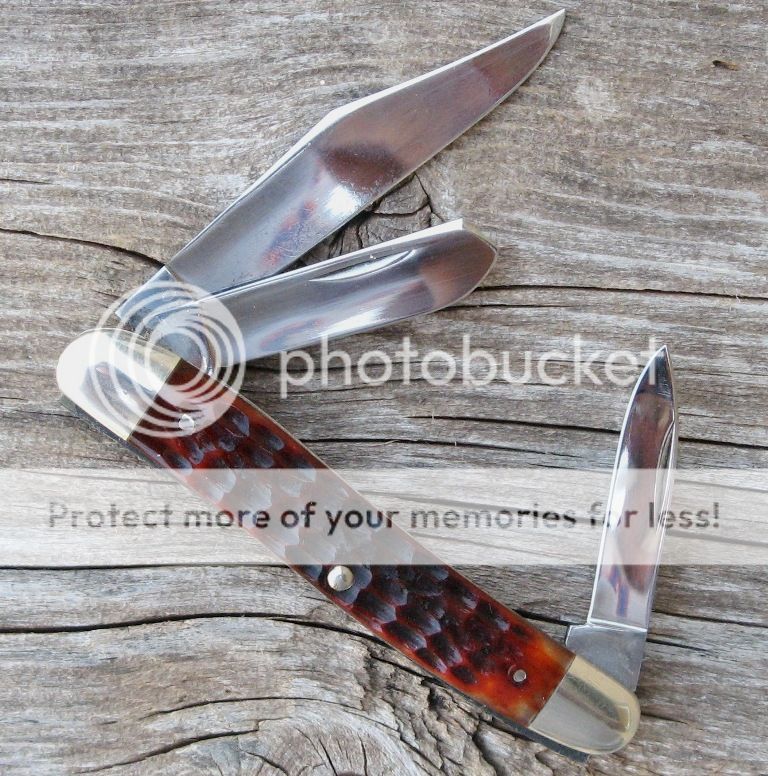
Case XX goodness...

I compared this knife to the modern age 087 in black composition and tru-sharp blades. It's interesting to me that the blades on the newer iteration are thicker than on the XX era knife. This, in turn, makes the whole knife thicker. I wonder why the change in blade thickness? Is it due to the hollow grinds Case now uses on many of their knives? I will try to post some pics later.

That is interesting. I have noticed, with smaller knives, many times the older ones are made from thinner blade stock, and often have some fantastic springy temper (great heat treat). On a smaller knife, I view that as a good thing. Makes for great slicing, and whittling fans love thinner blades (or so I hear).

Another curiosity to me, I've noticed that larger patterns from Case are often thicker-bladed in the older versions. I have a couple of folding hunters from the 60s/70s era, and a 1970 large Sod Buster, all of which use thicker blade stock than the modern versions.

I suspect part of this might just be due to changes in the thickness standards of available blade steel (sheet/bar stock), over the decades. I seem to recall reading some mention of that, probably here on the forums, but I'm not sure.
 
Last edited:
I compared this knife to the modern age 087 in black composition and tru-sharp blades. It's interesting to me that the blades on the newer iteration are thicker than on the XX era knife. This, in turn, makes the whole knife thicker. I wonder why the change in blade thickness? Is it due to the hollow grinds Case now uses on many of their knives? I will try to post some pics later.

Depends on what you mean by "thicker blades". A hollow grind will not affect the thickness at the spine, but the body of the blade will be thinner.
 
Depends on what you mean by "thicker blades". A hollow grind will not affect the thickness at the spine, but the body of the blade will be thinner.

:thumbup:
Many (maybe most) older Case knives were flat-ground, so that could definitely make them 'thicker' near the edge, compared to most of the hollow grinds on Case's blades these days (with a few exceptions).
 
I recently picked up a slimline trapper from the same era with the same color of bone covers. Pictures do not do them justice, they are beautiful and much different than todays versions. Wonderful find.
 
Thats a great find, and a great pattern too. Beautiful bone on yours. They just don't make em like that anymore.
Here's one I've had for some time now. It sees pocket time, and even if I don't have anything to cut, it is great to just pull out, and admire.

redbone1.jpg
 
I wish my photo skills were good enough to do the color of this bone justice.
Andrew

I think your pics are OK. Based on my experience, the brightness of the wood you have the knife laying on made the camera show color of the bone darker than it really is. I take similar pictures in the shade outdoors early in the morning. Wood grain is a good surface, but I've had better luck with duller, more neutral tan or beige wood color, not stained or varnished.

That's a great knife. I bet you could not get out of the antique shop fast enough when you made the purchase. And you are right, it's a "large peanut".

Here's one the same size with three blades. 087PE pattern 1965-1969 vintage.

case_087pe_b.jpg
 
Beautiful knife. As far as carrying it or not, in my opinion, there is no wrong answer here. Do what you like. The answer might be in what you had to pay for it. If it was expensive, then I'd be tempted to find the newer, less expensive version to use and keep it as a collector/heirloom piece.

Ed J
 
Back
Top