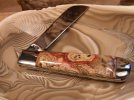
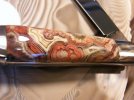
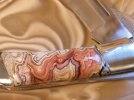
powernoodle -

Geeze I had to look that one up but it certainly applies...
Fractals and regular roughness
Although Mandelbrot coined the term fractal, some of the mathematical objects he presented in The Fractal Geometry of Nature had been described by other mathematicians. Before Mandelbrot, they had been regarded as isolated curiosities with unnatural and non-intuitive properties. Mandelbrot brought these objects together for the first time and turned them into essential tools for the long-stalled effort to extend the scope of science to non-smooth objects in the real world. He highlighted their common properties, such as self-similarity (linear, non-linear, or statistical), scale invariance, and a (usually) non-integer Hausdorff dimension.
He also emphasized the use of fractals as realistic and useful models of many "rough" phenomena in the real world. Natural fractals include the shapes of mountains, coastlines and river basins; the structures of plants, blood vessels and lungs; the clustering of galaxies; and Brownian motion. Fractals are found in human pursuits, such as music, painting, architecture, and stock market prices. Mandelbrot believed that fractals, far from being unnatural, were in many ways more intuitive and natural than the artificially smooth objects of traditional Euclidean geometry:




 Un Da/// real that is just awesome!!!!!:thumbup: