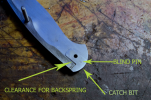
Catch bits

Joined
Jun 3, 2017
Messages
811
I usually wrap the catch bits around the end of the springs and if done well the back of the knife looks solid when the blade is opened. I solder the catch bit and bolster all together at the same time. Sometimes things slide around a bit on me and i get a little gap. I think i may start filing off the high spots of solder after tinning so that the pieces fit flatter before melting it all together. It is also next to impossible to know if you are perfectly lining up the pieces right before soldering. I also have a hard time with solder squeeze out in the little pocket where the spring goes. Any tips?

NJPpArL.jpg
 
I've never seem anything quite like it! Why construct a knife that way?
 
Well, it really depends i guess. If the bolsters are ground on the ends very close to the spring end, then just make the catch bit run parallel to the spring and no notch. This makes a square ends on the knife, and is fine for some styles. If you want the ends to be rounded (which usually means they extend out past the end of the spring), and you run the catch bit parallel to the spring, then when you look at the back of the knife there is a gap between the tang and the liner. The purpose is ti eliminate that gap. But, it is possible to end up with a little hole if your fit isnt good. Compare the top and bottom of the pic. I have seen store bought knives do catch bits like this.
 
Randy,

when I solder pre-tinned bolsters to liners, I flatten the soldered surface of the bolster to get rid of the high spots of solder so the two surfaces (bolster and liner are in good contact. I put a drop or two of liquid flux on the cleaned liner first, then lightly clamp with a large C shaped vise-grip, add a little more flux so it flows around the joint, then heat, then when the solder melts, introduce a little more solder and watch it flow through all the joints.

There is a thread here on bladeforums, where Ken Erickson discussed catch bits. The photos are gone now (thanks photobucket) as are almost all of the rest of the photos that Ken shared on his WIPs. Ken secured the catch bits in place with a blind pin. I don't know if he soldered also ...... I suspect not as he did mostly integral bolsters.

If you'd like I can email you the PDF of the original bladeforums thread with photos (assuming that's not breaking any rules here)

Saludos
J

JDWARE KNIVES
 
Randy,

when I solder pre-tinned bolsters to liners, I flatten the soldered surface of the bolster to get rid of the high spots of solder so the two surfaces (bolster and liner are in good contact. I put a drop or two of liquid flux on the cleaned liner first, then lightly clamp, add a little more flux so it flows around the joint, then heat, then when the solder melts, introduce a little more solder and watch it flow through all the joints.

There is a thread here on bladeforums, where Ken Erickson discussed catch bits. The photos are gone now (thanks photobucket) as are almost all of the rest of the photos that Ken shared on his WIPs. Ken secured the catch bits in place with a blind pin. I don't know if he soldered also ...... I suspect not as he did mostly integral bolsters.

If you'd like I can email you the PDF of the original bladeforums thread with photos (assuming that's not breaking any rules here)

Saludos
J

JDWARE KNIVES

Do you an email you dont mind being public? I looked on your web site and didnt see one. My email is my full name and for persec reasons i would rather not post it.
 
Oh ok, i can see now how a pin could work. I guess you could glue it and get everything set in place how you need it, then drill the blind pin hole and break the glue loose. May not need any solder but even if you did the two pins (pivot and blind) would ensure good aligment. I like it.
 
Last edited:
If I had to solder two different pieces at two different locations at the same time to the same liner, I'd probably solder the larger bolster first, then clamp it in place while I turned it over to solder the smaller piece on. You could even clamp a little straight edge/guide at the same time to help position the smaller piece. Obviously you want to be mindful of the solder you've already put on the bolster, but I imagine that if carefully done, it could work. You could probably even flow a little more solder into the bolster side if some were to run out, though if fluxed properly, I imagine it'd stay put.
The other option would be pinning the catch bit, or just milling your bolsters and/or catch bit out of the thicker liners.
 
I have thought about getting a mill but honestly when i sit here in my chair and imagine milling out all that waste, having to then surface pieces after milling, the difficulties of getting holes lined up that i dont run into now the way i do things, getting bolsters even on each half, the frustration when i mess up, and just all the additional problems just to avoid having solder joints, i am perfectly content soldering.
 
Back
Top