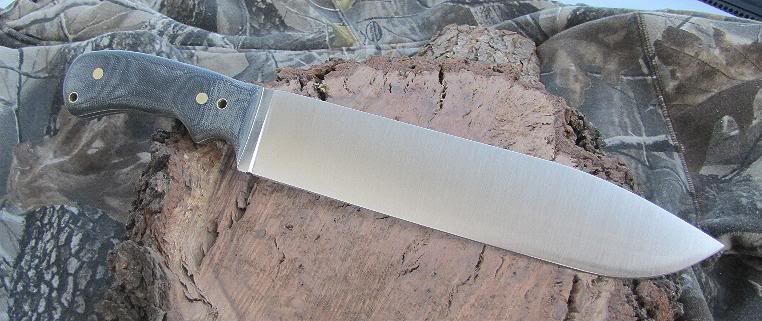
center of balance on big choppers

Joined
Jan 10, 2010
Messages
1,818
just finished (forged to shape) this 13" OAL chopper and it's my first big knife. It's full tang... hard to tell from these pics. So I'm wondering what people are shooting for in terms of balance on these big camp knives? This one is about an inch above the ricasso..


file6.jpg


file1.jpg
 
On the bigger knives I like to make sure I have a really good distal taper it helps to bring the balance point back toward the ricasso. It's hard to tell from the pic's without a shot of the spine how you did yours. But the overall profile looks great and I really like the handle.
 
not sure what people shoot for but the one I made is in about the same place, one inch above the ricasso. seems like it would help if it was top heavy though since you're basically using it like an axe.
 
Choppers need to be front heavy. The sweet spot is usually 1/3 back from the point. Handle length is important also. On blades 7" to 10", I prefer no less then a 5" handle to keep the weight forward.
Scott
 
thanks guys.... i used almost the entire file and there was very little steel to work with in terms of distal taper.. i did as much as my skill allows:

file2.jpg


but you've reminded me why i'd like to do this same knife with 1/4" stock... i guess that is the ticket...
 
My two choppers are very efficient ,designed for the job.
Shawn Knowles camp knife - 8" ,16 oz ,1/4" at thickest - balance 1" in front of guard
Kukri ,similar to military - 12" ,24 oz,1/4" at thickest - balance 2.75 " in front of guard

A full thickness ,full size tang adds no strength where it's needed but the weight puts the balance too far back.
 
I've done several bowies and fighters but no choppers and the balance point I shoot for is at the ricasso. This is where I feel the knife has the best balance. I'm assuming that the thicker blade in choppers is to add in strength and to get the tougher jobs done. What do you chopper makers shoot for in your ricasso thickness and do you prefer full or hidden tang? I've got a big ol piece of 5160 beggin to be forged into a chopper.
 
The front of the tang has the highest stress and that decreases quickly as you go back to the pommel. Tapering the tang works well.
In another forum there was an experiment that was informative. He had two knives , a Busse and a kukri of the same weight.He cut through logs counting the number of strokes to cut through.The kukri cut better [no surprise to me] because the kukri had a tapered tang and put the weight where it was needed -in the blade.The Busse had a full width and thickness tang but that weight was wasted it did nothing.
Pay attention to the front of the tang .See that there are no sharp corners !! Then taper thickness and width .Tapering the thickness may be a challenge but done well looks nice and is a mark of a skilled maker ! Weight up front for choppers !
 
Center of balance is good and well, but for choppers ( and sails) the center of EFFORT is what you want to tune.

If a blade was spine heavy, it might chop inefficiently,even if it balanced well. The effort should apply all the force of the blade at the "sweet spot" .I prefer this spot to be on the edge, about 1/3 back from the tip. Center of balance on choppers is about an inch in front of the ricasso. On a kukri, it is way forward of that. The bigger the chopper, the more the centers need to be moved forward ( within reason).
 
On this chopper I made, the balance point is 1" in front of the plunge lines. Overall it is 15" with a 5" handle. Blade is 10" and the cutting edge is 9 3/4". The sweet spot is 3 1/4" back front the point.
Scott

Picture387.jpg
 
Asking where the balance point (center of mass) should be is sorta putting the cart before the horse. First you need to decide how you want the piece to handle, where you want the "sweet spot" to be, etc., and work from there.

Historically, swords and other edged weapons had to be efficient, so they are a good place to look for guidance. Check out this article: Sword Impacts and Motions The ideas presented there really aren't as complicated as they first seem- pick up a stick and start whackin' stuff as you read.

And here's one instance of how I put these principles into action: Modifying balance for improved performance

On my "fighting" type blades I prefer more tip awareness and cutting power, so I push the "sweet spot" out further than the usual 1/3 more common on "choppers".
 
Back
Top