Ceramic Blade RC

I've never seen hairy glass... :o Am I missing something?


While it might be possible for a ceramic blade to 'grind' away glass in the same fashion that a diamond saw or diamond file can, there are no ceramic blades (or blades of any material) that can 'shave' off a thin slice of it.
(By the way, for you guys who have mothers with crystal stemware, you can fix [smooth out] the chips in them. Use your finest diamond sharpener very gently. Yer ma will luv ya!)

Stitchawl
 
Found this... Still shows diamonds to be hardest.

Mohs scale (mōz)
1. an arbitrary scale used to indicate relative hardness, arranged in 10 ascending degrees: 1, talc; 2, gypsum; 3, calcite; 4, fluorite; 5, apatite; 6, orthoclase; 7, quartz; 8, topaz; 9, corundum; 10, diamond
2. a modification of this scale, retaining its first six minerals and continuing: 7, pure silica glass; 8, quartz; 9, topaz; 10, garnet; 11, fused zircon; 12, corundum; 13, silicon carbide; 14, boron carbide; 15, diamond
Etymology: after F. Mohs (1773-1839), Ger mineralogist
Webster's New World College Dictionary Copyright © 2009 by Wiley Publishing, Inc., Cleveland, Ohio.

Looks as if they just could have used decimal points and retained the 1-10 scale..

Stitchawl
 
..so idk,i know wiki isnt 100% legit but usually it's pretty spot on.

When I was a kid, word was that Jupiter was a giant snowball or some such thing. I recall teachers telling us the supercooled liquid and flowing window glass concepts. One of the footnotes on the Wiki article put the glass issue pretty well:

http://math.ucr.edu/home/baez/physics/General/Glass/glass.html

"There is no clear answer to the question "Is glass solid or liquid?". In terms of molecular dynamics and thermodynamics it is possible to justify various different views that it is a highly viscous liquid, an amorphous solid, or simply that glass is another state of matter that is neither liquid nor solid. The difference is semantic. In terms of its material properties we can do little better. There is no clear definition of the distinction between solids and highly viscous liquids. All such phases or states of matter are idealisations of real material properties. Nevertheless, from a more common sense point of view, glass should be considered a solid since it is rigid according to everyday experience. The use of the term "supercooled liquid" to describe glass still persists, but is considered by many to be an unfortunate misnomer that should be avoided. In any case, claims that glass panes in old windows have deformed due to glass flow have never been substantiated. Examples of Roman glassware and calculations based on measurements of glass visco-properties indicate that these claims cannot be true. The observed features are more easily explained as a result of the imperfect methods used to make glass window panes before the float glass process was invented."
 
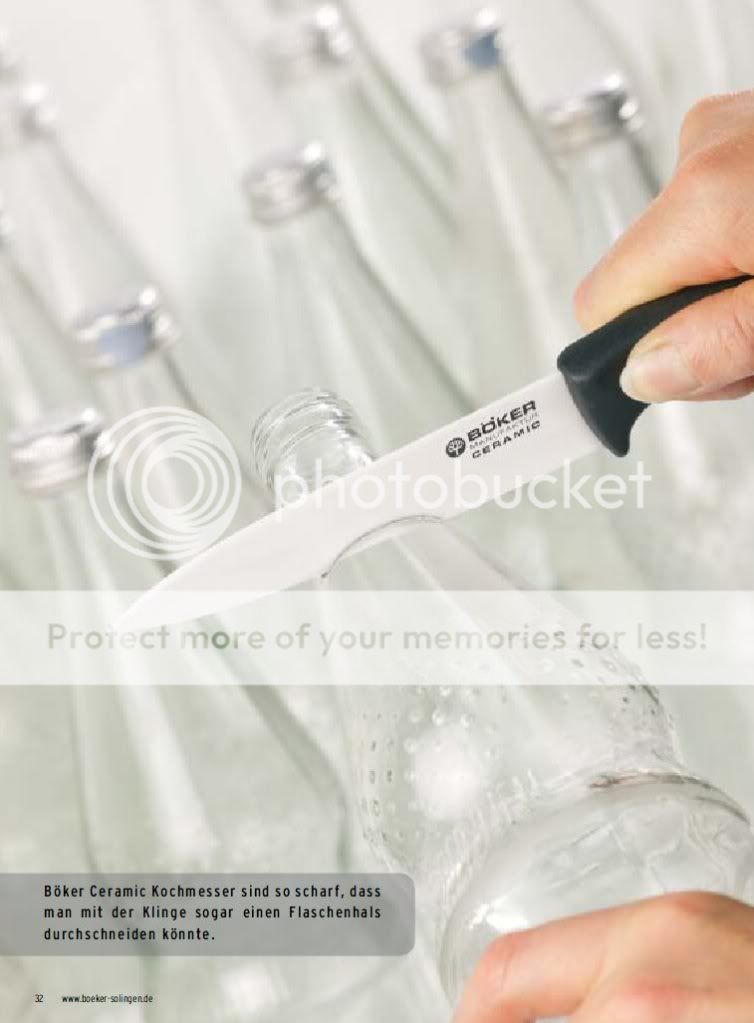
A page from Boker catalogue :)
boker_catalogue.jpg
 
Last year were a TV show in the german Pro7. Boker's sharpenig chief said that their (Kyocera) bades run on 59 HRC. And he cut half a beer bottle with a ceramic kitchen knife. :D
 
Steel hardness is measured by driving a hard steel pin into the steel and measuring the depth of the indentation it makes. If you did that to a ceramic blade, it would shatter or, at least, break in half. So there is no Rockwell C scale hardness for a ceramic blade. The Rockwell C scale is for steel hardness.

I did do some tests several years ago and came to the conclution that a ceramic blade will hold an edge about 4 or 5 times longer than a steel blade hardened to RC 60 or thereabouts. It wasn't a very definitive test because the edges behave and feel different from one another. Ceramic blades can't take a very acute bevel angle because they chip readily so I had to dull down my steel knife to make the comparisons. I was comparing a factory edged ceramic with a personally sharpened steel knife that I tried to get to about the same angle. I would say my results are probably not very definitive but probably reasonbly indicative.
 
Last year were a TV show in the german Pro7. Boker's sharpenig chief said that their (Kyocera) bades run on 59 HRC. And he cut half a beer bottle with a ceramic kitchen knife. :D

Want to buy a bridge? :D

I'd guess one could 'saw' a glass bottle in half using ceramics, but I really doubt that it would 'cut' the glass.


Stitchawl
 
Back
Top