Chainsaw Injury Hemorrhage Control kit - supplementry kit to standard FAK

great kit :thumbup:

i recently attended a chainsaw safety workshop - it was emphasized that your chainsaw injury first aid should be carried with you. it's great to have such a good kit as yours back in the truck - but it's still back in the truck, not with you. a smaller version, with quickclot, on your person at all times is a good idea.

ah yes, let me clarify. On my belt is a pouch with a personal FAK and a Israeli bandage. Thats with me everywhere. In the truck or at the muster station (ussually the truck) ther is the stock FAK and the Pelican case. The truck is never more than about 30 to 50 feet from where i'm cutting.
 
I am having some trouble uploading it from my phone. My computer is not playing nice.:mad:

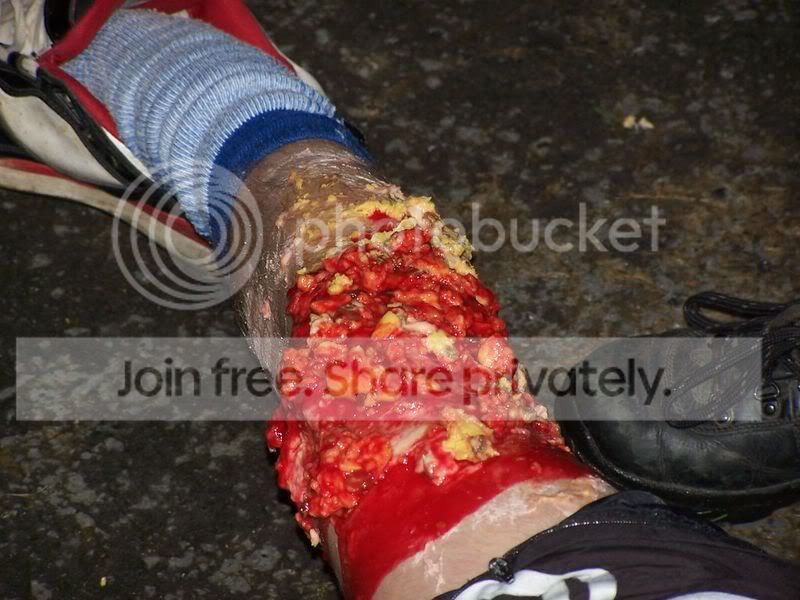
Here is a similar one I dug up though. Enjoy!:eek:

injury.jpg

looks like someone threw up after a cherry pie eating contest.
 
From animals. The vet has stuff for the other situation ;)

Not if your dog is hurt bad in the bush with you. He will require first aid just like a person would prior to recieving advanced medical care.

As far a injuries from animals, you would approach them in much the same way as you would no matter what the mechanism was. Soft tissue traumas concern is controlling the bleeding. First with direct pressure, the progressing all the way to a tourniquet if need be. Irrigation of wound prior to application of dirrect pressure is good, especially with an animal bite, or injury. Then bandage the dressing to hold it in place always alert of not comprimising vascularity(pulses), unless using a tourniquet, which in that case you should release pressure every 10-15minutes to avoid necrosis(tissue dying).

After bleeding is controlled, then pt needs to be taken somewhere for advanced care. That fun Rabies series and such.
 
i've yet to find anyone here that carries it or Celox, nor have i found anyone that trains in it use. Its kinda of a shunned product up here, even the EMTs / firefighters etc dont carry it.

do you know why it's shunned? i know there is concern with tissue damage from the heat generated by quickclot but my understanding is that isn't an issue with celox
 
Unless............There is bowel evisceration (disembowelment). Then you need to irrigate the site well and dress with a saline soaked dressing and top with aluminum foil or saran wrap prior to wraping with kerlex......
 
do you know why it's shunned? i know there is concern with tissue damage from the heat generated by quickclot but my understanding is that isn't an issue with celox


Its not carried by us because of the concern with irigation to visualize the injury and assess damage, and how the hospital is gonna deal with said injury, kinda like liquid stitches. If you are a long time away from the advanced medical care, then in the field it is advisable to use it in a pinch if nothing else is stopping the bleeding. I mean, by whatever means to save your life bro.:thumbup:
 
Not if your dog is hurt bad in the bush with you. He will require first aid just like a person would prior to recieving advanced medical care.

As far a injuries from animals, you would approach them in much the same way as you would no matter what the mechanism was. Soft tissue traumas concern is controlling the bleeding. First with direct pressure, the progressing all the way to a tourniquet if need be. Irrigation of wound prior to application of dirrect pressure is good, especially with an animal bite, or injury. Then bandage the dressing to hold it in place always alert of not comprimising vascularity(pulses), unless using a tourniquet, which in that case you should release pressure every 10-15minutes to avoid necrosis(tissue dying).

After bleeding is controlled, then pt needs to be taken somewhere for advanced care. That fun Rabies series and such.

That's what I thought, but wasn't sure if there was something I was forgetting. I've had some courses on machinery injuries, but most of the course involved dealing with the nature of the machinery accident as opposed to the actual patient. We only briefly went over animal-related stuff, but the first aid was indeed pretty much the same. I plan to take a good first aid course at some point, no idea why I haven't so far. Thanks for the reply.
 
My EMS system does not carry quickclot either, and I've not gotten a really definitive answer as to why. It seems like it may be mostly a cost thing, and that civilian studies aren't really that well documented so far (or so I am told). Luckily we are about a 10 minute ambulance ride to Vanderbilt Trauma, so it isn't a real issue in my Dept. The whole state is covered by Vandy lifeflight, and they may carry it. I know they can give blood en route.

But back on topic, great kit, fantastic idea and well thought out. It makes me happy to know that guys with dangerous jobs are taking safety more seriously. While accidents = job security, I don't wish it on anyone. Hope you never have to use it man.
 
The birds here dont carry it, and we dont either. I believe you might be right on with the civilian study thing, but I know the military has been using it. Watch out, over the next few years prehospital emergency care, as well as the way hospitals are approaching Trauma, is gonna change, dictated by the Docs that are getting all the invaluable trauma training overseas in combat zones. its already started.......
 
Its not carried by us because of the concern with irigation to visualize the injury and assess damage, and how the hospital is gonna deal with said injury, kinda like liquid stitches. If you are a long time away from the advanced medical care, then in the field it is advisable to use it in a pinch if nothing else is stopping the bleeding. I mean, by whatever means to save your life bro.:thumbup:

thanks for the info :thumbup: if i hear the ambulance sirens I'll hold off on the quickclot - but if i'm a few days hike in from the trailhead, well...
 
I had an accident with a chain saw last spring. 36 stitches in my face made a believer in prevention is the best course. I have been using a chain saw for 30 years. Careful is not enough. Thankfully I was not far from the hospital. At first I used my leather glove for a pressure bandage. My son brought me toweling. I should have had him grab a "womans pad" for the bleeding. It would have been enough.
 
Wow. This was my first glimpse at a chainsaw injury. What a mess. While I can't recommend anything to add to the kit from a medical perspective, it seems to me that tossing in a flask of strong whiskey wouldn't hurt. After treating the poor recipient of a gaping, chewed-up wound, I would certainly appreciate a stiff drink. ;)

All the best,

- Mike
 
ive posted it before and i'll post it again:

slide24.jpg


thems the stats for 1994 for incidents of chainsaw injuries (reported )
 
do you know why it's shunned? i know there is concern with tissue damage from the heat generated by quickclot but my understanding is that isn't an issue with celox

Direct pressure and then tourniquets work better, and are easily accomplished without retrieving a kit. The only application for celox/QC is proximal injuries where it is impossible to get a TQ above it- think groin or armpit. This is how the majority of the studies of these agents are designed- cut a live pigs leg darn near off at the junction with its body, let it bleed for a predetermined amount of time and then pour the agent on. So yes, it has its uses- and is very effective, but there are simpler, more readily accessible, and certainly no less effective techniques to manage hemorrhage.

Tourniquets have long been thought of a last ditch item, but the recent lessons from the middle east have taught us that they are not nearly as dangerous as previously thought, and have now been used quite liberally for several years. If there is a contribution to prehospital medicine that comes from the middle east, it will not be powdered hemostatic agents, it will be the new attitude toward tourniquets. That is evident in the new PHTLS and ATLS curriculua.
 
I tree climb with chainsaws in the off season of trucking (usually fall/winter for me). On my tree harness is a pair of EMT shears and a Israeli Bandage. I have practiced with the IB while up the tree, 100+ feet, strapped in with the wirecore lanyard and standing on climbing spurs, wearing old pants, saw running, full climbing gear on. I cannot say enough good things about the IB. It is a lifesaver. It is easy to apply, acts as a TQ when needed and applies pressure to the integrated pressure dressing.

one of the old timer climbers that trained me, taught me how to use the leather strap from one of the climbing spurs , along with a neckerchief to make a improvised pressure dressing while up the tree. Showed me how to get to ground under duress, safely.

the new school (WCB here in BC) does'nt even touch on such basics. But they do teach you how to make a pretty stump thats "legal" in their eyes. All the old school fallers and climbers are livid about he new training. Great TV documentary show about it on CBC , i'll try to dig up the article and name....
 
Back
Top