

- Joined
- Aug 23, 2004
- Messages
- 382
The previous chapter covered a family of a solid-handle multi tools made in France, represented primarily by the Pocket Tool Kit, a plier tool imported and distributed by the Seaboard Steel Company. Given the number of variations that were produced, and the length of time they were in production, I would judge these Seaboard Steel tools to have been fairly successful in their day.
However, I also pointed out that Imitation is the sincerest form of flattery, and another measure of the success of these vintage tools is the fact that shortly thereafter, they were virtually duplicated by manufacturers from two other countries.
Always striving to better their French rivals, master cutlers from Germany took the basic design and layout of the Seaboard device and refined it somewhat:
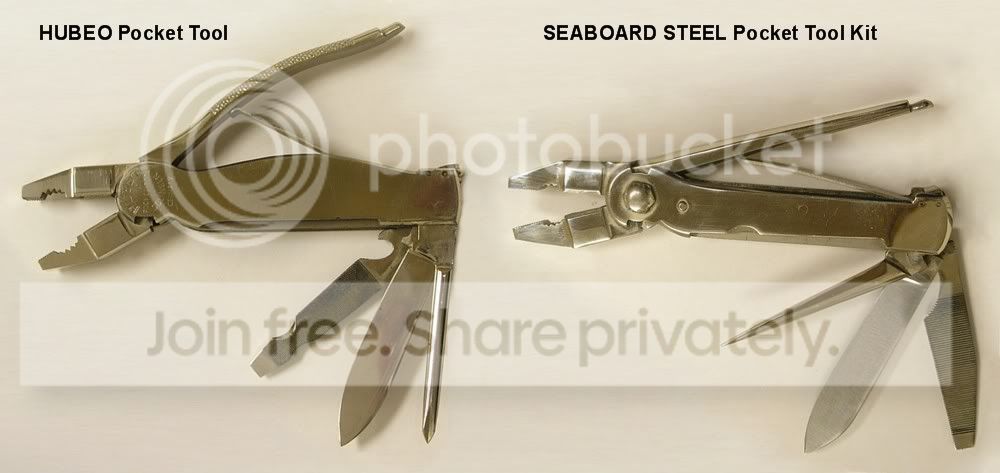
The HUBEO POCKET TOOL improves upon the French design in a number of ways. Gone is the massive hex head bolt that the plier jaws pivot on, replaced by a large hinge pin that is staked flush and polished smooth on both sides. Also improved is the plier handle, which went from ramrod straight on the French version to ergonomically curved on the German. Textured checkering was added along the top edge of the handle, giving the user a better surface to grip on, and a phillips screwdriver was substituted for the earlier tools triangle awl. Overall fit, finish, and function is superior throughout on the German model.
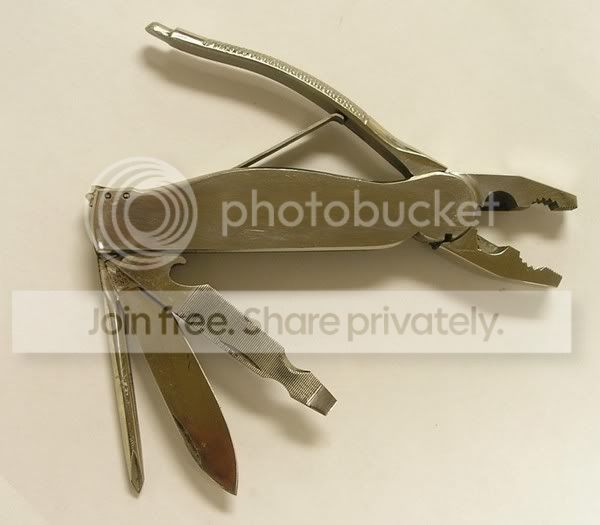
Despite these differences however, the two tools were certainly cut from the same cloth. As can be seen from the photos, the plier jaws themselves are nearly identical. Both units employ the same type of plier spring, and both have a very similar latch to hold the pliers shut when not in use. In addition to a spear-point knife blade, both tools also include a combination file blade/bottle opener/screwdriver blade. Only where the Hubeo substitutes a phillips screwdriver for the Seaboards triangle awl do the two devices differ in capabilities.
Produced in Solingen by the Hugo Berns Company, the Hubeo seems to be simply a natural evolution from the slightly earlier Seaboards.
Meanwhile, half a world away, another plier multi-gadget was being manufactured that also closely imitated the tools from France:
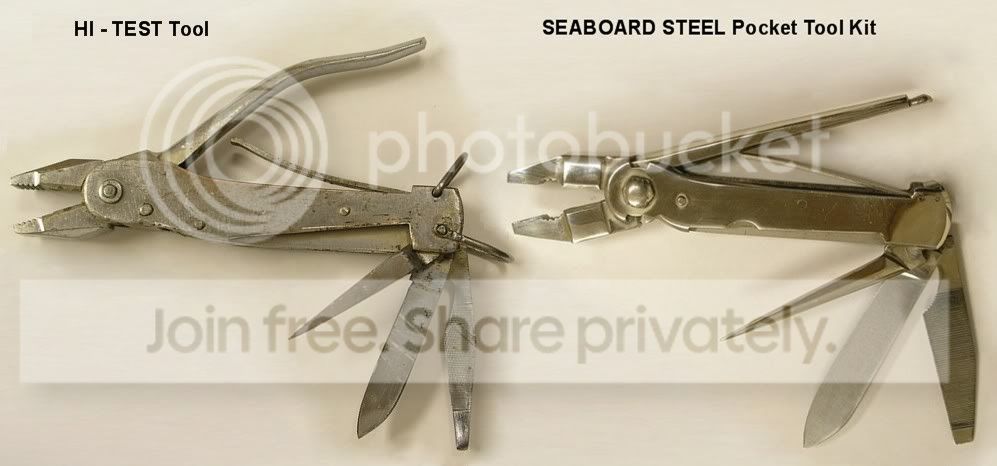
The HI-TEST tool, manufactured in Japan, shares many of the same features as the Seaboard Steel Pocket Tool Kit and the Hubeo Pocket Tool. Basic solid-handle layout is the same, whereby one handle of the plier tool is solid, and the other handle is the body of the tool itself. All three models utilize the same plier spring mechanism, along with the same array of three folding blades. Following the lead of the French, the Japanese tool has the same spear point knife, combination file blade, and triangle awl arrangement.
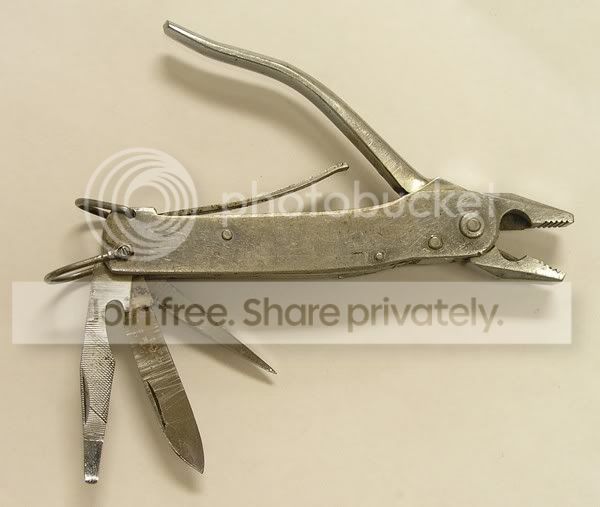
Similar as it was however, the quality of the HI-TEST falls well short of its European counterparts. It is a strong, solid tool, but the manufacturing is somewhat on the crude side. Fit and finish is a bit rough, and the nickel plating (as can be seen in the photos) is not nearly as polished as on the German tool. Other production shortcuts include a simple heavy rivet for the pliers to pivot on, and a basic wire bail to keep the jaws closed when not in use.
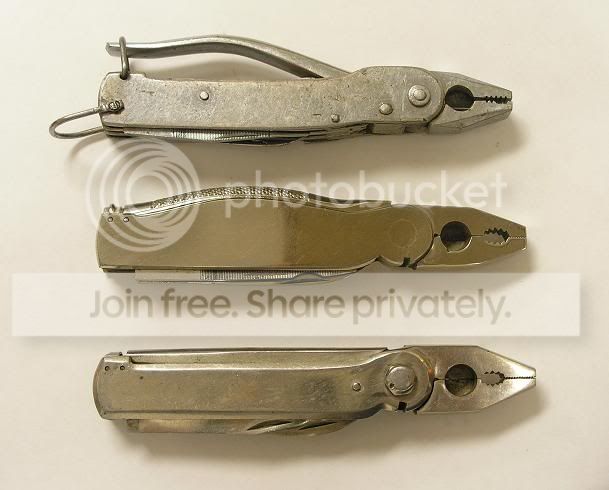
Despite being manufactured in three different countries, the similarities among these three early multi tools are much more evident than the differences. All were about the same size, shared many of the same features, and were designed and purchased with the same intentions in mind; to get as much function and versatility as possible into one, single, handy sized device. Capability-wise, all were a considerable improvement over the standard Barlow pocketknife of the day.
Im glad we have a lot more choices in multi tools today than folks did fifty years ago, but honestly, I would not feel under-equipped wearing any one of these three tools on my belt.
~Bob
However, I also pointed out that Imitation is the sincerest form of flattery, and another measure of the success of these vintage tools is the fact that shortly thereafter, they were virtually duplicated by manufacturers from two other countries.
Always striving to better their French rivals, master cutlers from Germany took the basic design and layout of the Seaboard device and refined it somewhat:
The HUBEO POCKET TOOL improves upon the French design in a number of ways. Gone is the massive hex head bolt that the plier jaws pivot on, replaced by a large hinge pin that is staked flush and polished smooth on both sides. Also improved is the plier handle, which went from ramrod straight on the French version to ergonomically curved on the German. Textured checkering was added along the top edge of the handle, giving the user a better surface to grip on, and a phillips screwdriver was substituted for the earlier tools triangle awl. Overall fit, finish, and function is superior throughout on the German model.
Despite these differences however, the two tools were certainly cut from the same cloth. As can be seen from the photos, the plier jaws themselves are nearly identical. Both units employ the same type of plier spring, and both have a very similar latch to hold the pliers shut when not in use. In addition to a spear-point knife blade, both tools also include a combination file blade/bottle opener/screwdriver blade. Only where the Hubeo substitutes a phillips screwdriver for the Seaboards triangle awl do the two devices differ in capabilities.
Produced in Solingen by the Hugo Berns Company, the Hubeo seems to be simply a natural evolution from the slightly earlier Seaboards.
Meanwhile, half a world away, another plier multi-gadget was being manufactured that also closely imitated the tools from France:
The HI-TEST tool, manufactured in Japan, shares many of the same features as the Seaboard Steel Pocket Tool Kit and the Hubeo Pocket Tool. Basic solid-handle layout is the same, whereby one handle of the plier tool is solid, and the other handle is the body of the tool itself. All three models utilize the same plier spring mechanism, along with the same array of three folding blades. Following the lead of the French, the Japanese tool has the same spear point knife, combination file blade, and triangle awl arrangement.
Similar as it was however, the quality of the HI-TEST falls well short of its European counterparts. It is a strong, solid tool, but the manufacturing is somewhat on the crude side. Fit and finish is a bit rough, and the nickel plating (as can be seen in the photos) is not nearly as polished as on the German tool. Other production shortcuts include a simple heavy rivet for the pliers to pivot on, and a basic wire bail to keep the jaws closed when not in use.
Despite being manufactured in three different countries, the similarities among these three early multi tools are much more evident than the differences. All were about the same size, shared many of the same features, and were designed and purchased with the same intentions in mind; to get as much function and versatility as possible into one, single, handy sized device. Capability-wise, all were a considerable improvement over the standard Barlow pocketknife of the day.
Im glad we have a lot more choices in multi tools today than folks did fifty years ago, but honestly, I would not feel under-equipped wearing any one of these three tools on my belt.
~Bob

