

- Joined
- Aug 23, 2004
- Messages
- 382
In the early 1990s, the famous cutlery firm of A.G. Russell http://www.agrussell.com/ introduced a beautiful new solid-handle multi tool in their mail order catalog. Called the Pocket Tool Box, it was actually manufactured in Japan by Seki, then imported and distributed by A.G. Russell.
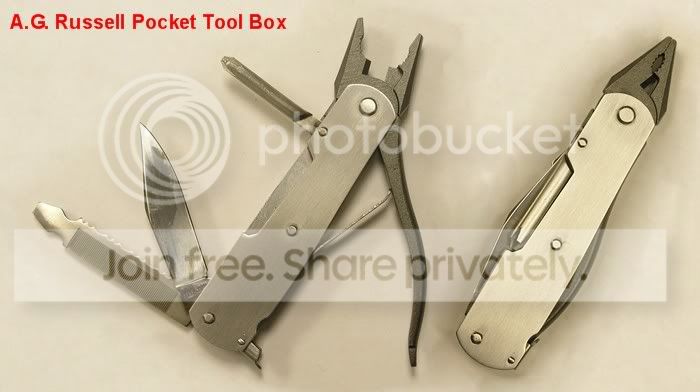
I no longer have a catalog with the exact wording, but I remember the description of the Pocket Tool Box as being based upon a 60-year-old German design. The plier jaws were relatively small and limited compared to other plier tools, but the uniqueness of its design never failed to turn heads. Like all Seki products, quality was top notch.
But what about that catalog reference to a 60-year-old German tool? It took me a few years, but I eventually obtained a couple examples of this vintage predecessor of the A.G. Russell device.
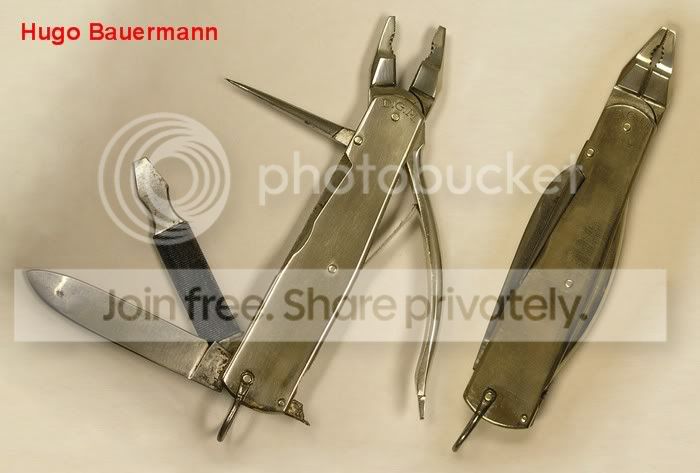
Unique and exquisite the 1990s Pocket Tool Box may have been, but this marvelous piece of workmanship from a half-century or so earlier was even better. Produced by the Hugo Bauermann company of Solingen, Germany, it has an old world craftsmanship about it that simply cannot be found in tools made today. All the edges are rounded, all the surfaces are polished, and the components fit together like a fine Swiss watch. Picking it up and playing with it, one is almost reminded of a fine medical-quality instrument.
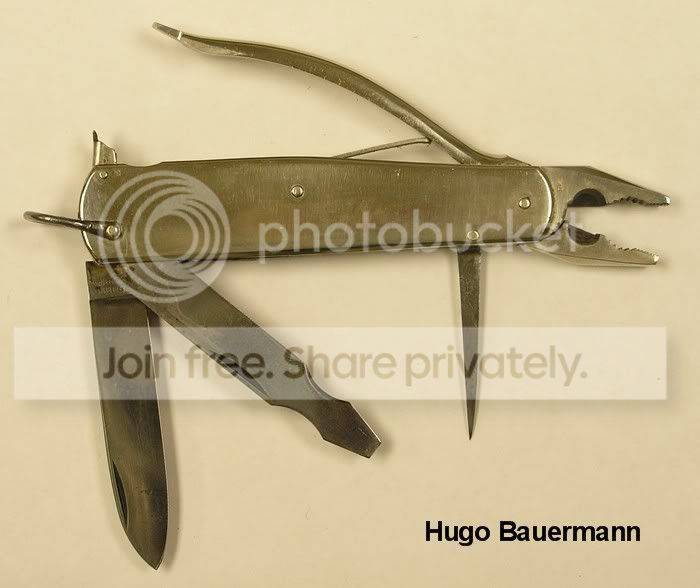
Exquisite certainly, but not delicate. In addition to a solid set of pliers, the Hugo Bauermann tool also came equipped with a 2-1/2 long spear point knife blade, a combination screwdriver / wire stripper / file blade, and a wicked little triangle awl. Serrations on the plier jaws were substantial, and a wire cutter feature was included. The pliers themselves are spring-loaded, held in the closed position by a clever little latch, similar to the French and German pliers discussed in Chapter 7. A lanyard ring completes the ensemble.
(Notice the splendid ergonomics. The triangle awl folds down to match the contour of the side panel. The plier handle closes down within the panels, with only smooth, rounded surfaces sticking up. Nothing to abrade the hand in use or the pocket while carrying.)
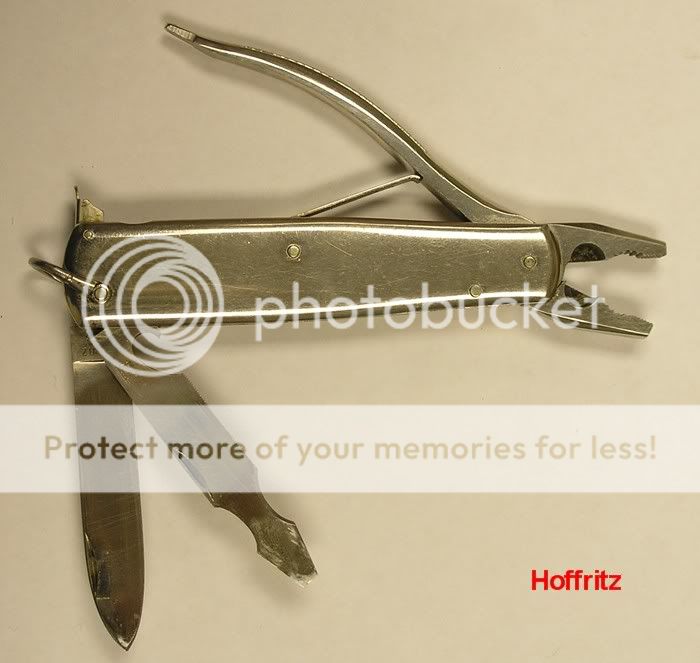
Another tool from this family is shown above, wearing the Hoffritz , New York logo. It was made in Germany also, and differs from the Bauermann tool only slightly. The edges of the side panels are more rounded. There is a band of diamond checkering running along the top edge of the plier handle, to give the owner a better grip when in use. And the combination blade has a bottle cap lifter notch in addition to its other functions. Other aspects of the two are largely the same, leading me to conclude that both originated from the same factory.
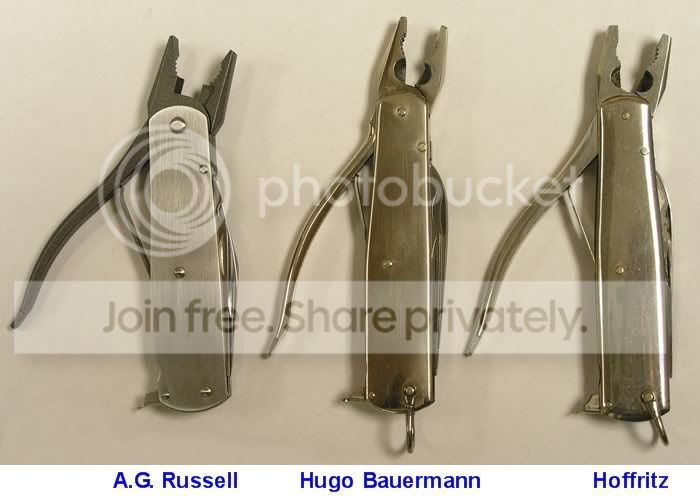
In addition to these two examples, I am also aware of variations stamped with the Queen Cutlery logo, as well as the Voss Cutlery Company logo. On Bernard Levines website, he further makes mention of this version, labeled as the Coles pliers-knife. http://pweb.netcom.com/~brlevine/coles01.jpg
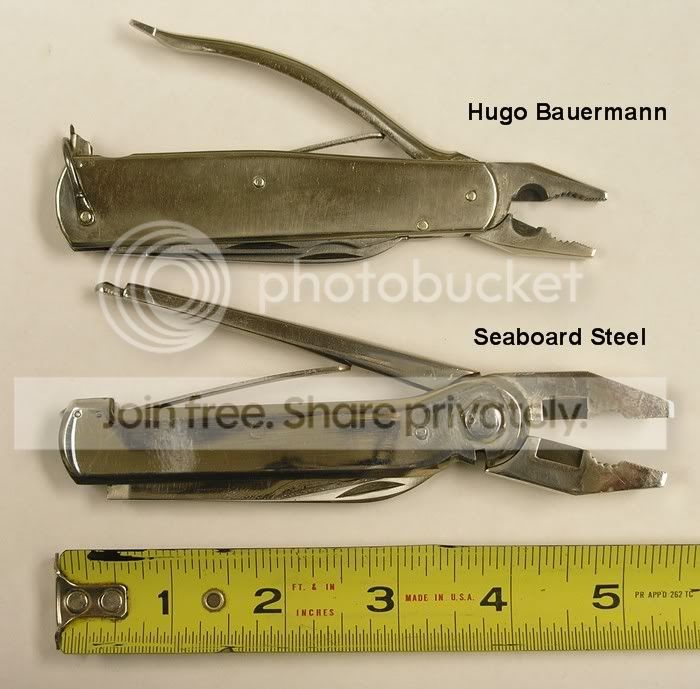
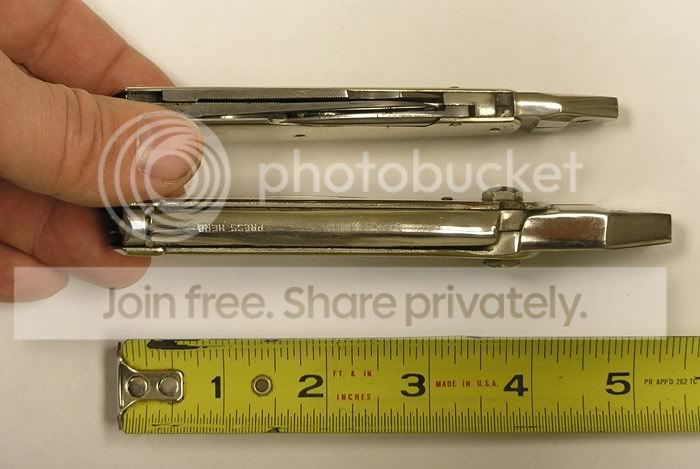
Noticably smaller and lighter than the Seaboard Steel or Hubeo tools featured in Chapter 7, these superb Hugo Bauermann or Hoffritz plier knives could be carried around in your hip pocket all day without being noticed. Then when the situation called for it, they could spring forth to take care of any number of chores. Without a doubt there are more capable multi tools available today, but none as beautiful in form and function as these.
~Bob
I no longer have a catalog with the exact wording, but I remember the description of the Pocket Tool Box as being based upon a 60-year-old German design. The plier jaws were relatively small and limited compared to other plier tools, but the uniqueness of its design never failed to turn heads. Like all Seki products, quality was top notch.
But what about that catalog reference to a 60-year-old German tool? It took me a few years, but I eventually obtained a couple examples of this vintage predecessor of the A.G. Russell device.
Unique and exquisite the 1990s Pocket Tool Box may have been, but this marvelous piece of workmanship from a half-century or so earlier was even better. Produced by the Hugo Bauermann company of Solingen, Germany, it has an old world craftsmanship about it that simply cannot be found in tools made today. All the edges are rounded, all the surfaces are polished, and the components fit together like a fine Swiss watch. Picking it up and playing with it, one is almost reminded of a fine medical-quality instrument.
Exquisite certainly, but not delicate. In addition to a solid set of pliers, the Hugo Bauermann tool also came equipped with a 2-1/2 long spear point knife blade, a combination screwdriver / wire stripper / file blade, and a wicked little triangle awl. Serrations on the plier jaws were substantial, and a wire cutter feature was included. The pliers themselves are spring-loaded, held in the closed position by a clever little latch, similar to the French and German pliers discussed in Chapter 7. A lanyard ring completes the ensemble.
(Notice the splendid ergonomics. The triangle awl folds down to match the contour of the side panel. The plier handle closes down within the panels, with only smooth, rounded surfaces sticking up. Nothing to abrade the hand in use or the pocket while carrying.)
Another tool from this family is shown above, wearing the Hoffritz , New York logo. It was made in Germany also, and differs from the Bauermann tool only slightly. The edges of the side panels are more rounded. There is a band of diamond checkering running along the top edge of the plier handle, to give the owner a better grip when in use. And the combination blade has a bottle cap lifter notch in addition to its other functions. Other aspects of the two are largely the same, leading me to conclude that both originated from the same factory.
In addition to these two examples, I am also aware of variations stamped with the Queen Cutlery logo, as well as the Voss Cutlery Company logo. On Bernard Levines website, he further makes mention of this version, labeled as the Coles pliers-knife. http://pweb.netcom.com/~brlevine/coles01.jpg
Noticably smaller and lighter than the Seaboard Steel or Hubeo tools featured in Chapter 7, these superb Hugo Bauermann or Hoffritz plier knives could be carried around in your hip pocket all day without being noticed. Then when the situation called for it, they could spring forth to take care of any number of chores. Without a doubt there are more capable multi tools available today, but none as beautiful in form and function as these.
~Bob

