
-
The BladeForums.com 2024 Traditional Knife is available! Price is $250 ea (shipped within CONUS).
Order here: https://www.bladeforums.com/help/2024-traditional/
You are using an out of date browser. It may not display this or other websites correctly.
You should upgrade or use an alternative browser.
You should upgrade or use an alternative browser.
Cheapskate Heroes
- Thread starter oldmanwilly
- Start date

oldmanwilly
Gold Member
- Joined
- Mar 7, 2014
- Messages
- 4,935
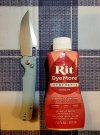
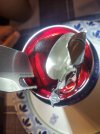
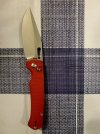
Great Dye job! I never thought of putting it in a can, not a bad idea.
oldmanwilly
Gold Member
- Joined
- Mar 7, 2014
- Messages
- 4,935
In case anyone hasn't noticed - and I don't know why anyone would have - I've become a big fan of the newly released Okapi knives. I had always been curious of the brand but found it hard to find a genuine one and was concerned about the quality (I'd heard some pretty mixed reviews). Evidently the company was recently purchased by some new owners who are fellow knife enthusiasts and decided to update the classic designs. I don't have an old model to compare against, but i think the changes were well chosen. These are absolutely great cheapskate knives:
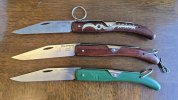
I got one classic locking knife in 1075 and two of the slip-joints in N690, one each with wood and FRN handles.
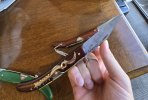
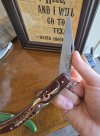
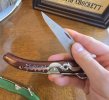
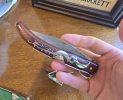
I was pleasantly surprised at how authoritative and tight the lock is, even still after a few months of use and fiddling. It has less vertical and horizontal play than several of my more expensive lockback folders. The knife is easy to open and close one-handed after a little practice: opening is like pinching open a 110, just with less inertia due to the light weight. The Scagel-style cutouts make one-hand manipulation much easier, I'm glad they didn't use a nail-nick. Closing is actually quite easy once you figure out the leverage:
The slipjoints are equally easy to open one-handed and, of course, easier to close. Don't slam it shut though, there's serious blade-rap built into the design:
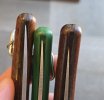
All 3 have it. Only the FRN models seems to be affected, I reckon because the FRN is more abrasive. This is the feature I like least about these knives, but it's forgivable given the price and relatively minimal effects.
I'm also not wild about the chisel grind, but it's thin enough that the blades still slice very well. Perhaps they skew a bit to one side when cutting thick stuff like apples, carrots, etc but it's manageable. The flat side is also slightly concave on all 3 of mine; I imagine using these is a little similar to using a Yakut knife. I've decided to reprofile them into double-bevels, but I'll take my time and do a little bit each time I sharpen them.
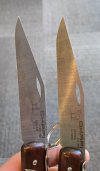
Touchups are easy on all 3 and edge retention is quite good for the price, no complaints from me.
Carrying in the pocket was tough at first: they're just so long and tend to turn sideways in my pocket, which is a pet peeve of mine. As you can see, I've added a bail and clip which makes them so easy to carry now. Stays perfectly vertical in the pocket. They're great to carry in exercise shorts too: clip into my waistband and they basically disappear until needed.
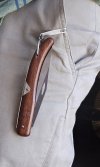
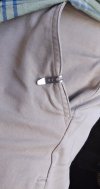
Out of all 3, I prefer to carry the wooden slipjoint. I like the locking one best, but the ring and locking tab protrusion tend to get hung up with my keys and aren't comfortable to carry in the back pocket (at least, not when I sit down...).
I'm glad I got all 3 and really enjoy carrying them. I've even taken to carrying them more than several of my favorite modern folders. At about $30 each, they're definitely cheapskate fodder and are great for actual use. I've ordered a couple more as gifts for friends and clients.
#10
I got one classic locking knife in 1075 and two of the slip-joints in N690, one each with wood and FRN handles.
I was pleasantly surprised at how authoritative and tight the lock is, even still after a few months of use and fiddling. It has less vertical and horizontal play than several of my more expensive lockback folders. The knife is easy to open and close one-handed after a little practice: opening is like pinching open a 110, just with less inertia due to the light weight. The Scagel-style cutouts make one-hand manipulation much easier, I'm glad they didn't use a nail-nick. Closing is actually quite easy once you figure out the leverage:
The slipjoints are equally easy to open one-handed and, of course, easier to close. Don't slam it shut though, there's serious blade-rap built into the design:
All 3 have it. Only the FRN models seems to be affected, I reckon because the FRN is more abrasive. This is the feature I like least about these knives, but it's forgivable given the price and relatively minimal effects.
I'm also not wild about the chisel grind, but it's thin enough that the blades still slice very well. Perhaps they skew a bit to one side when cutting thick stuff like apples, carrots, etc but it's manageable. The flat side is also slightly concave on all 3 of mine; I imagine using these is a little similar to using a Yakut knife. I've decided to reprofile them into double-bevels, but I'll take my time and do a little bit each time I sharpen them.
Touchups are easy on all 3 and edge retention is quite good for the price, no complaints from me.
Carrying in the pocket was tough at first: they're just so long and tend to turn sideways in my pocket, which is a pet peeve of mine. As you can see, I've added a bail and clip which makes them so easy to carry now. Stays perfectly vertical in the pocket. They're great to carry in exercise shorts too: clip into my waistband and they basically disappear until needed.
Out of all 3, I prefer to carry the wooden slipjoint. I like the locking one best, but the ring and locking tab protrusion tend to get hung up with my keys and aren't comfortable to carry in the back pocket (at least, not when I sit down...).
I'm glad I got all 3 and really enjoy carrying them. I've even taken to carrying them more than several of my favorite modern folders. At about $30 each, they're definitely cheapskate fodder and are great for actual use. I've ordered a couple more as gifts for friends and clients.
#10
Last edited:
oldmanwilly
Gold Member
- Joined
- Mar 7, 2014
- Messages
- 4,935
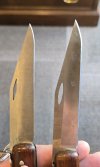
A little follow up here since I hit the photo limit in my last post. Here's a Pic that kinda shows the concave feature on flat ground side of the blade (in this case, the right side).
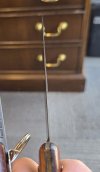
The tip even veers a bit to the right. No big deal. It's actually kind of uniquely useful to take consistently thin shavings of thick vegetables like carrots. But it can bind up a bit if you're just trying to chop them up for the pot. It slices meat and other soft materials very well.
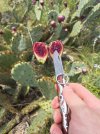
The long handles and blades are nice too, they help keep my hands clean and safe.
Also, in case anyone cares, the blade profiles differ slightly. You'll notice the N690 blades have a bit more belly and taller tip while the 1075 blades have a shorter belly and more abrupt tip (almost like a broken back seax).
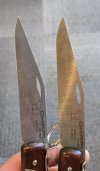
The cutouts are also different: one diamond shaped and the other oval shaped. These differences don't bother me at all in use, just details I find interesting. Perhaps they differ to help the maker tell the blades apart during manufacturing.
The tip even veers a bit to the right. No big deal. It's actually kind of uniquely useful to take consistently thin shavings of thick vegetables like carrots. But it can bind up a bit if you're just trying to chop them up for the pot. It slices meat and other soft materials very well.
The long handles and blades are nice too, they help keep my hands clean and safe.
Also, in case anyone cares, the blade profiles differ slightly. You'll notice the N690 blades have a bit more belly and taller tip while the 1075 blades have a shorter belly and more abrupt tip (almost like a broken back seax).
The cutouts are also different: one diamond shaped and the other oval shaped. These differences don't bother me at all in use, just details I find interesting. Perhaps they differ to help the maker tell the blades apart during manufacturing.

Henry Beige
Gold Member
- Joined
- Jun 1, 2015
- Messages
- 3,780
The ringlock knife is the “ratchet”, preferred as an instrument of robbery and self defense by Jamaican rudeboys. When I got my first one, actually a Cold Steel Kudu, I found a number of articles and videos on how to tune and manipulate these knives for showy one-handed opening and closing. I developed a little proficiency with my Kudu, but found that my meager skills did not transfer over to the Okapi ratchet, which was assembled too tightly to flip the blade.
A few years ago, I tried another ratchet, but found it even more tightly built and sprung than my old one. By that time I had lost interest anyway, so did not explore the possible ways the knife could be loosened. My enthusiasm migrated over to the Biltong, which proved to be a cheap and charming pocket knife which I carried for a number of years. It is nice to see that the Biltong is still made in carbon steel, alongside a couple of more expensive variants in N690.
My current supply of Biltongs will last me the rest of my life, but the big slip joint has some appeal, particularly in green.
A few years ago, I tried another ratchet, but found it even more tightly built and sprung than my old one. By that time I had lost interest anyway, so did not explore the possible ways the knife could be loosened. My enthusiasm migrated over to the Biltong, which proved to be a cheap and charming pocket knife which I carried for a number of years. It is nice to see that the Biltong is still made in carbon steel, alongside a couple of more expensive variants in N690.
My current supply of Biltongs will last me the rest of my life, but the big slip joint has some appeal, particularly in green.
oldmanwilly
Gold Member
- Joined
- Mar 7, 2014
- Messages
- 4,935
 Henry Beige
indeed, I've seen videos of guys pulling the lock ring with one finger and flicking the blades out with a big swinging motion. After opening and closing mine one time I knew for a fact that I wouldn't be able to flick mine open without some radical modifications. I can pinch mine open easily enough, I'd rather have the strong spring and lock. If I need to quickly flick open a folder I'll just carry an auto or a Spyderco with a zip tie/wave modification.
Henry Beige
indeed, I've seen videos of guys pulling the lock ring with one finger and flicking the blades out with a big swinging motion. After opening and closing mine one time I knew for a fact that I wouldn't be able to flick mine open without some radical modifications. I can pinch mine open easily enough, I'd rather have the strong spring and lock. If I need to quickly flick open a folder I'll just carry an auto or a Spyderco with a zip tie/wave modification.
- Joined
- Jul 23, 2015
- Messages
- 20,238
I ground off the ratchet of my Cold Steel Eland and could “spydie drop” it. I replaced the ring with paracord so it didn’t rattle around. I also tried a paracord knot instead of a paracord loop so that I could pinch the knot instead of having to pull through the loop.
oldmanwilly
Gold Member
- Joined
- Mar 7, 2014
- Messages
- 4,935
I ground off the ratchet of my Cold Steel Eland and could “spydie drop” it. I replaced the ring with paracord so it didn’t rattle around. I also tried a paracord knot instead of a paracord loop so that I could pinch the knot instead of having to pull through the loop.
Call me crazy, but I kinda like the ratchet feature. I'm not expecting ball-bearing smoothness, and it's a sensory thing I enjoy.

qmether
Gold Member
- Joined
- Jan 27, 2017
- Messages
- 776
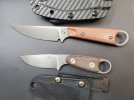
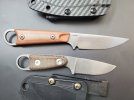
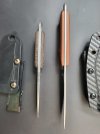
The sub $30 "Scoutrat" has been wreaking havoc on my Izula's carry time. I always thought the Izula would benefit from a thinner blade stock but the straight spine is biggest improvement here. The extra length and Kydex-like sheath doesn't hurt either.
- Joined
- Jul 23, 2015
- Messages
- 20,238
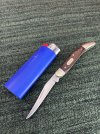
oldmanwilly
Gold Member
- Joined
- Mar 7, 2014
- Messages
- 4,935
The sub $30 "Scoutrat" has been wreaking havoc on my Izula's carry time. I always thought the Izula would benefit from a thinner blade stock but the straight spine is biggest improvement here. The extra length and Kydex-like sheath doesn't hurt either.
View attachment 3162924
View attachment 3162925
View attachment 3162926
That looks like a winner! Kind of reminds me of something from Montana Knife, but I like your price point much better.
Who, exactly is the maker? I'm having trouble finding it online.
qmether
Gold Member
- Joined
- Jan 27, 2017
- Messages
- 776
It seems Scoutrat is the maker, or brand rather. I'm unable to find a modelThat looks like a winner! Kind of reminds me of something from Montana Knife, but I like your price point much better.
Who, exactly is the maker? I'm having trouble finding it online.

Must be a big river site exclusive, I'm not seeing it elsewhere.
$20 more will get it in Nitro-V.
I don't know if it is the perspective, but the orange one looks a bit thinner than the Izula. The angle/thickness behind the edge also in play in cutting performance. The spine thickness is mostly for mass and strength.The sub $30 "Scoutrat" has been wreaking havoc on my Izula's carry time. I always thought the Izula would benefit from a thinner blade stock but the straight spine is biggest improvement here. The extra length and Kydex-like sheath doesn't hurt either.
View attachment 3162924
View attachment 3162925
View attachment 3162926
I recently returned to Vietnam, my birth place, got some blades from there. Both are made to order, but the 2nd one is more personalize. Blades are about 10-11 inches.
The 1st one has premade blade, I just asked for the final assembly.

The style of this second one is more sensible in the culture, they will not show if not asked, and they refuse to mark their name on it. Because of the time constrain on my end, I gave them 3 days to make this one, so we agree on function over form, focus on hardness and edge rather than visual, which makes it look a little bit more rough. Total for both would be about 25 C$.

I also stayed in Japan for a bit and got what basically a fixed blade Higonokami, made by Nagao Kanekoma, the main Higonokami maker.

The 1st one has premade blade, I just asked for the final assembly.
The style of this second one is more sensible in the culture, they will not show if not asked, and they refuse to mark their name on it. Because of the time constrain on my end, I gave them 3 days to make this one, so we agree on function over form, focus on hardness and edge rather than visual, which makes it look a little bit more rough. Total for both would be about 25 C$.
I also stayed in Japan for a bit and got what basically a fixed blade Higonokami, made by Nagao Kanekoma, the main Higonokami maker.

Ironbut
Gold Member
- Joined
- Mar 1, 2016
- Messages
- 9,824
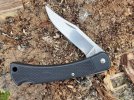
One of the on-line knife places had these Buck 110 LTs on sale for $15 a couple years ago after Christmas. I ordered two. Heck, you can't even get an Opinel for that price. I call them my "beater Bucks." One stays in the overalls I wear when cutting wood, the other rides in the tool box on my tractor.
oldmanwilly
Gold Member
- Joined
- Mar 7, 2014
- Messages
- 4,935
Right around Christmas my wife said she was tired of my hodge-podge of paring knives and asked me to pick out a "pretty" one that she could wrap up as one of my Christmas gifts. She's a keeper.
Anyway, I started looking around but couldn't find any "pretty" ones that looked useful or were cheap enough for my taste. So, naturally, I bought three cheap ones in a quest to figure out which I liked the most.
The contenders:
- Russell Green River (about $15.00)
- Sanelli Premana Jolly (about $33.00)
- Great Eastern Cutlery Steak Knife (about $45.00)
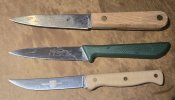
Out of the three, the clear winner is the Green River for with the Sanelli following closely behind.
The GEC is a fine knife, great for steaks, but it is just not a good paring knife. The handle is so small and thin it's hard to maintain control, while the trailing point is not ideal for fine detail work. I'll keep it but will probably use it as a steak knife only, or maybe a "youth model" skinning knife for my daughter.
The Sanelli really is a great paring knife. The fine serrations help it cut cleanly and more smoothly than an edge with deeper serrations. The handle is big enough to be comfortable in use and unobtrusive, but just a touch small for my taste. The serrations are ground a bit abruptly so the blade will pull to one side when cutting an apple, kind of like a super thin chisel grind, but it's not a problem during most tasks. I do appreciate the serrations being ground on the correct side of the blade, unlike most other options on the market. No rust so far and I bought it from VCM3
who provided an excellent kydex sheath, making for a good package for ultralight travel or as a bird/trout knife.
VCM3
who provided an excellent kydex sheath, making for a good package for ultralight travel or as a bird/trout knife.
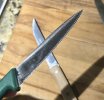
Finally, the Green River is just about perfect. The only improvement I would make is to have a blade in AEB-L, although the 1075 used is perfectly adequate. It takes a patina quickly, but it's smooth, remains rust free, and is extraordinary easy to keep sharp. Surprisingly enough, it keeps a good working edge for a long time. The blade is ultra thin, flexible, and long enough to handle larger tasks. My favorite feature is the larger handle: it fills my hands perfectly and allows excellent control in a reverse grip (which is how I typically use a paring knife). I intend to get several more to keep as spares and to distribute around the hunting camp.
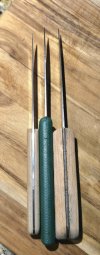
They're all good cheapskate options, I don't regret any of them. The more Green River knives I get, the more I like them. I wish they made a full sized chef knife.
Anyway, I started looking around but couldn't find any "pretty" ones that looked useful or were cheap enough for my taste. So, naturally, I bought three cheap ones in a quest to figure out which I liked the most.
The contenders:
- Russell Green River (about $15.00)
- Sanelli Premana Jolly (about $33.00)
- Great Eastern Cutlery Steak Knife (about $45.00)
Out of the three, the clear winner is the Green River for with the Sanelli following closely behind.
The GEC is a fine knife, great for steaks, but it is just not a good paring knife. The handle is so small and thin it's hard to maintain control, while the trailing point is not ideal for fine detail work. I'll keep it but will probably use it as a steak knife only, or maybe a "youth model" skinning knife for my daughter.
The Sanelli really is a great paring knife. The fine serrations help it cut cleanly and more smoothly than an edge with deeper serrations. The handle is big enough to be comfortable in use and unobtrusive, but just a touch small for my taste. The serrations are ground a bit abruptly so the blade will pull to one side when cutting an apple, kind of like a super thin chisel grind, but it's not a problem during most tasks. I do appreciate the serrations being ground on the correct side of the blade, unlike most other options on the market. No rust so far and I bought it from
VCM3
who provided an excellent kydex sheath, making for a good package for ultralight travel or as a bird/trout knife.Finally, the Green River is just about perfect. The only improvement I would make is to have a blade in AEB-L, although the 1075 used is perfectly adequate. It takes a patina quickly, but it's smooth, remains rust free, and is extraordinary easy to keep sharp. Surprisingly enough, it keeps a good working edge for a long time. The blade is ultra thin, flexible, and long enough to handle larger tasks. My favorite feature is the larger handle: it fills my hands perfectly and allows excellent control in a reverse grip (which is how I typically use a paring knife). I intend to get several more to keep as spares and to distribute around the hunting camp.
They're all good cheapskate options, I don't regret any of them. The more Green River knives I get, the more I like them. I wish they made a full sized chef knife.
Last edited:
oldmanwilly
Gold Member
- Joined
- Mar 7, 2014
- Messages
- 4,935
Welp, I finally got a lemon. I had seen pics of these cheap shepherd knives from Spain and decided to try one out. I actually ordered two of them because the design looked attractive and I thought one would make a good gift for a buddy of mine.
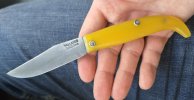
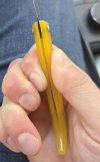
It's got a good looking blade profile, but aside from decent spring tension, that's about all the positive commentary I've got. In short: the handles are soft, flimsy plastic which is generally not comfortable and the blade skews hard to one side when opened.
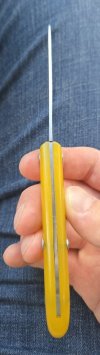
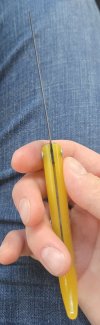
To clarify: the blade and tang appear straight, but however it is mounted to the handle causes the blade to skew to one side.
The whole thing is pinned together very loosely, making the blade terribly wobbly in use. I peened the pivot pin on both sides to tighten it up, which helped, but the blade remains more unstable than I would prefer. I could have peened it more but I was concerned about peening it shut if I proceeded.
Granted, the wobbly blade is probably no longer due to a loose pivot but to the general floppiness of the plastic handle. It takes very little pressure to get it to flex.
The blade is some carbon steel which sharpened up easily but doesn't hold an edge for too long, and the blade stock is decently thick behind the edge. It came completely dull from the factory. Not that I would expect much out of a cheap knife like this, but I get better results out of carbon steel used in Opinel and Okapi Knives.
I'm a cheapskate, and as a cheapskate I don't expect perfection in cheap knives. I have fiddled with most of the peasant knives I've gotten to fix little issues here and there and to suit my preferences. Normally, these little fixes only need to address one or two minor problems and I generally enjoy using the knives afterwards. In this case, however, I don't think anything short of removing the blade and constructing an entirely new handle from stiffer materials will make this knife enjoyable to use. But all of that will likely cost more than a handful of these knives and I'm too cheap for that.
To be clear, both of the knives I received had the same problems. I wanted to return them but my buddy said he wanted to keep his so I did my best to get them both into usable shape and give the knives a decent chance to grow on me.
I'm not mad about my experience. It's a cheap knife, what should I expect?
I paid about $33.00 for each of these Pallares knives, which is more than most comparably sized folding knives by Opinel, MAM, Okapi, and other similar peasant knife makers cost. A basic Douk Douk is also about $33.00 but the quality is head-and-shoulders above that of the Pallares. For the price, even a cheap peasant knife like the latter four mentioned above can be excellent users.
I would not spend a penny on another one of these Pallares folders unless I desperately needed a knife and it was the only option available in a timely fashion (and I had time to add a useable edge). Until then, I will continue to enjoy my better, cheaper knives.
It's got a good looking blade profile, but aside from decent spring tension, that's about all the positive commentary I've got. In short: the handles are soft, flimsy plastic which is generally not comfortable and the blade skews hard to one side when opened.
To clarify: the blade and tang appear straight, but however it is mounted to the handle causes the blade to skew to one side.
The whole thing is pinned together very loosely, making the blade terribly wobbly in use. I peened the pivot pin on both sides to tighten it up, which helped, but the blade remains more unstable than I would prefer. I could have peened it more but I was concerned about peening it shut if I proceeded.
Granted, the wobbly blade is probably no longer due to a loose pivot but to the general floppiness of the plastic handle. It takes very little pressure to get it to flex.
The blade is some carbon steel which sharpened up easily but doesn't hold an edge for too long, and the blade stock is decently thick behind the edge. It came completely dull from the factory. Not that I would expect much out of a cheap knife like this, but I get better results out of carbon steel used in Opinel and Okapi Knives.
I'm a cheapskate, and as a cheapskate I don't expect perfection in cheap knives. I have fiddled with most of the peasant knives I've gotten to fix little issues here and there and to suit my preferences. Normally, these little fixes only need to address one or two minor problems and I generally enjoy using the knives afterwards. In this case, however, I don't think anything short of removing the blade and constructing an entirely new handle from stiffer materials will make this knife enjoyable to use. But all of that will likely cost more than a handful of these knives and I'm too cheap for that.
To be clear, both of the knives I received had the same problems. I wanted to return them but my buddy said he wanted to keep his so I did my best to get them both into usable shape and give the knives a decent chance to grow on me.
I'm not mad about my experience. It's a cheap knife, what should I expect?
I paid about $33.00 for each of these Pallares knives, which is more than most comparably sized folding knives by Opinel, MAM, Okapi, and other similar peasant knife makers cost. A basic Douk Douk is also about $33.00 but the quality is head-and-shoulders above that of the Pallares. For the price, even a cheap peasant knife like the latter four mentioned above can be excellent users.
I would not spend a penny on another one of these Pallares folders unless I desperately needed a knife and it was the only option available in a timely fashion (and I had time to add a useable edge). Until then, I will continue to enjoy my better, cheaper knives.
Last edited:

chevyrulez1
Gold Member
- Joined
- Oct 2, 2007
- Messages
- 886
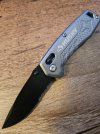
Here is my latest submission, found this at the orange hardware store for $7.88. Mystery steel, axis lock, aluminum scales, made in Vietnam. This is the second hardware store knife I have gotten that was made in Vietnam this year.
Overall for $8 it seems like a pretty decent beater. Came shaving sharp out of the pack.
Overall for $8 it seems like a pretty decent beater. Came shaving sharp out of the pack.
- Joined
- Jul 23, 2015
- Messages
- 20,238
That Husky looks like a heck of a deal
I use Pallarès knives made in Solsona, Catalonia, Spain. I mainly use them in the summer when the lack of thick clothing makes it impossible to carry a much more visible Opinel. I don't have this exact model, but the "common" model, which comes in four sizes up to a 4-inch blade.Welp, I finally got a lemon. I had seen pics of these cheap shepherd knives from Spain and decided to try one out. I actually ordered two of them because the design looked attractive and I thought one would make a good gift for a buddy of mine.
View attachment 3199188
It's got a good looking blade profile, but aside from decent spring tension, that's about all the positive commentary I've got. In short: the handles are soft, flimsy plastic which is generally not comfortable and the blade skews hard to one side when opened.
View attachment 3199191
View attachment 3199193
To clarify: the blade and tang appear straight, but however it is mounted to the handle causes the blade to skew to one side.
The whole thing is pinned together very loosely, making the blade terribly wobbly in use. I peened the pivot pin on both sides to tighten it up, which helped, but the blade remains more unstable than I would prefer. I could have peened it more but I was concerned about peening it shut if I proceeded.
Granted, the wobbly blade is probably no longer due to a loose pivot but to the general floppiness of the plastic handle. It takes very little pressure to get it to flex.
View attachment 3199192
The blade is some carbon steel which sharpened up easily but doesn't hold an edge for too long, and the blade stock is decently thick behind the edge. It came completely dull from the factory. Not that I would expect much out of a cheap knife like this, but I get better results out of carbon steel used in Opinel and Okapi Knives.
I'm a cheapskate, and as a cheapskate I don't expect perfection in cheap knives. I have fiddled with most of the peasant knives I've gotten to fix little issues here and there and to suit my preferences. Normally, these little fixes only need to address one or two minor problems and I generally enjoy using the knives afterwards. In this case, however, I don't think anything short of removing the blade and constructing an entirely new handle from stiffer materials will make this knife enjoyable to use. But all of that will likely cost more than a handful of these knives and I'm too cheap for that.
To be clear, both of the knives I received had the same problems. I wanted to return them but my buddy said he wanted to keep his so I did my best to get them both into usable shape and give the knives a decent chance to grow on me.
I'm not mad about my experience. It's a cheap knife, what should I expect?
I paid about $33.00 for each of these Pallares knives, which is more than most comparably sized folding knives by Opinel, MAM, Okapi, and other similar peasant knife makers cost. A basic Douk Douk is also about $33.00 but the quality is head-and-shoulders above that of the Pallares. For the price, even a cheap peasant knife like the latter four mentioned above can be excellent users.
I would not spend a penny on another one of these Pallares folders unless I desperately needed a knife and it was the only option available in a timely fashion (and I had time to add a useable edge). Until then, I will continue to enjoy my better, cheaper knives.
At first, I didn't like them, and they spent years in a drawer.
But they are very useful, lightweight, and very sharp. Some have more spring tension than others, but that's the only manufacturing flaw I've found! I even prefer them to my Douk-Douk! In the same category of summer knife!
Yours is clearly a lemon, but it's not worth sending it back given the price. I bought mine locally in Valencia, I think, further south but still in the area. It's definitely a privilege to have examined them before buying; it makes all the difference!
bad luck! try again! and in the same time it's a shame to send such a pity knife!