

Last Visible Canary
actively parsing hurf durf
- Joined
- Nov 28, 2006
- Messages
- 4,577
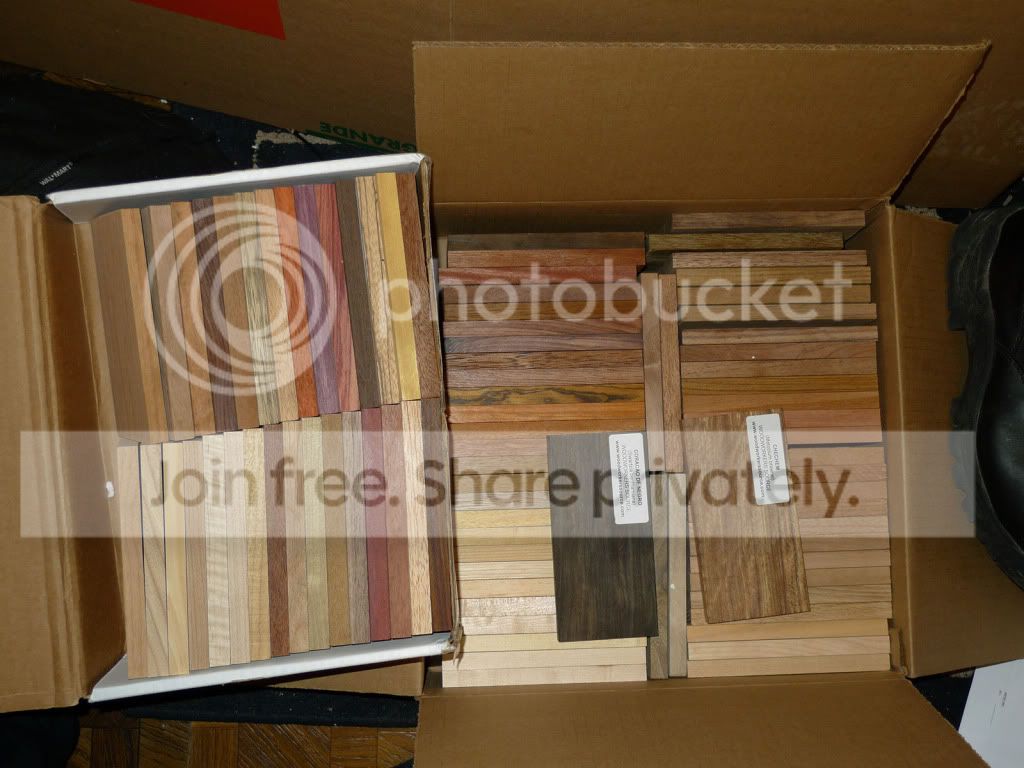
I was going to buy a 22 piece sampler pack from bell forest products just to have them, but then I found wood workers source, which had 87 species of samples and a larger 6"x3"x1/2" sample format. So, seeing that, I bought all of them  (they actually sent 3 species in their sampler pack that weren't in the individual sale list, so my pack has a total of 90). There's a lot of stunning peices in it, including 5 different types of maple, but there are 2 that stand out above the rest.
Chechem (metopium brownei) and coracao de negro (Swartzia benthamiana) . I've never seen a wood like them. It reminds me of lignum vitae, but totally different. These pictures were mostly taken without flash under energy efficient florescent bulbs, so the blue channel is almost non existent. as such, they come out with a log of yellow and green, so the color isn't quite right. It's the best I can do at 9pm :foot:
the kingwood, purple heart and bocote were visible the second I opened the box, such unique grain and color.
This is an hdr of the coracao de negro. it's pattern is almost to close to recognise as wood grain, except in those area's where the cut gets closer to parallel with the rings.


look at this end grain. I'm mean, just look at it. I have never seen a set of wood rings that were that incredibly small and tight. I feel almost bad about having this piece just thinking of how old it is. For every year of growth in the chechem, it took 4-7 years of growth to match it in the coracao de negro. it feels like a piece of marble it's so dense and heavy.

this pic really doesn't do the grain justice, but you can see the weird shifting of tones and grain patterns on the coracao de negro

the chechem is just weird. it has a kind of curling, but the wood cut used didn't bring it out, instead it's just in the form of rough lines across the grain. It.... it's tight and twisted like lignum vitae, but chaotic in the different textures present.

there is almost no blue information in this image, so the color and contrast is off

A lot of these woods would be pretty hard to stabilize, being extremely dense close grained hardwoods, but the size is right for most small blade handle scales. at around 4$ a piece, the price is sometimes good sometimes not so good, but as a library source I'm very happy to have such a wide variety in a uniform format, even at the price I paid.
having never seen either of these woods before I was absolutely amazed by them.
(they actually sent 3 species in their sampler pack that weren't in the individual sale list, so my pack has a total of 90). There's a lot of stunning peices in it, including 5 different types of maple, but there are 2 that stand out above the rest. Chechem (metopium brownei) and coracao de negro (Swartzia benthamiana) . I've never seen a wood like them. It reminds me of lignum vitae, but totally different. These pictures were mostly taken without flash under energy efficient florescent bulbs, so the blue channel is almost non existent. as such, they come out with a log of yellow and green, so the color isn't quite right. It's the best I can do at 9pm :foot:
the kingwood, purple heart and bocote were visible the second I opened the box, such unique grain and color.
This is an hdr of the coracao de negro. it's pattern is almost to close to recognise as wood grain, except in those area's where the cut gets closer to parallel with the rings.
look at this end grain. I'm mean, just look at it. I have never seen a set of wood rings that were that incredibly small and tight. I feel almost bad about having this piece just thinking of how old it is. For every year of growth in the chechem, it took 4-7 years of growth to match it in the coracao de negro. it feels like a piece of marble it's so dense and heavy.
this pic really doesn't do the grain justice, but you can see the weird shifting of tones and grain patterns on the coracao de negro
the chechem is just weird. it has a kind of curling, but the wood cut used didn't bring it out, instead it's just in the form of rough lines across the grain. It.... it's tight and twisted like lignum vitae, but chaotic in the different textures present.
there is almost no blue information in this image, so the color and contrast is off
A lot of these woods would be pretty hard to stabilize, being extremely dense close grained hardwoods, but the size is right for most small blade handle scales. at around 4$ a piece, the price is sometimes good sometimes not so good, but as a library source I'm very happy to have such a wide variety in a uniform format, even at the price I paid.
having never seen either of these woods before I was absolutely amazed by them.


