Check my specifications for a linerlocker

Joined
Mar 27, 2009
Messages
122
Your opinion on my specs please. Edit: drawing in later post.

Blade: 2 7/8" length blade, approxamately 3/4" wide.
3/32" precision ground CPM 154 (grind and drill before HT, final buff and sharpen after sent out for HT at a TOOl & Die CNC tool corp.)

Liner and linerlock: .050 6A4LV Ti

Handles: Approximately 1/8" thick Black Walnut

Thanks in advance
 
Last edited:
At 3/32 thick I would put a lead in grind like Bob does and do most of the grinding after heat treat. It is less likely to warp this way since it is so thin.
 
Two opinions from the past:

Rusty McDonald: "CPM154 is easy to work before it is hardened, It's the after part that is hard on belts."........."I grind mine down to 220 then HT them myself, I try to leave the edge a little thinner than a dime. I'd say when I do mine they are 90% done with grinding. But you may want to leave more."

Hellgap: 'I would buy the cpm 154 precision ground, and send it out for heat treat. I would hand sand to 600 and buff and make it shine like a mirror. Then when you get it back there is very little left to do other than remove the scale and rebuff.Sharpening is the last thing done, as I've been taught."

3/32" to thin CPM154 for Hellbap's suggestion?
 
I believe the 3/32 could make a good working knife, if that's what you want it for if flat ground bottom to top, but is a bit on the thin side when hollow ground with a 10"wheel unless the folder is not going to see much if any use then dowm to .080 works for me. Frank
 
I also think you should grind it after heat treat. 3/32 is fine, but as Frank said, you'll need a larger wheel or a narrower knife if you want to hollow grind and not leave a good bit of full thickness spine.
 
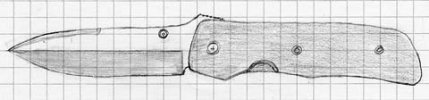
Here's a drawing of the knife I hope to make. It's a small folder baised on Bob Terzuola's work. Does 1/8" thickness sound better?
 

Attachments

  • Linerlock drawing small.jpg
    Linerlock drawing small.jpg
    11.3 KB · Views: 42
Here's a drawing of the knife I hope to make. It's a small folder baised on Bob Terzuola's work. Does 1/8" thickness sound better?

Heck no. OK this is from a consumer viewpoint cause my folder experience is sadly lacking as a maker. I think you said the blade was 2 7/8"?? So maybe OAL about 3 3/4? (I love this knife already.)

This is not a tactical knife, it is a gents linerlock. 3/32 is great! Thinner cuts better and this isn't a prybar. Flat grind it with a taper to the tip. .050Ti sounds about perfect for this knife.

I think you are exactly on track for a very nice project!

Rob!
 
With the grind only going about half way uo the blade the 3/32 with that short of a blade should work out well. Frank
 
Thanks for the input from both of you. And you're right I can't really call it a tactical knife, but I didn't know what to call it. "Gentlemen's Folder", good name, except what about the women who also love knives?
So 3/32" isn't to small to be able to do the bevel I've drawn? I do not have an example to measure. Anyone have a photo of a bevel on a 3/32" knife? How clearly will it show up? Or does that even matter?
 
3/32 is not a bad size to work with on a gent's folder, keeps the whole thing nice and thin. The hollow grind to flat transition will be very difficult to keep sharp if full mirror is chosen.

I would suggest a 6" or 8" grinding wheel to show off the transition best.

George
 
3/32 is not a bad size to work with on a gent's folder, keeps the whole thing nice and thin. The hollow grind to flat transition will be very difficult to keep sharp if full mirror is chosen.

I would suggest a 6" or 8" grinding wheel to show off the transition best.

George

I understand the 6"-8" grinding wheel, (I assume 6" would be best if hollow grinding).
But I do not understand how a full mirror finish would make it hard to keep sharp.
Also what if it were flat angle to flat, with no hollow grind. Better or worse?
 
Transition lines from bevel to flat tend to wash out during mirror finishing, just the nature of the soft buffing wheels.

A more radical transition ie from a hollow grind to a flat will stand out better than the transtition from a flat ground bevel to a flat. This is where the diameter of the grinding wheel comes into play...the smaller the wheel the greater the angle change.

If a fine grit belt was used on the hollow grind and a surface grinder used on the flats running the length of the blade the appearance of the transition is highlighted by the play of light and the line patterns produced.

George
 
Back
Top