Check out this kukri

Joined
Mar 9, 2010
Messages
45
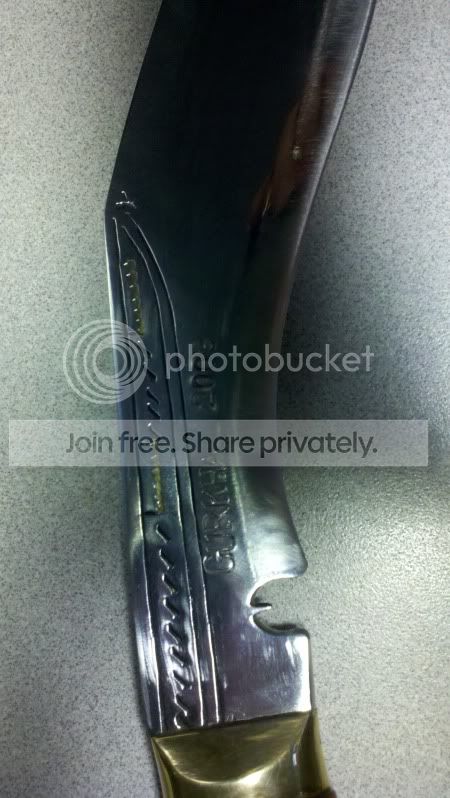
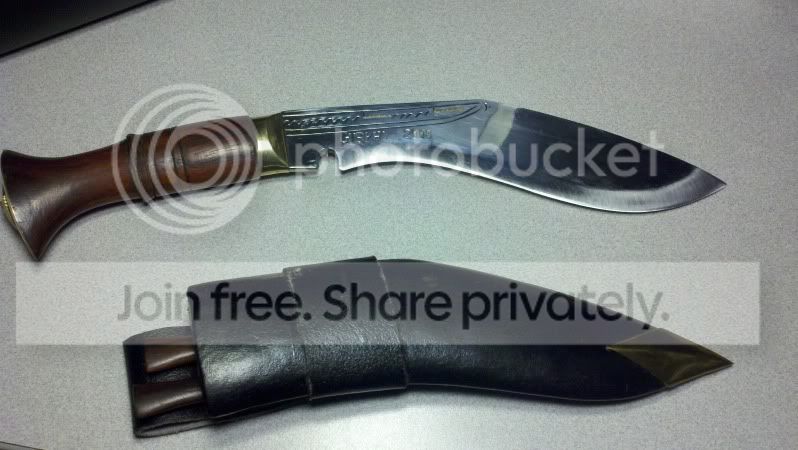
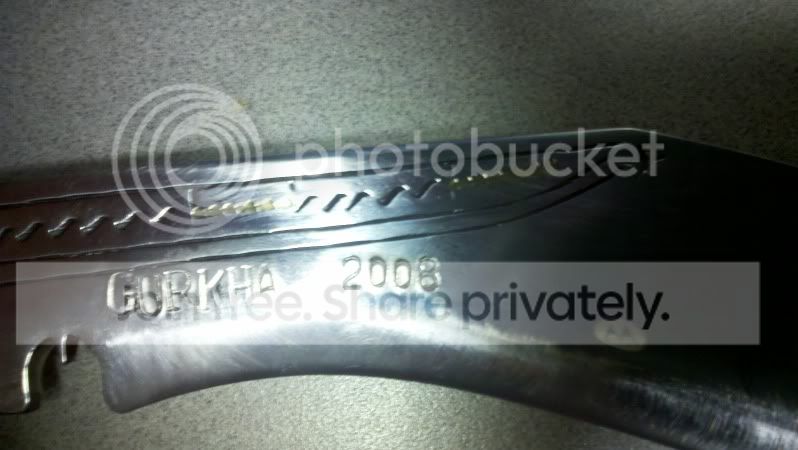
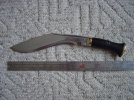
I'm sharpening a kukri for a friend of mine, and I was wanting to get any info anyone here can offer. He was given this kukri from a friend of his that served overseas in Afghanistan. The friend told him a ghurka traded with him and that it is a genuine ghurka kukri. The knife is approx 1/4 thick on the spine, very well put together. No spaces, no wiggling at all. There is brass on the bolster and buttplate that has tarnished over time, but a gold inlay in the blade itself has not tarnished. I am wondering if this is actual gold in the blade. It states on the blade, "GURHKA 2008"

Here are some pics:

KHUKRI2.jpg


KHUKRI1.jpg


KHUKRI4.jpg


KHUKRI3.jpg


Thanks in advance
 
Very nice. I have been wanting one of those, i don't know why I do I just do. So that means I will get one, LOL.
 
Anybody know what is the purpose of the semicircular cutout with the pointy thing in it, at the base of the sharpened edge? Obviously it serves as a sharpening choil, but is the pointy thing just decorative or does it serve some function?
 
That's a real Nepalese khukuri--from the looks of the sheath and the engraving on the blade, it was made by Gurkha House/Khukuri House. Khukuri House is the most popular source of khukuris for Nepalese troops worldwide, so yes, it's the real deal.

The cho (cutout) is religious and symbolizes Shiva's trisul (trident) which is a symbol of Saivism (a branch of Hinduism). They've been on there forever. Similarly, the Sword of Shiva (the decoration on the blade) has religious significance. I have a khukuri much like it that I used to split a durian up yesterday.
 
Thanks, man. It looked authentic to me, but I don't know those knives. The trident thing is interesting, too.
 
It sharpened up nicely. It was made with a convex edge so I just went off that edge and it took a beautiful convex. I took it up to 2500 grit before moving to 2 different compounds on leather. Don't mind the pics, that was at 800 and now it is clear as crystal.. Shaving sharp. He'll appreciate all this information. I know very little about these weapons and it was intriguing to do some research on them. I definitely have to pick one up soon.
 
So much of these are made in India, Pakistan and China... And for sure they then go everywhere, including Afghanistan.
I am sort of surprised that the blade looks so bright - nearly like it is made from stainless steel. It probably was just never used so far. But it is sort of intriguing.
Do not like that "Gurkha 2008" writing I must say. Does not go well with "gold". Or rather say, goes too well with "gold".
Sorry about what I have said, but really I am quite sceptic about that kind staff made for and sold to tourists.
 
Yeah I understand what you're saying. I'm pretty skeptical about these things too. It seems like the real deal though. Just feels right when you're holding it.
 
It is absolutely the real deal. The brass inlay isn't a tourist feature either. Now, the ones used in villages tend to have fatter handles and aren't as shiny or as refined, but Gurkhas must have 'shiny' dress khukuris for parades and such. In the field, they use ones that aren't as polished. The polishing often heats up the blade and leads to loss of temper (which can lead to the edge softening), but I bet you still have an absolutely serviceable blade on your hands.

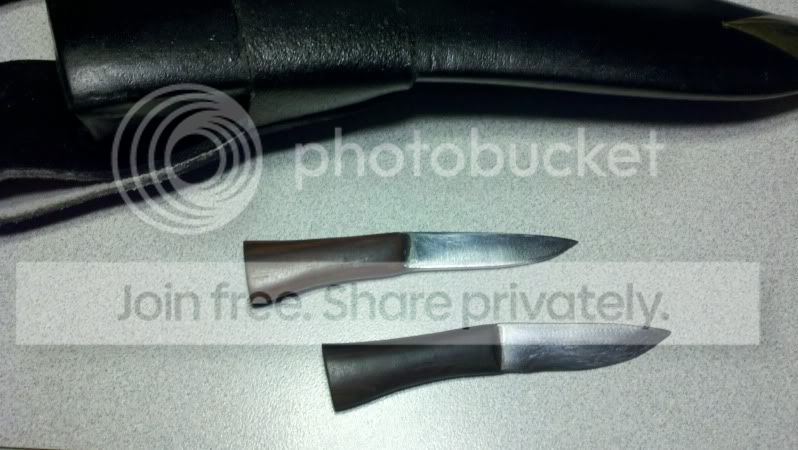
The Himalayan Imports guys will be by soon to talk about their khukuris. HI does make some very solid choppers, but I personally prefer the KHHIs with some caveats--you need to upgrade the karda and chakmak (the small knife and 'steel'), you need to upsize the handle an inch or so if you're not of small stature, and you'll be waiting several weeks for delivery. I also feel KHHI scabbards are much better than HI's, but with HI you're dealing with an American-based dealer and you get a warranty on your khukuri, which is nice. KHHI did offer me a free khukuri when I had an issue with one of theirs however. Try one of each and see what you think. :) You can expect much faster shipping with HI, and their handles are made for western hands (although personally, I feel they're a little too long).

Now, if you want an entirely different beast altogether, check out Tora blades. They offer styles that nobody else does, although they sure are pricey!
 
Yes, it's the real deal. Nothing touristy about that one.
By the engraving and blade style, i would have to say you have a nice sirupate there.

I won't speculate on the actual maker, as it could be KH(patan) or KH (Thamel), NKH (all under the KHHI umbrella) or GKH (separate entity in dharan). Whom all fill their niche quite nicely...as does H.I.. It could've also been made by any one of the Aruns in the area, wether contracted to KHHI or not. Hard to tell since none of them mark their khukuri with a brand distinction.

I also won't bore you with recommendations on where to buy, as that is not what you're asking about and many here already know what i would tell you anyway.

Careful polishing of a properly heat treated khukuri will not lead to any appreciable loss of temper. You should not worry about using that khuk for its intended purpose. Bear in mind though that a sirupate is mostly weapon and is not well suited to chopping chores.
Being a khukuri, though, it will still do the job, just not as well as patterns intended for that purpose. There are many styles of khukuri, designed to fill specific roles.

The Kauri or Cho and the Sword of Shiva are there for religious significance. They have always been there and probably always will be. Many would say that it is not a real nepalese khukuri without them. The inlay is brass, hammered into the pattern cold.


Here are a few links from the H.I. forum that should help you:

(this one is a must read)
http://www.bladeforums.com/forums/s...-and-Greatest-Safety-Thread.-REQUIRED-READING!

http://www.himalayan-imports.com/FAQindex.html

http://www.bladeforums.com/forums/showthread.php/719860-Himalayan-Imports-Link-Library

Feel free to drop by the H.I. forum to ask questions and to find out why we've imported the finest khukuri from nepal for over 20 years.

 
Thank you Karda for all of that information. I've just returned the kukri to it's owner and he was happy with the edge I applied and all the information you all provided. He's happy to know this is not a tourist piece. Now I'm interested in my own kukri, while sharpening that one I think I fell in love. haha
 
Hi Sgt.

A Gurkha may have given this to someone but it is not a military issued kukri. It is just like a US Marine giving someone a look-a-like Ka-Bar with writing on it "Marine Knife.

The current military issue kukri to the Gurkha units is the Service No1 and is marked much differently. The current [and recent past] issues are horn handled, 10.5" blade, 5.5" handle and have the Service No1 patttern; they are marked as follows:
ORDEP
NEPAL
6/91 (month & year of issue)

This doesn't mean that what you have is a fake, it is simply a Nepalese kukri and someone used the generic name Gurkha. But of course a Gurkha is a unit or an individual soldier, not a knife. It looks small, do you have the blade length? Only "use" will tell if it is a tourist grade or a real user. The tourist grade will begin to fall apart quickly with use, the bolster will come loose, the handle will come loose, the blade will roll badly, chip or break.

If it is a "user" from one of the better Khukuri Houses that Karda mentioned then it will be a good knife for someone for many years. Good luck.
 
Sgt.

Here are a few pics of the military issue of today and 2 of the past models dating back to WWII.

Here is the current issue, referred to as the Service No.1:
DSC03181.JPG

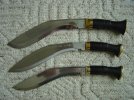
Here is the Service No.1 with 2 previous issues. Generally speaking, the older the issue the larger they were. From Top to bottom:
WWII
Pattern One (Post WWII - 70's or 80's?)
Service No.1
DSC03184.JPG

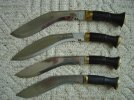
Here I inserted the Jungle kukri at the bottom. It has the same specs as the Service No.1 except that the horn handle is not polished and the blade has a satin finish instead of the polished Service No.1. This Jungle kukri is supposedly the one that is used in the field so that they don't mess up their issued Service No.1 that is subject to inspection.
(Kind of like having a set of uniforms set aside that are never worn for inspections!)
DSC03185.JPG

Hope that gives you a visual.
 
Back
Top