Choosing my Paramilitary 2 steel for EDC

well if CTS-20CP is the best version of the knife thats what im after BUT if M390 is going to be the best version i can wait... which one will be best in an EDC situation ( cardboard paper light wood boxes etc..) as far as edge retention and overall performance ive read many threads and im hearing great things about both but some are touting M390 as slightly better

if thats the case i can pickup a used s30v para2 and preorder a M390

how the M390 stacks up against 20CP will depend on what HRC the M390 blades are run at. either way, both steels will give you a very high level of wear resistance and their performance shouldn't be too far off.
 
i want my first para 2 to be a sweet one i have 12 s30v knives already
ive read many threads and im hearing great things about both but some are touting M390 as slightly better

if you already have lots of s30v knives I would just wait and get the one you want. you should start learning about steels and what different alloying elements do to the overall performance of the blade. I have two new black-on-black s30v Pm2s and they are good knives. the harder steels are a bit deceptive because they will not seem as sharp like aus 8 or vg 10 to the touch but they will cut much better and retain the edge longer. but back to your question the harder steels are a bitch to sharpen. if you are not into spending lots of time sharpening or perfecting your edge then softer steel will be better.

if you live in flodira (high humidity - oh I can only rmember the hell that was orlando) anways I would just get the m390 one since it has 20% chromium and will be better for rust resistance. The cts-20cp has 9.3% vanadium for hardness and is also mid-high carbon. for me I would buy a s90v if I had the choice or a cts-20cp but they are almost identical in material makeup. second choice would be a m390 more exotic and rare.

have fun the pm2 is amazing :thumbup:
 
S35VN = S30V (basically) so I wouldn't waste my time even thinking about that one, (unless you're a collector who has to have every variation made).

20CP = S90V and is outstanding and a great value compared to the current price of the S90V version.

M390 and 20CP are both outstanding steels, both among the best available or close to it, and you can't go wrong with either one. However, M390 is different than 20CP. Hard for me to describe the differences though. I happen to like the edge I can easily get with M390 more, (but I still thought the 20CP version was good enough to buy three of them). They are both great "super" steels and, as I said, you can't go wrong with either one.

You are going to have to wait quite a while to get an M390 one so I would go for the 20CP now while they are still available, which is what I did, and also am pre-ordering an M390 version. If you find you like one more than the other, you could probably sell either one for close to what you paid for it. You might even be able to make a profit if you wait a while.

The Para 2 is a great knife no matter what steel is in it. Just get one and start enjoying one of the best knives Spyderco has ever made.
 
Last edited:
if you live in flodira (high humidity - oh I can only rmember the hell that was orlando) anways I would just get the m390 one since it has 20% chromium and will be better for rust resistance.

i bike ride 3-4 times a week and my 20CP is with me 95% of the time in my waist band. i have yet to tarnish, pit or oxidize the blade with my sweat. 20CP is holding up well for me in the corrosion resistance department.
 
i bike ride 3-4 times a week and my 20CP is with me 95% of the time in my waist band. i have yet to tarnish, pit or oxidize the blade with my sweat. 20CP is holding up well for me in the corrosion resistance department.

of course since a chromium content of ~12%+ makes a steel moderately stainless. your 20cp is 13% chromium alloy

Characteristics of alloying elements


Manganese (Mn) – improves hardenability, ductility and wear resistance. Mn eliminates formation of harmful iron sulfides, increasing strength at high temperatures.

Nickel (Ni) – increases strength, impact strength and toughness, impart corrosion resistance in combination with other elements.

Chromium (Cr) – improves hardenability, strength and wear resistance, sharply increases corrosion resistance at high concentrations (> 12%).

Tungsten (W) – increases hardness particularly at elevated temperatures due to stable carbides, refines grain size.

Vanadium (V) – increases strength, hardness, creep resistance and impact resistance due to formation of hard vanadium carbides, limits grain size.

Molybdenum (Mo) – increases hardenability and strength particularly at high temperatures and under dynamic conditions.

Silicon (Si) – improves strength, elasticity, acid resistance and promotes large grain sizes, which cause increasing magnetic permeability.

Titanium (Ti) – improves strength and corrosion resistance, limits austenite grain size.

Cobalt (Co) – improves strength at high temperatures and magnetic permeability.

Zirconium (Zr) – increases strength and limits grain sizes.

Boron (B) – highly effective hardenability agent, improves deformability and machinability.

Copper (Cu) – improves corrosion resistance.

Aluminum (Al) – deoxidizer, limits austenite grains growth.

Effects of Alloying Elements in Steel

Steel is basically iron alloyed to carbon with certain additional elements to give the required properties to the finished melt. Listed below is a summary of the effects various alloying elements in steel.
•Carbon
•Manganese
•Chromium
•Nickel
•Molybdenum
•Titanium
•Phosphorus
•Sulphur
•Selenium
•Niobium
•Nitrogen
•Silicon
•Cobalt
•Tantalum
•Copper

Carbon

The basic metal, iron, is alloyed with carbon to make steel and has the effect of increasing the hardness and strength by heat treatment but the addition of carbon enables a wide range of hardness and strength.

Manganese

Manganese is added to steel to improve hot working properties and increase strength, toughness and hardenability. Manganese, like nickel, is an austenite forming element and has been used as a substitute for nickel in the A.I.S.I 200 Series of Austenitic stainless steels (e.g. A.I.S.I 202 as a substitute for A.I.S.I 304)

Chromium

Chromium is added to the steel to increase resistance to oxidation. This resistance increases as more chromium is added. 'Stainless Steel' has approximately 11% chromium and a very marked degree of general corrosion resistance when compared with steels with a lower percentage of chromium. When added to low alloy steels, chromium can increase the response to heat treatment, thus improving hardenability and strength.

Nickel

Nickel is added in large amounts, over about 8%, to high chromium stainless steel to form the most important class of corrosion and heat resistant steels. These are the austenitic stainless steels, typified by 18-8, where the tendency of nickel to form austenite is responsible for a great toughness and high strength at both high and low temperatures. Nickel also improves resistance to oxidation and corrosion. It increases toughness at low temperatures when added in smaller amounts to alloy steels.

Molybdenum

Molybdenum, when added to chromium-nickel austenitic steels, improves resistance to pitting corrosion especially by chlorides and sulphur chemicals. When added to low alloy steels, molybdenum improves high temperature strengths and hardness. When added to chromium steels it greatly diminishes the tendency of steels to decay in service or in heat treatment.

Titanium

The main use of titanium as an alloying element in steel is for carbide stabilisation. It combines with carbon to for titanium carbides, which are quite stable and hard to dissolve in steel, this tends to minimise the occurrence of inter-granular corrosion, as with A.I.S.I 321, when adding approximately 0.25%/0.60% titanium, the carbon combines with the titanium in preference to chromium, preventing a tie-up of corrosion resisting chromium as inter-granular carbides and the accompanying loss of corrosion resistance at the grain boundaries.

Phosphorus

Phosphorus is usually added with sulphur to improve machinability in low alloy steels, phosphorus, in small amounts, aids strength and corrosion resistance. Experimental work shows that phosphorus present in austenitic stainless steels increases strength. Phosphorus additions are known to increase the tendency to cracking during welding.

Sulphur

When added in small amounts sulphur improves machinability but does not cause hot shortness. Hot shortness is reduced by the addition of manganese, which combines with the sulphur to form manganese sulphide. As manganese sulphide has a higher melting point than iron sulphide, which would form if manganese were not present, the weak spots at the grain boundaries are greatly reduced during hot working.

Selenium

Selenium is added to improve machinability.

Niobium (Columbium)

Niobium is added to steel in order to stabilise carbon, and as such performs in the same way as described for titanium. Niobium also has the effect of strengthening steels and alloys for high temperature service.

Nitrogen

Nitrogen has the effect of increasing the austenitic stability of stainless steels and is, as in the case of nickel, an austenite forming element. Yield strength is greatly improved when nitrogen is added to austenitic stainless steels.

Silicon

Silicon is used as a deoxidising (killing) agent in the melting of steel, as a result, most steels contain a small percentage of silicon. Silicon contributes to hardening of the ferritic phase in steels and for this reason silicon killed steels are somewhat harder and stiffer than aluminium killed steels.

Cobalt

Cobalt becomes highly radioactive when exposed to the intense radiation of nuclear reactors, and as a result, any stainless steel that is in nuclear service will have a cobalt restriction, usually aproximately 0.2% maximum. This problem is emphasised because there is residual cobalt content in the nickel used in producing these steels.

Tantalum

Chemically similar to niobium and has similar effects.

Copper

Copper is normally present in stainless steels as a residual element. However it is added to a few alloys to produce precipitation hardening properties.

 
im leaning towards getting a used para 2 in s30v for now just to own one and pre ordering a blue M390 all the CTS-80CP's ive tried to buy are heading towards the $200 mark i dont mind spending that much on a knife , but atm with school starting and a wife and 7yr old to care for and school about to start again for me (at 36) dropping $200 on a knife when i can get a used for $75 and under and pre order one knowing ill be in a better place financially when it comes out seems the smart choice.. who knows maybe ill eventually own both cts-20cp and M390 in the future...
 
I thought it was great when I went from 154cm to s30v. I thought it just couldn't get any better and now making choice of steels will make your head hurt. S30V PARA 2 get it ,you will thanks me later.
 
s30v is more than respectable for EDC .. i can obviously afford to pre order a knife not out till 2012 and maybe by then ill have enough to own both steels
 
of course since a chromium content of ~12%+ makes a steel moderately stainless. your 20cp is 13% chromium alloy

well that's only part of the picture. ZDP-189 has 20% chrome and it's less corrosion resistant than 20CP. the amount of carbon and heat treat recipe have alot to do with corrosion resistance. if a steel has high amounts of chromium in it and high amounts of carbon, the carbon will lock up the chromium into chromium carbide and the corrosion resistance will decrease. 20CP has 9.25% vanadium along with 12.8% chromium, the vanadium ties up a good amount of the carbon and allows more free chromium to exist in the steel and prevent corrosion.
 
Last edited:
im leaning towards getting a used para 2 in s30v for now just to own one and pre ordering a blue M390 all the CTS-80CP's ive tried to buy are heading towards the $200 mark i dont mind spending that much on a knife , but atm with school starting and a wife and 7yr old to care for and school about to start again for me (at 36) dropping $200 on a knife when i can get a used for $75 and under and pre order one knowing ill be in a better place financially when it comes out seems the smart choice.. who knows maybe ill eventually own both cts-20cp and M390 in the future...

in all honesty, my s30v para2 was my main EDC until i got my 20CP, i rarely use my s30v model now. just something for you to think about.
 
i know it really is a tough choice... my real choice would be to own BOTH a CTS-20CP and an M390.... maybe ill just try and hold off my OCD for a para 2 till i can find a CTS-20CP and pre order the m390...... man its hard...... :)
 
i will own a M390 para2 and there is a good chance i will carry both equally, but if i did miss out on the M390 model, i really wouldn't feel bad because i already own an equal performer. the same goes for the M390 para2 and if i missed out on the 20CP, i wouldn't feel bad either. IMO, it's more about which handle color you like better as both of their performances and prices are close. just my 2 cents.
 
I pre ordered a Blue Para 2 in M390 for now... ill keep my eyes peeled for a 2nd hand para 2 in s30v or if i get some cash between now and spring ill try to find a CTS-20CP.. but for now i look forward to my M390 :)
 
well that's only part of the picture. ZDP-189 has 20% chrome and it's less corrosion resistant than 20CP. the amount of carbon and heat treat recipe have alot to do with corrosion resistance. if a steel has high amounts of chromium in it and high amounts of carbon, the carbon will lock up the chromium into chromium carbide and the corrosion resistance will decrease. 20CP has 9.25% vanadium along with 12.8% chromium, the vanadium ties up a good amount of the carbon and allows more free chromium to exist in the steel and prevent corrosion.

thanks for the time you provided in my education =)
that's great stuff to know
 
Gets the cts20cp para!for the uses you describe you want the steel with better wear resistance. http://www.bladeforums.com/forums/showthread.php/793481-Ranking-of-Steels-in-Categories-based-on-Edge-Retention-cutting-5-8-quot-rope unless you work and live on the beach don't worry about rust. I've had this knife in my pocket at work when im sweating so bad just from being in my pocket there's a layer of condensation just sitting on steel when I pull it out and I've never seen any signs of rust.270405_122479627843166_100002433890009_168303_3888199_n.jpg
 
Last edited:
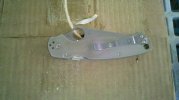
Wooo little upgrade in picture loading .i can dig it. Pic above is para sitting on some 1ply hemp twine
 
my other decision to pass on the CTS-20cp is that the gray is a magnet for dirt and stains... im gonna get a used s30v for now use it as my edc and maybe for my B-day in Oct or xmas ill get a CTS... im thinking ill switch the black scales over ....
 
Stop stressing, and just get the S30V. Its a really great steel. Doesn't keep an edge as long as the newest super super steels mentioned here, but it still holds a great edge. As long as you touch it up after use its not going to get dull anyway.

A place got a small batch in last week for $91, priority shipping brought it to $100. A bargin IMO for a great knife with S30V.
The place I ordered my CTS-20cp from said they will get another batch and I still have a chance at one. I hope to get it since I'm a steel junky( like many here), but honestly my S30V Para is plenty good enough for me.
 
Nothing wrong with S30V. For most people all the latest greatest super steels bring to the table is bragging rights. Buy the S30V if it doesn't perform to the level you require buy the other at a later date. It is also by far the best value for a user.
 
Bragging rights ,don't think so. During the busy months at my job I have to sharpen s30 at the end of everyday it gets annoying after a 12 hr shift when you don't feel like doing anything after you get home. On the other hand it took about two weeks before I was ready to sharpen my 20cp and honestly it didn't really need it. I guess im not most people :D
 
Back
Top