Choppers, Lanyards, and the Snap Cut?

Joined
Jul 15, 2012
Messages
1,885
I thought I'd float this one to the community... Is there an optimal lanyard configuration for the snap cut?

Personally, I use a lanyard on my choppers when I know I will be chopping for a while. The snap cut feels natural to me and it simply delivers maximum mechanical advantage throughout the entire motion of a swing. However, if improperly configured a lanyard can become restrictive and alter the natural motion of a swing thus diminishing accuracy and therefore efficiency. It's a balance thing.

How are you configuring your lanyard to allow for full range of motion as well as maximum security?
 
Maybe this is a Q best answered by a Competitor in Competition Chopping Contests.
I believe there are World Champions among the members in the BF Custom & Handmade Knives forum.

I don't use lanyards at all and my way of chopping isn't at that level.
I'm very slow and careful with chopping tools in hand.

Regards
Mikael
 
I'm no competitor, but I feel a forward lanyard around the hand feels much more natural than a rear-mounted one around the wrist. I'm also convinced it's a heckuva lot safer.
 
I think that lanyards in general are a bad idea with choppers. If you're not able to hold the tool securely without one you shouldn't be chopping at all. Take a break and rest. Hydrate. Eat something. At least catch your breath. THEN continue. Trying to push through fatigue is the number one way that accidents happen.
 
That's exactly why I posted this. Endurance; working to the point of fatigue. Because that's exactly when accidents DO happen.

Let's not thread jack. It's assumed that one should stop or take a brake when the time is right.
 
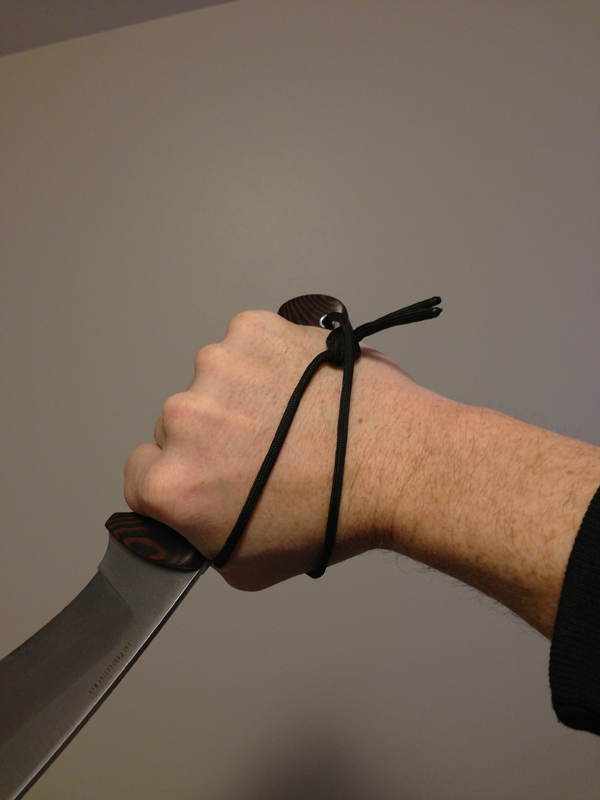
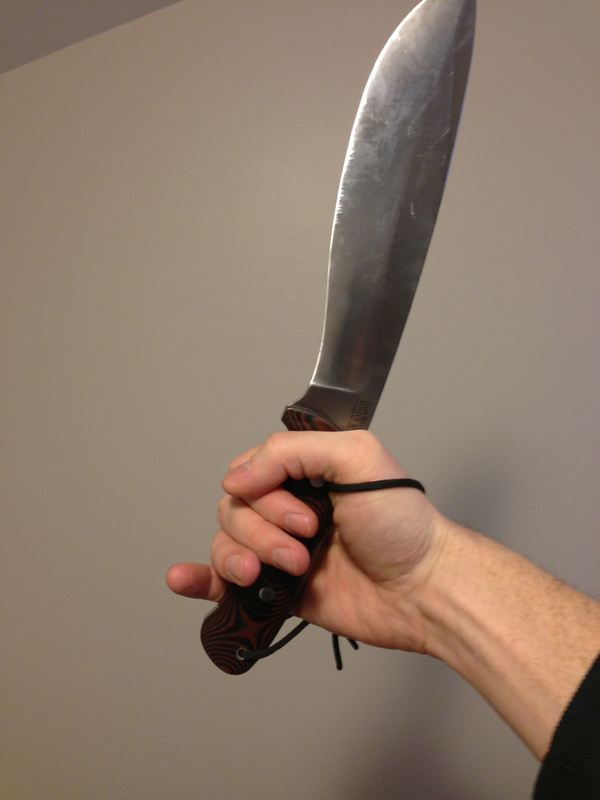
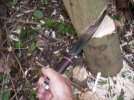
At this point, I wrap the chord around my hand. However, as you can see the lanyard inhibits a full backwards rocking motion of the knife/handle and that translates into reduced motion of the wrist unless the lanyard is loosened. When it's loosened, it becomes less secure. That's the trade off I'm looking into.

.

IMG_0066.jpg


IMG_0067.jpg
 
Would you mind posting a picture of what you mean?

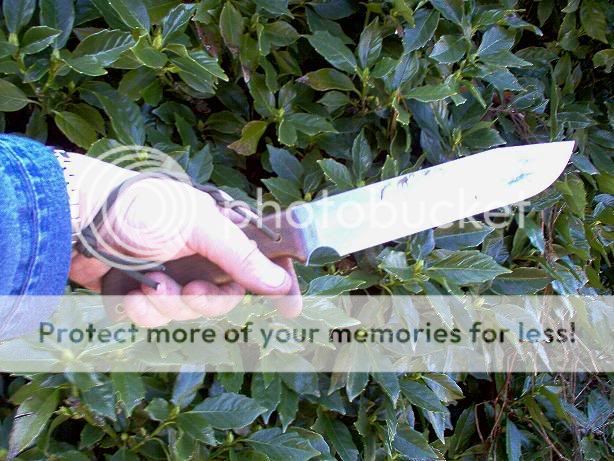
This is one example, there are a couple different ways to "wrap" the lanyard around/over your hand:
fl.jpg


It's important that it not be too tight, as obviously that will restrict movement of your wrist and be uncomfortable. The chief advantages are that A) if for some reason you let go of the knife, it can't swing under/around and cut you - it will stay right where you can easily wrap your fingers around the handle again; as I understand it a famous maker/cutter (I want to say Warren Osbourne, but I can't swear to it) sliced open his forearm badly when a rear-mounted-lanyard knife slipped from his grasp and swung back under his arm. He subsequently encouraged front lanyards... and B) it allows for a slightly relaxed, but secure grip on non-cutting motions. For a comp cutter who works in bursts of several seconds or a couple minutes, that's not a big deal. For a guy clearing a campsite or yard, it can make a big difference.

I think that lanyards in general are a bad idea with choppers. If you're not able to hold the tool securely without one you shouldn't be chopping at all.

Stuff happens. Do you wear a seatbelt when you drive a car? Me too. :)

At this point, I wrap the chord around my hand.

Honestly, I would rather have no lanyard at all and risk sending my knife flying into the woods than use a lanyard like that. If that bad boy slips, you have a very large, very sharp blade moving very quickly, and it has nowhere to go except right back into you.
 
It's important that it not be too tight, as obviously that will restrict movement of your wrist and be uncomfortable. The chief advantages are that A) if for some reason you let go of the knife, it can't swing under/around and cut you - it will stay right where you can easily wrap your fingers around the handle again; as I understand it a famous maker/cutter (I want to say Warren Osbourne, but I can't swear to it) sliced open his forearm badly when a rear-mounted-lanyard knife slipped from his grasp and swung back under his arm. He subsequently encouraged front lanyards... and B) it allows for a slightly relaxed, but secure grip on non-cutting motions. For a comp cutter who works in bursts of several seconds or a couple minutes, that's not a big deal. For a guy clearing a campsite or yard, it can make a big difference.

Honestly, I would rather have no lanyard at all and risk sending my knife flying into the woods than use a lanyard like that. If that bad boy slips, you have a very large, very sharp blade moving very quickly, and it has nowhere to go except right back into you.

A flying chopper is a nightmare!
It has never happened to me in over 40 years of use, but that's no reason to ignore safety.
If a front lanyard like the one showed can be used, that sounds like a solid advice.

The pic shows me and the NL1 Tor up in a Pinetree, trimming off two bad branches.
I always sheath the knife before changing position and the work is done without hurry.
I also ask people around the tree to not stay and watch,to avoid any risks if an incident occurs.

View attachment 328422View attachment 328423

BTW I keep pieces of string in both left&right pockets to be used for stopping blood when/if there's a cut.

Regards
Mikael
 
Honestly, I would rather have no lanyard at all and risk sending my knife flying into the woods than use a lanyard like that. If that bad boy slips, you have a very large, very sharp blade moving very quickly, and it has nowhere to go except right back into you.

Yea. If one let go of the blade, that particular lanyard wrap seems like it would facilitate knife travel towards a user.

This is one example, there are a couple different ways to "wrap" the lanyard around/over your hand:
fl.jpg


It's important that it not be too tight, as obviously that will restrict movement of your wrist and be uncomfortable. The chief advantages are that A) if for some reason you let go of the knife, it can't swing under/around and cut you - it will stay right where you can easily wrap your fingers around the handle again...

At this point I totally buy your argument. I think I now understand one reason why Siegle typically uses all tubes on his choppers; the tube located closest to the ricasso can be used as a forward positioned lanyard hole.
 
...the tube located closest to the ricasso can be used as a forward positioned lanyard hole.

Yup, that's become very popular and it's a fine idea. Incidentally, that picture I posted is a Scott Gossman knife, originally posted by him in a similar discussion.

A flying chopper is a nightmare!
It has never happened to me in over 40 years of use, but that's no reason to ignore safety.
If a front lanyard like the one showed can be used, that sounds like a solid advice.

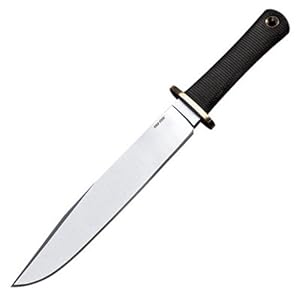
It's never happened to me either, but it almost did once with a stock CS Trailmaster on a rainy night in the woods, and it scared the dickens out of me. That got me really thinking hard about handle design and lanyards on big knives. My only real problem with that knife is poor handle design; it's as wide at the guard as it is at the butt, with no palm swell in the middle. Under speed/stress it's very hard to grip securely and it "wants" to slip out of your hand. Stock image here:

31sUl7DDwML._SL500_AA300_.jpg


The knives you and Alfred have both shown, as well as the Gossman example, have much better handle designs, with more thickness/width at the back, which makes them much easier to "lock" into your hand. :thumbup:
 
Yup, that's become very popular and it's a fine idea. Incidentally, that picture I posted is a Scott Gossman knife, originally posted by him in a similar discussion.

It's never happened to me either, but it almost did once with a stock CS Trailmaster on a rainy night in the woods, and it scared the dickens out of me. That got me really thinking hard about handle design and lanyards on big knives. My only real problem with that knife is poor handle design; it's as wide at the guard as it is at the butt, with no palm swell in the middle. Under speed/stress it's very hard to grip securely and it "wants" to slip out of your hand. Stock image here:

The knives you and Alfred have both shown, as well as the Gossman example, have much better handle designs, with more thickness/width at the back, which makes them much easier to "lock" into your hand. :thumbup:

Yes a locking grip is very important on heavy knives!:thumbup:
If it's possible to lock in various hand positions, it is easier to find the right and safe grip.
That CS Trailmaster has a similiar design as my NL1 had before the change to Sambar Stag.

The shorter and lighter NL2 also have this concave almost coffinhandle shape.
On the NL2 this works perfectly and I always find a locking grip, even in a two-three fingergrip.
I use that grip on short 8" choppers to get the lenght of a 10" blade knife and this increases tip speed for more efficient impact.
This grip also allows for the wrist to swing in a full arc.

NL2 028.jpg

On a heavier and/or longer knife, I think this grip isn't needed and the handle can be made with a regular palmswell handle.
I haven't used a knife like the one Alfred shows, but the best chopper I have, the Golok from BR have a superb handleshape with palmswell.
There wasn't any handfatigue after a day with 5,5 hours of chopping at the summerhouse.

Regards
Mikael
 
Last edited:
Back
Top