
Circular Segment - Radius Platen

RyanW

Moderator
Joined
Jul 17, 2009
Messages
3,327
I have been looking into making a Japanese knife for my brother, He lived in Japan for 3 years speaks fluently so does his wife. Mike Davis has been helping me with the specifics and a few terms to use when researching. I am looking at grinding the Unagi which i understand to be a Hollow grind done on a 5' wheel. I am not going to be able to grind on a 5' wheel. so I am looking at making a radius platen but am having a hard time figuring out the best way to calculate the radius. over a 10" platen.

I found a bunch of formulas to calculate a "Circular Segment" which is what I think I need but my Math skills are nonexistent.

In the end I was hoping that I could grind the radius into a 1/4 - 3/4" x 2" x 10" piece of steel so that I can have the back flat for the screw taps.
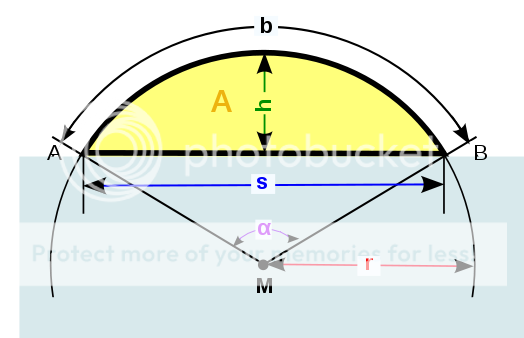
524px-Circular_segment.png


I need the "h" measurement in the yellow portion (10" section) on a 5 foot wheel....
 
That's a harder project than it looks.

One of the Guys, I think it was Nathan the Machinist, was selling platens for a KMG to give you a 3 or 4 foot diameter hollow platen.

See this link.

You might see if he is planning another batch...
 
grinding an unagi will leave you very unhappy, and your shop/grinder will smell bad for a very long time. :)

Unagi= eel ;) (freshwater eel to be exact)

what your looking for here is "urisaki"

there's a few guys here whom I believe have made radiused platens already.
 
I found a formula and calculated 1.715", which sounds reasonable. I would take a string and tie a pencil and a nail 30" apart. Take a piece of plywood 30+" long by a foot or so wide, or secure two pieces of wood about 30" apart. Swing your arc and measure 10" across it. mark a line and measure from one to the other. I'll bet it's just under an inch and three quarters.
 
Thanks for all the quick Replies... I will get busy searching threads and Eating some urisaki! I love Eel... (Thanks Sean haha)
 
I found a formula and calculated 1.715", which sounds reasonable. I would take a string and tie a pencil and a nail 30" apart. Take a piece of plywood 30+" long by a foot or so wide, or secure two pieces of wood about 30" apart. Swing your arc and measure 10" across it. mark a line and measure from one to the other. I'll bet it's just under an inch and three quarters.

Like I said, just under seven sixteenths :-( Wow, I don't know where I went wrong. This is going to bother me!
 
for future reference for people....
a very simple ways of calculating this:
First off, ignore the arc length labeled "b", I'm going to use that variable for mathematical pureness and we don't care what that value is anyway.

Now we need to figure out a right triangle here so we don't have to do anything more difficult than the application of the Pythagorean theorem.
(a^2+b^2=c^2 where C is the hypotenuse of the triangle and A and B are smaller legs of the triangle in a right triangle(90° angle in triangle))

Even though we don't have a right triangle in this picture we can make one simple enough. Imagine that there is a line going strait up from the center point of the circle strait up to the center of line "s". Now we know that "h" + our new line will = 30". And now that we have a line there we discover that we have a right triangle.

Now to define the values that we know.
Line segment MB is 30 inches(radius of the circle) This will be the hypotenuse of our right triangle we just defined.
Line segment or "s" is 10 inches.
The imaginary line that we drew earlier bisects line "s" at the halfway point, thus 10"/2 or 5" will be one of the shorter lengths of our formula.

so now we just feed in our numbers into the formula

(5)^2+b^2=(30)^2 [square our known values]
25+b^2=900 [subtract 25 from both sides to get like terms grouped up correctly]
b^2=875 [square root both sides]
b = 29.58039892"

Now, from that imaginary line we drew in the beginning, we know that b + h will be the radius of the circle, a value we conveniently know. Now to do some even simpler math.

29.58039892" + h = 30" [subtract 29.58039892" from both sides]
h = .4196010845"

We did it!

For reference there are several way to approach this problem, but this is by far the simplest way of approaching this problem that doesn't involve the scary word buttons on a calculator and I always prefer the simplest approach.
 
for future reference for people....
a very simple ways of calculating this:
First off, ignore the arc length labeled "b", I'm going to use that variable for mathematical pureness and we don't care what that value is anyway.

Now we need to figure out a right triangle here so we don't have to do anything more difficult than the application of the Pythagorean theorem.
(a^2+b^2=c^2 where C is the hypotenuse of the triangle and A and B are smaller legs of the triangle in a right triangle(90° angle in triangle))

Even though we don't have a right triangle in this picture we can make one simple enough. Imagine that there is a line going strait up from the center point of the circle strait up to the center of line "s". Now we know that "h" + our new line will = 30". And now that we have a line there we discover that we have a right triangle.

Now to define the values that we know.
Line segment MB is 30 inches(radius of the circle) This will be the hypotenuse of our right triangle we just defined.
Line segment or "s" is 10 inches.
The imaginary line that we drew earlier bisects line "s" at the halfway point, thus 10"/2 or 5" will be one of the shorter lengths of our formula.

so now we just feed in our numbers into the formula

(5)^2+b^2=(30)^2 [square our known values]
25+b^2=900 [subtract 25 from both sides to get like terms grouped up correctly]
b^2=875 [square root both sides]
b = 29.58039892"

Now, from that imaginary line we drew in the beginning, we know that b + h will be the radius of the circle, a value we conveniently know. Now to do some even simpler math.

29.58039892" + h = 30" [subtract 29.58039892" from both sides]
h = .4196010845"

We did it!

For reference there are several way to approach this problem, but this is by far the simplest way of approaching this problem that doesn't involve the scary word buttons on a calculator and I always prefer the simplest approach.


WOW That is Simple.... :confused:
 
fair enough :foot: I probably complicated it ALOT by trying to say it in a approachable way....

This will take less reading and really doesnt take any explaining.

We know c(the cord) and r(radius).

theta = 2 arcsin(c/[2r]),
d(apothem) = r cos(theta/2),
h = r - d,
fin
 
Last edited:
Yep, you know 2 legs of a right triangle. (5" and 30" in this case)
Figure for the 3rd leg using Pythagoras' theorem.
Subtract that answer from your radius.
I am a big fan of simple math.
 
I did it the easy way, I bought a 48 inch radius platen from Nathan and bolted it to my Grizzly grinder (I haven't had a chance to finish building my Bader Clone) and did my first hollow grind in years on it. Nathan's platen is beautiful!

-Page
 
I did it the easy way, I bought a 48 inch radius platen from Nathan and bolted it to my Grizzly grinder (I haven't had a chance to finish building my Bader Clone) and did my first hollow grind in years on it. Nathan's platen is beautiful!

-Page

I keep hearing about Nathan's platen but can never find them... I am guessing you mean Nathan the Machinist is the correct Nathan.
 
I keep hearing about Nathan's platen but can never find them... I am guessing you mean Nathan the Machinist is the correct Nathan.
That would indeed be Nathan Carruthers (Nathan The Machinist) He did a batch, got enough interest that they all presold, best darn idea on these boards in a long time. I got mine in 48 inch radius to replicate the hollow grind produced by the big old stone wheels in Solingen in the Middle Ages

-Page
 
Just find a 5' circle and use it to scribe a line :D Wagon wheel rim....55 gallon drum....string and a piece of chalk set to 2.5' from the center to the chalk layine out a big circle is not too hard.
 
Back
Top