
Clear coating of scales

Joined
Jun 16, 2007
Messages
301
Hi guys,

This is where I am currently at with my knife:
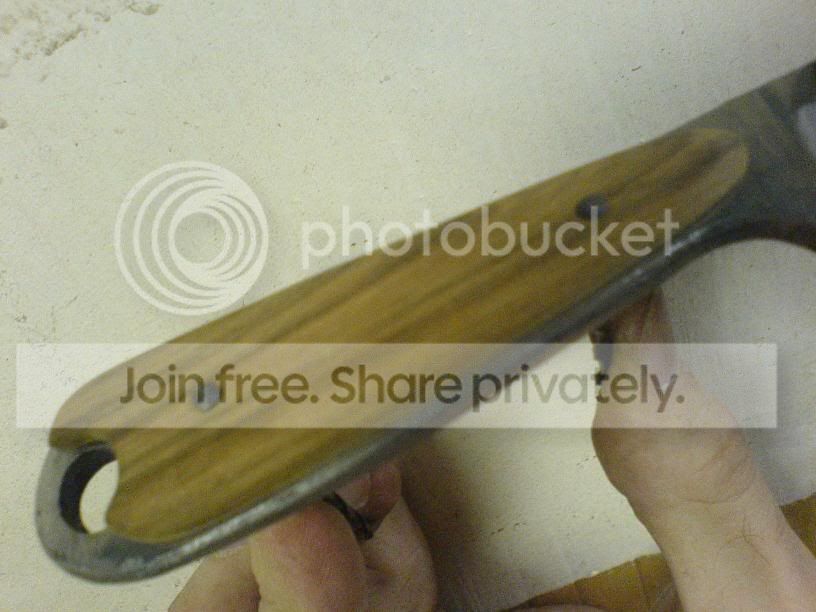
k2sclft2.jpg


Hope this image works! Scales are tambotie to be pinned and glued with epoxy. They are slightly recessed from the handle tang periphery. (Shown with pins holding scale in place for illustration purposes only)

I am weary to treat the scales with oils for risk of oils seeping through and around scales and adversely affecting the adhesive. I would like to apply some clear coating:

What products would you guys suggest (preferably product type rather that brand name, as manufacturers vary per country), and what would be the application methods to get a good finish.

Would you apply some coats before fitting the scales, or do all coats once scales are fitted? (to reduce overpainting onto protruding tang steel)

Thanks
Lang
 
I haven't used it myself, but some respected knife makers have sayd that CCL knifeoil is one of the best products to use.
 
oil shouldnt affect your adhesive. if it is, you may want to chnge adhesive not oil. i have just switched to oil after only using clear coating.. i like oil much better. what kinda adhesive do you use? and if you peen the pins.. depending on how hard the wood is, you shouldnt actually NEED adhesive
hope this helps
~Chris
 
Good Morning Langchop, I agree with the first 2 responses. I've never tried CCL but have used tru-oil which is a fast drying form of linseed oil I believe. Quite a few gunstock type oil finishs work well too, Brownells sells several different types.

I use stabilized wood almost exclusively now which tends to buff out quite nicely ( most of the time ;) ) When it doesn't, that is what I use to even out the finish.

If you're doing shadow box type scales and they are basically to shape and size you can finish prior to mounting on the tang. :thumbup:
 
If you want the best look for the wood, an oil finish is it.
Oil finishes do not need to be put on the tang side of the scale, so gluing isn't a problem, beside, as mentioned above, the pins will do most of the work keeping the scales in place.
Oil finishes so take a considerable time to fully polymerize - boiled linseed oil will take a week to cure, minimum...
You could use a wiping varnish, as it's easier to put on, and dries faster than a pure oil finish.
I'd stay away from water based finishes, as they are lifeless looking and hard to repair if you scratch them.
Be sure to show us the finished knife when it's all done.
 
Jantz Supply http://www.knifemaking,com has Tru Oil and Dembart Oil (both originally created for custom gunstocks) and a custom made stock has a beautiful, durable finish. A good filler and sealer is available in both brands for filling the pores of the wood - the better the wood is filled and sealed, and the better the sanding process on your wood, the better the final finish. It takes time and sanding and resanding, applying layer after layer until the wood is perfect, but the results are well worth it. As for the adhesive (epoxy) I have never had a customer comment on this effecting the adhesion if properly applied and we hear it all!
 
Tru oil works good but should be thinned by 1/3 with mineral spirits or it wont dry. Put it on and wipe it off, put it on and wipe it off, put it on and wipe it off, 0000 steel wool between coats, and give yourself a week or two. For a fine firearm its worth the trouble. For knives you can stop anywhere you are happy with the look.
 
Yea I intend to use epoxy and I have always found epoxy exceptional. Was just not sure if it would be affected by oil. Thanks for the advice. Chris the pins are just going to be pins and not peened, so it is just to give lateral support to the scales, but still relying on the epoxy.
 
that works...
i only started peening mine about 3 knives ago. just trying to pass on knowledge i have been given. good luck!
~Chris
 
Thanks guys... I think I will go just with oil seeing as though it seems the overwheloming favourite.

David, whats meant by "shadow box scales"?.. I'm ignorant.

Lang
 
One thing that I have used in the past and which does a good job of both stabilizing and finishing wood scales is super glue.

Wearing rubber gloves in a well-ventilated area, just squirt a quantity of the clear, runny super glue variety on the scales and smooth it on with your finger, taking care to not stop your finger moving, and not to glue yourself or your knife to any other object.

The super glue hardens fast, and any lumps or blemishes can be sanded down. Several coats give a very hard, clear finish that waterproofs very well. It will also fill any cracks or gaps or holes in the wood or in the spaces between wood and tang.

Andy

Thanks guys... I think I will go just with oil seeing as though it seems the overwheloming favourite.

David, whats meant by "shadow box scales"?.. I'm ignorant.

Lang
 
Andrew that reminds me of a story I have to tell!.. I was introduced to a 75 year old woodworker who provided wood scales for local knifemakers:

The night I visited him he spent two hours showing me his workshop and all the different woods. He then gave me two scales as a sample to use, one of which had a tiny crack on one corner. He told me about 'magical' solution that would fix this, and showed me the sticker on the bottle and told me to write it down. I obediently wrote it down: "5ml" , and then he went on to apply the 'magical solution' to the crack in the wood. It worked well, and when he turned away I picked up the bottle and turned it around to find a bigger tag... cyanoacrylate..(superglue!)

Thanks for the tips guys

Lang

PS. The mans woodworking was exceptional
 
Back
Top