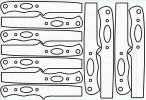
CNC Machine For Shield Inlays?

Joined
Feb 26, 2026
Messages
3
Hey everybody!

I have a question concerning carving out shield inlays in knife handle material. Would it be possible to do this with a CNC machine? Like one of the portable home versions?
 
Hey everybody!
Yes, it’s definitely possible with a CNC machine.

We make highly unique custom knives with premium handle work and shield inlays — designs that truly stand out and are unlike anything commonly seen.

Feel free to send me a message, and I can share some of our exclusive pieces and custom options with you.

I have a question concerning carving out shield inlays in knife handle material. Would it be possible to do this with a CNC machine? Like one of the portable home versions?
 
If you don't already have a CNC milling machine, you would have to inlay an awful lot of shields to make the purchase feasible and for learning the programming.
There are waterjet/laser businesses that supply both shields and the cutouts for them.
It might be feasible to make a very small "parser" type cutter to be used with a flexible shaft machine or rotary tool. Never really thought about that. Of course the shields would have to be inlayed before the handles are installed.
 
I don't see why one of the more inexpensive desktop CNC machines wouldn't work. You don't need a large work area, and your standard handle materials aren't going to take much load to cut. If you've never used any kind of a CNC machine, there's definitely a learning curve, and I'd say it's pretty steep, but once you get the basics down, it's really not that bad. I'm sure that between YouTube and ChatGPT you'd be able to figure it out.
 
There was a facebook post where a maker indicated he uses a carbide bit with one of those cheap orange table top CNC machines to cut stainless steel shields. I want to reach out to him and ask more questions. I can see those being used for cutting pockets for sure, but actual shields from 416 stainless seems beyond their capability.
 
I think you could use a cheap router style cnc to do that, longevity and accuracy are the question. I believe they would be ideal for doing this for an acceptable level of fit and finish.

You want ball screws, linear rails, closed loop steppers if you can. This will push maybe two grand. I bet for 300$ or so you could get really close, especially with g10 or a composite,
 
There was a facebook post where a maker indicated he uses a carbide bit with one of those cheap orange table top CNC machines to cut stainless steel shields. I want to reach out to him and ask more questions. I can see those being used for cutting pockets for sure, but actual shields from 416 stainless seems beyond their capability.
I imagine they're taking very light passes, and using some sort of coolant or air blast to help clear chips. I've cut 1/8" thick steel using a .050 carbide endmill on my home built CNC router, but it was a major pain and took a long time. That said, shields don't have to be very thick, and cutting thinner steel, aluminum or brass is a lot easier, especially with larger endmills if you can get away with that. Heat and chips are definitely the enemy though, and any way you can mitigate that should help.
 
I chatted with the maker that uses small CNC machine to cut stainless steel shields and pockets. Here are some of the suggestions he gave. The secret sauce seemed to be a third party program that managed speeds/feeds along with high quality carbide cutter and some coolant:

This is the machine I use is LUNYEE 3018 PRO Max CNC . I use 4 flute 1/32 carbide bits with a 1/8” shank. The spetool brand is what I’ve had the best luck with.
I use a website called inventables. I design my shield in Inkscape then send it over to that site; it allows you to adjust you speed and feed in their program. On steel I run my spindle speed and cut speed less than half along with some cutting fluid and I’ve had very minimal trouble.
 
I chatted with the maker that uses small CNC machine to cut stainless steel shields and pockets. Here are some of the suggestions he gave. The secret sauce seemed to be a third party program that managed speeds/feeds along with high quality carbide cutter and some coolant:

This is the machine I use is LUNYEE 3018 PRO Max CNC . I use 4 flute 1/32 carbide bits with a 1/8” shank. The spetool brand is what I’ve had the best luck with.
I use a website called inventables. I design my shield in Inkscape then send it over to that site; it allows you to adjust you speed and feed in their program. On steel I run my spindle speed and cut speed less than half along with some cutting fluid and I’ve had very minimal trouble.

$300 router and some free programs, that's taking proper advantage of what is available! Good stuff
 
I use the easel inventables for doing guard blanks for hidden tang knives on my CNC. It's an easier CAD/CAM software to use and lets you select bits, materials and gives recommended speeds/feeds for them. It has options to allow cutting on the line, inside or outside the line, so I think it would be somewhat easy to get shields to fit well into the pocket you can mill out? I use a 800W cnc mill setup with all linear rails, but not ball screws or closed loop steppers and it has no problems machining thru up to 3/8" thick Micarta or G10. I haven't tried aluminum or other metals yet.

I also use easel inventables for making templates to use with my laser. I set the cutting depth to match the material I am cutting so it does 1 pass, sent it to cut on the line and export the G Code, which can be opened by LightBurn. This way I can laser out wood templates to test my DXF files, make prototypes/templates, make sheath patterns to cut out from leather, or do wooden knife stands. I can also laser onto steel the profiles I want to cut out so I have cutting/drilling lines/circles marked out.

I know a friend of mine used his CNC to profile out folder blades, .05" per pass, about 10 minutes for a 3" ish blade in .08" thick steel, including a large oval thumb opener cutout. Not sure how long a router designed for wood will last doing that? I know I can upgrade mine to a heavier duty water cooled spindle and VFD, closed loop motors and ball screws, but it works fine for G10 and Micarta. I have access to a makerspace type thing at work with a CNC mill and manual mill, too, that I need to get clearance/training to use as well as their waterjet machine!

 
I use the easel inventables for doing guard blanks for hidden tang knives on my CNC. It's an easier CAD/CAM software to use and lets you select bits, materials and gives recommended speeds/feeds for them. It has options to allow cutting on the line, inside or outside the line, so I think it would be somewhat easy to get shields to fit well into the pocket you can mill out? I use a 800W cnc mill setup with all linear rails, but not ball screws or closed loop steppers and it has no problems machining thru up to 3/8" thick Micarta or G10. I haven't tried aluminum or other metals yet.

I also use easel inventables for making templates to use with my laser. I set the cutting depth to match the material I am cutting so it does 1 pass, sent it to cut on the line and export the G Code, which can be opened by LightBurn. This way I can laser out wood templates to test my DXF files, make prototypes/templates, make sheath patterns to cut out from leather, or do wooden knife stands. I can also laser onto steel the profiles I want to cut out so I have cutting/drilling lines/circles marked out.

I know a friend of mine used his CNC to profile out folder blades, .05" per pass, about 10 minutes for a 3" ish blade in .08" thick steel, including a large oval thumb opener cutout. Not sure how long a router designed for wood will last doing that? I know I can upgrade mine to a heavier duty water cooled spindle and VFD, closed loop motors and ball screws, but it works fine for G10 and Micarta. I have access to a makerspace type thing at work with a CNC mill and manual mill, too, that I need to get clearance/training to use as well as their waterjet machine!

Yeah you don't need any of that stuff, each thing helps out though. Spend 80% more to make it 20% better kind of thing, depends what you are doing though. I'm on router #4 so sharing what little I have picked up along the way.

Linear rails help keep everything stiff, ball screws a bit more accurate and you can be harder on them, steppers have more torque, closed loop just means the motors are communicating location to an extent.

I may try some metal, I'm just after tight inlays in composites.

Let me know how that waterjet goes if it is a Wazer. I signed up at the makerspace here and the machine needed troubleshooting, nothing too hard to sort out I think.
 
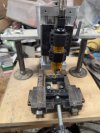
Yeah, I waited until one with 3 axis linear rails (instead of the round rails) went on sale with the 800W spindle, I think it was 600 when I got it? I also used it for a laser platform until I got a dedicated laser gantry to swap out the different laser heads on (so I needed a 24V board), too. I use a 710 watt generic foredom type tool instead of a Dremel now and it has enough oomph to do what I need it to do, including opening up pin holes in hardened steel, connecting drilled holes to skeletonize handles, etc. I built up a setup with linear rails, actuator table, etc to use the foredom hand piece as a mill to slot the synthetic guards. I use a burr type bit instead of an actual end mill, so I need to try the end mills and see how they work differently.

This was the FrankenMill:
PXL_20250207_200123043.jpg

Desktop CNC is so much nicer! I can cut out shaped blanks for guards, or just mill the slot in an oversized blank and shape to what I need it to be.

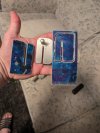
Also did these little tools to make it easier to take the diamond hole prongs out of thick leather with the CNC:
PXL_20250902_005850431.jpg

If you are just milling the pockets in synthetic material, I think even the cheap desktop CNC will work for that pretty well! Just go slow and don't overload the bit/motors. Take smaller bites and you should be fine!

It's a ProtoMax water jet; haven't gotten to schedule the training session for it yet. They were waiting on some supplies to come in, hopefully they arrived so I can get trained!


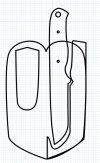
This is why I like easel inventables; even I can figure it out! I can trace a picture of the knife, size it to actual dimensions and make a mock up of how the sheath will fit by moving the pieces around and then laser cutting the leather from the G Code:

Screenshot 2026-01-03 100107.jpgEDC 3 sheath template.jpg

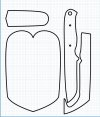
Or setting up a G code to convert to .dxf for laser cut steel with cut lines and see how I can stack the blades to get the most out of the steel. The water jet has a 1/16" kerf, so I set up to use a 1/16" end mill and cut on or outside the line:

Screenshot 2025-12-31 121646.jpg
 
Back
Top